



In Stock
AI Teaching kit
₹2,320.00
Quick Answer: The AI Teaching Kit is a hands-on classroom kit for teaching the basics of artificial intelligence with real hardware, listed in the Stem Kits range beside the Dobot robotics products. With an AI teaching kit students collect data, train simple recognition models and make devices respond to what the model detects.
Making Artificial Intelligence Concrete
Artificial intelligence is hard to teach from slides because its central idea, a system that learns from examples, only becomes clear when students supply the examples themselves. A kit like this gives them that experience: they capture images or sounds, label them, train a model, then watch it succeed and fail on new inputs.
The failures are where most of the learning happens. A model trained only on photos taken under classroom lights may stumble near a window; one given too few examples of a class may confuse it with another. Students discover for themselves why training data needs to be varied and balanced, and that discovery leads naturally into discussions of bias and fairness in real AI systems.
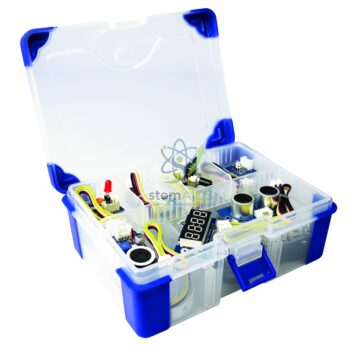
Connecting a trained model to hardware closes the loop: a recognised gesture lights an indicator, a spoken command moves a motor, or an identified object is sorted by a robot arm. The modules, camera, microphone and software supplied in this kit are not detailed in the listing and should be confirmed before planning a scheme of work.
Applications
- Image classification projects that tell apart fruits, recyclables or hand signs
- Voice or sound command projects that trigger lights, motors or displays
- Data-quality investigations comparing a model trained on a small, uniform dataset with one trained on a varied dataset
- Ethics lessons on bias, privacy and responsible use, grounded in the students’ own models
- Linking recognition to robotics, such as vision-based sorting with the Dobot Magician Basic Arm
Specifications
| Type | Hands-on AI teaching kit for classrooms |
| Core concepts | Data collection, labelling, training, testing and deployment of a model |
| Typical recognition tasks | Images, colours, gestures or speech, depending on the software |
| Suited to | Middle school to college, with activity depth adjusted to level |
| Hardware and software included | Confirm at enquiry |
Care & Handling
- Keep camera lenses and microphones clean and uncovered; smudges and muffled microphones reduce recognition accuracy.
- Tell students not to collect images or recordings of other people without consent, and delete personal data at the end of a project.
- Handle circuit boards by their edges and store modules in antistatic bags between lessons.
- Save class projects and datasets to a shared, backed-up folder so work is not lost between sessions.
Why Choose LabEquip
Schools setting up an AI or robotics lab usually want one kit per group so every student trains a model rather than watching a demonstration. LabEquip lists the AI teaching kit in its Stem Kits range; tell us the age group and number of groups through the contact page so the kit contents can be matched to your syllabus.
Frequently Asked Questions
Do students need programming experience to use the kit?
Not to begin with. Beginner AI tools let students collect examples and train a model through a visual interface. Programming comes in when they use the model’s output to control hardware or want finer control over training.
What is the difference between training and testing a model?
Training means showing the model labelled examples so it learns patterns. Testing means checking it on new examples it has never seen. A model that scores well only on its training data has memorised rather than learned.
Why does the model make mistakes in a different room?
The lighting, background or noise differs from the training data, so the inputs look unfamiliar. Collecting examples in several conditions makes the model more robust, which is a practical lesson in dataset design.
How can the kit be used to teach bias?
Ask students to train a model with far more examples of one class than another, then compare its accuracy on each. The imbalance shows up clearly and leads to a discussion of how biased data affects real AI systems.
Does the kit need an internet connection?
That depends on the software supplied. Some classroom AI tools train models on the device and others use online services. Confirm the software and connectivity needs when you enquire if internet access in your lab is limited.
What age group is it suitable for?
Simple image and sound recognition projects work from middle school, while model testing, data analysis and robot integration suit senior secondary and college students. Teachers can adjust the depth of each activity to the class.
Last Updated: September 2026
You must be logged in to post a review.
Bestsellers
Sale
Sale
Sale
Sale


Reviews
There are no reviews yet.