
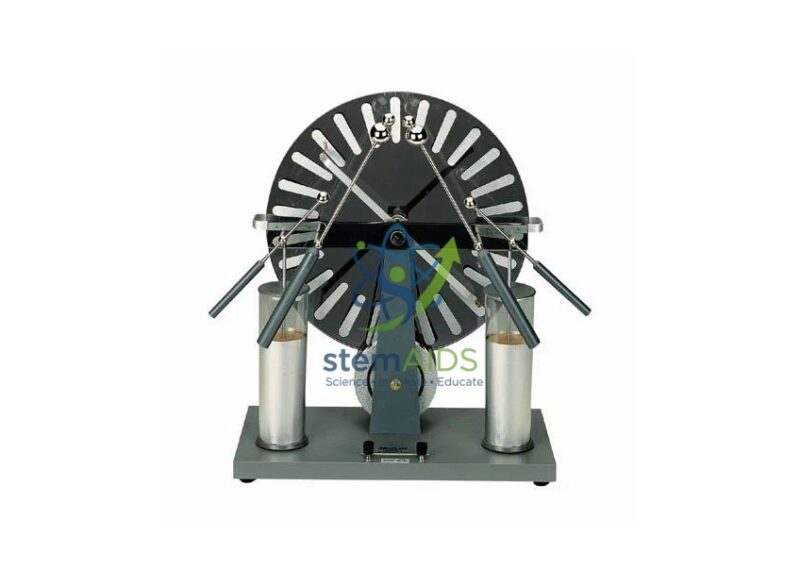
Quick Answer: The Wimshurst machine is a hand-cranked electrostatic influence generator in which two insulating discs carrying metal sectors turn in opposite directions, building up opposite charges that are stored in Leyden jars and released as sparks between two discharge balls. Physics teachers use it to produce high-voltage static charge for spark, induction and field demonstrations without any mains supply.
How Counter-Rotating Discs Multiply Charge
A Wimshurst generator does not create charge by rubbing. Each disc carries a ring of thin metal sectors, and a neutralising bar with brushes at both ends lies diagonally across each disc, the bars on the front and back set at an angle to one another. The bar joins sectors on opposite sides of the same disc. When a sector passes a charged sector on the other disc, charge flows along the bar and leaves it carrying the opposite sign, so every pass leaves the sectors more strongly charged than before.
As the discs keep turning, positive charge is carried round to one pair of collecting combs and negative charge to the other. The combs feed the two Leyden jars, which act as capacitors, and the potential difference between the discharge balls rises until the air between them breaks down in a spark. The process starts from the trace of stray charge always present, which is why the polarity of the terminals can occasionally swap between sessions.
The Leyden Jars and the Spark Gap
The two Leyden jars change the character of the discharge. With the jars connected, charge accumulates for longer before the gap breaks down, giving fewer but brighter, louder sparks; with the jars disconnected, on machines where they can be unhooked, the stored charge is small and the sparks are thin and frequent. Widening the gap between the discharge balls raises the voltage needed for breakdown, so students can see that spark length and stored energy are linked. Spark length also falls in humid air, because moisture lets charge leak from the discs and insulating pillars.
Classroom Demonstrations
- Producing visible sparks to discuss dielectric breakdown of air, lightning and the role of gap width
- Charging an electroscope, a field-pattern tank or a parallel-plate capacitor from a high-voltage source
- Showing the effect of capacitance by comparing sparks with and without the Leyden jars in the circuit
- Running electric-wind and action-of-points demonstrations from a pointed conductor fixed to one terminal
Specifications
| Type | Wimshurst influence (electrostatic) generator, hand-cranked |
| Charging elements | Two counter-rotating insulating discs carrying metal sectors, with neutralising bars and collecting combs |
| Charge storage | Leyden jar capacitors, as pictured |
| Output | High-voltage static charge, discharged as a spark between two adjustable balls |
| Disc diameter, maximum spark length and accessories | Confirm at enquiry |
Care & Handling
- Keep the generator in a dry, warm room; a few minutes near a heater drives off surface moisture before a lesson.
- Wipe the discs and insulating pillars with a clean, dry, lint-free cloth; avoid polishes and sprays that leave a conducting film.
- After turning stops, touch the discharge balls together or discharge each jar with an earthed rod, because the Leyden jars can hold charge for some time.
- Check the drive belts for cracks and slipping, and replace them as a pair if one has stretched.
Why Choose LabEquip
Schools and colleges buy an influence machine when they want sparks and high-voltage charge without a mains supply, for lessons from lower secondary electrostatics to undergraduate demonstrations. LabEquip lists it with matching spare drive belts and the rest of its physics lab equipment; send your quantity and any accessory needs through the contact page.
Frequently Asked Questions
How is a Wimshurst machine different from a Van de Graaff generator?
The Wimshurst design builds charge by influence between two counter-rotating discs and stores it in Leyden jars, giving bright sparks between two terminals. A Van de Graaff carries charge on a moving belt to a single large dome, which suits hair-raising and corona demonstrations.
Why are the two discs made to turn in opposite directions?
Charge multiplication depends on sectors on one disc sweeping past sectors on the other. One drive belt is crossed so that the discs counter-rotate; if both turned the same way the sectors would not move past each other and almost no charge would build up.
Why does the generator fail to spark on a damp day?
Water vapour forms a thin conducting film on the discs and insulating supports, so charge leaks away as fast as it is produced. Drying the generator near a heater, keeping the room dry and cleaning off dust usually restores normal sparking.
Is it safe for students to touch the terminals?
The sparks from a school influence generator are startling and can be painful, and the Leyden jars store enough charge to give a sharp shock. Let only the teacher handle the terminals, discharge the jars after use, and keep anyone with an implanted electronic medical device away from the demonstration.
Which way should the handle be turned?
The combs and neutralising bars are arranged for one direction of rotation, so turn the handle the way the instructions or the marking on the frame show. A steady, moderate speed gives more reliable output than fast bursts.
What can the generator be connected to?
Insulated leads from the terminals can charge an electroscope, a field-pattern tank, a capacitor or a set of Franklin bells. Keep leads short and away from earthed objects, which let charge leak away.
Last Updated: October 2026




Reviews
There are no reviews yet.