
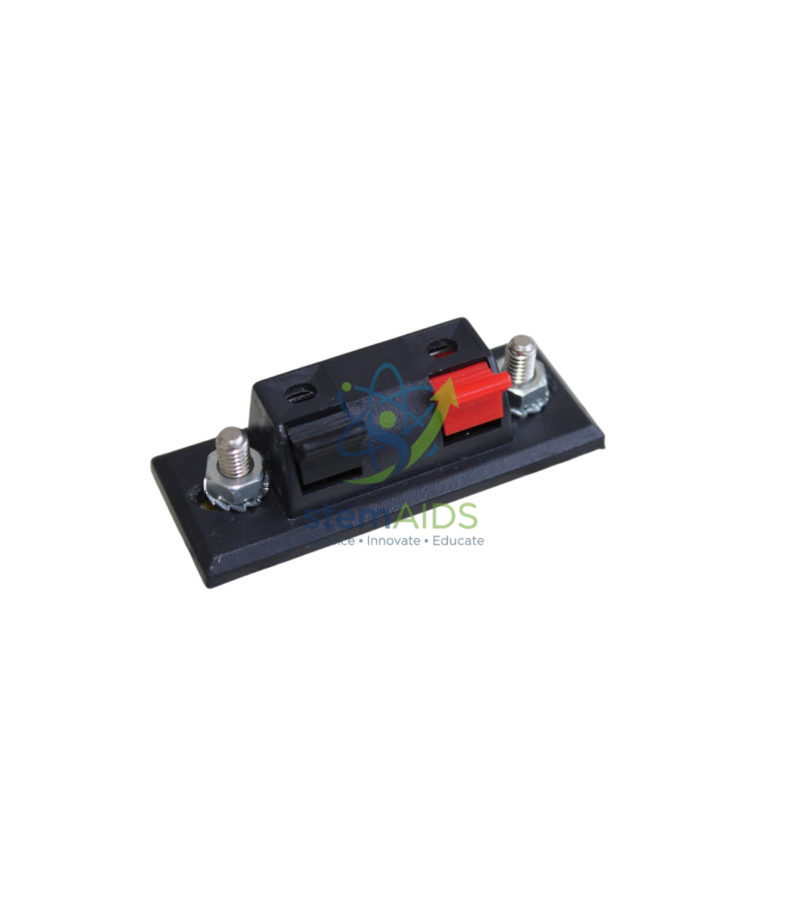
Quick Answer: The UME universal component holder is a base for mounting a two-lead electronic part of your choice, with a terminal at each end and a central holder on a dark base, as pictured. The UME universal component holder lets a part that has no module of its own join a circuit on the UME board.
A Place for Parts Without Their Own Module
A module system covers the common components, but practicals often call for something else: a particular resistor value, a sensor, a short length of wire, a part a student has chosen. The universal component holder solves this. The part is clamped between the end terminals, and the holder then behaves like any other module in the circuit.
Because the base is open, the part can be swapped in seconds, which suits investigations where the component itself is the variable. Five resistors of different values can be measured in turn on one holder, or a thermistor can be replaced by a light-dependent resistor without rebuilding the rest of the circuit.
Specifications
| Product | UME universal component holder |
| Construction in photograph | Dark base with a terminal at each end and a central holder |
| Accepts | One two-lead component or a short length of wire |
| Connection | End terminals; used with the UME module board |
| Lead and wire thickness range | Confirm at enquiry |
Investigations Using the Holder
Mount a length of thin resistance wire between the terminals of the UME holder and measure current and voltage to find its resistance, then repeat with a longer or thinner piece to explore R = ρL/A. As a teacher demonstration, a thin fuse wire can be mounted and the current from a current-limited low-voltage supply raised slowly until the wire melts, with a safety screen in place.
Sensors and switches work too: a thermistor warmed by fingers, a reed switch closed by a magnet, or a diode tested in both directions. In each case the holder keeps the part secure and the circuit tidy.
Uses
- Measuring the resistance of wires of different lengths and thicknesses
- Testing resistors, thermistors, LDRs and diodes one after another
- Demonstrating a fuse wire melting as the current rises
- Adding a student-chosen component to an existing module circuit
Care & Handling
- Tighten the terminals firmly but not so hard that fine wire is cut
- Allow wires and components to cool before removing them after high-current tests
- Keep the base clean and dry and the terminal threads free of debris
- Store with the terminals screwed down so small parts are not lost
Why Choose LabEquip
Teachers who own a UME module set buy the holder so any experiment can include a part the set does not contain. LabEquip supplies it with self-assembly UME enclosures for parts that need a permanent module of their own; contact LabEquip about quantities, or browse our physics lab equipment.
Frequently Asked Questions
Which parts can be mounted in the holder?
Any part with two leads, such as a resistor, capacitor, diode, thermistor or LDR, and short lengths of wire for resistance or fuse experiments.
How is this different from a self-assembly enclosure?
The holder is for parts that change often, clamped and removed in seconds. A self-assembly enclosure is for building a permanent, labelled module around one component.
Can it be used for a resistance of a wire experiment?
Yes. Clamp the wire between the terminals, measure current and voltage, and repeat with other lengths or thicknesses to show how resistance depends on length and cross-section.
Is a fuse-wire demonstration safe on the holder?
It can be shown by the teacher with a current-limited low-voltage supply, a thin fuse wire and a safety screen. Let the holder and terminals cool before handling them afterwards.
Does polarity matter?
Only for polarised parts such as diodes, LEDs and electrolytic capacitors. Note which terminal goes to the positive side of the circuit when mounting them.
What thickness of lead or wire do the terminals take?
Normal component leads and thin wires clamp under the terminals. The full range of thicknesses can be confirmed at enquiry if you plan to use heavier wire.
Last Updated: October 2026




Reviews
There are no reviews yet.