
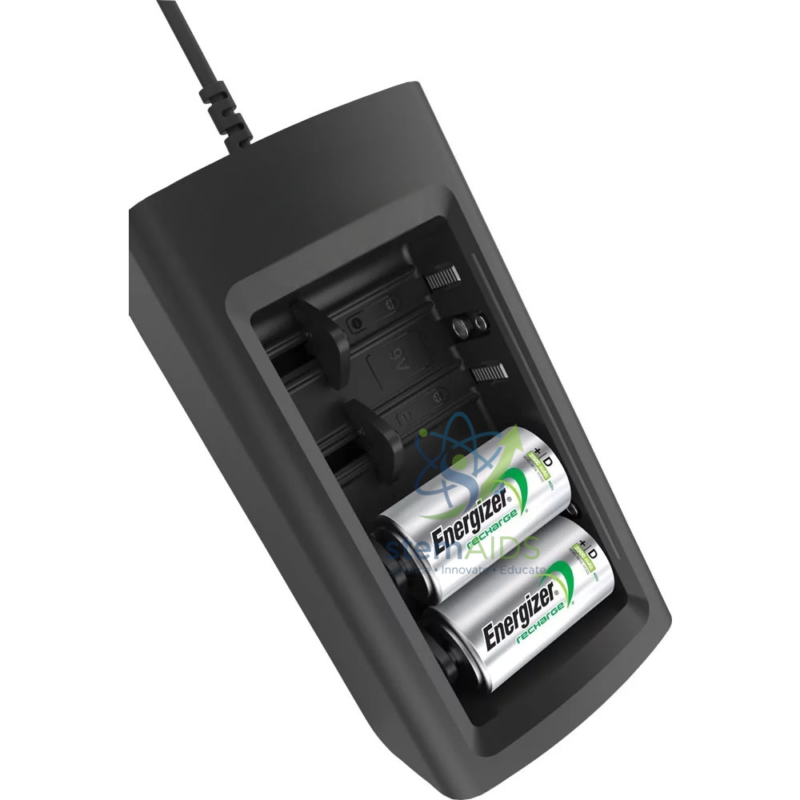
Quick Answer: The universal charger is a mains-powered battery charger with adjustable bays that hold rechargeable cells of several sizes, as the product photograph shows with two large cells in place. Laboratories use a universal battery charger to keep rechargeable cells for torches, meters, timers and circuit work ready between lessons.
Charging as Energy Storage
A rechargeable cell stores energy chemically. Charging drives a current into the cell in the reverse direction to normal discharge, so that the chemical reactions run backwards and the cell is restored. A charger supplies that current under control, watching the cells and reducing or ending the charge as they become full, because overcharging produces heat and gas inside the cell.
The capacity printed on a rechargeable cell, in milliamp-hours, tells how much charge it can deliver. Comparing that figure with the charging current gives a rough charging time, and comparing the energy drawn from the mains with the energy delivered back by the cell gives a charging efficiency below 100 percent, since some energy is lost as heat. Both make good extension calculations for a lesson on electrical energy.
One Charger for Mixed Cells
The word universal refers to the bays: adjustable contacts or sliding holders let one charger take cells of different sizes, which suits a prep room where torches, meters and kits use different cells. The charger is meant for rechargeable cells only. Ordinary alkaline cells and lithium coin cells such as the CR2032 must never be placed in it, as they are not designed to accept a charging current and can leak or rupture.
Specifications
| Product | Universal battery charger |
| Form in the photograph | Desktop charger with adjustable bays and mains lead |
| Cells | Rechargeable cells of several sizes |
| Use | Recharging cells for torches, meters, timers and kits |
| Not for | Alkaline, zinc-carbon or lithium primary cells |
| Cell sizes, chemistry and number of bays | Confirm at enquiry |
Applications
- Recharging cells for torches, timers and handheld meters used in practicals
- Keeping cell-powered kits and two-cell battery holders supplied for circuit work
- Calculating charging time and efficiency from capacity, current and energy
- Reducing the number of single-use batteries bought by a department
Care & Handling
- Charge only rechargeable cells of a type the universal battery charger is designed for
- Place cells the right way round in each bay and check that the contacts grip them
- Charge on a non-flammable surface with space around the charger, and unplug it when charging is complete
- Remove cells that become hot, swollen or leaky, and recycle them
Why Choose LabEquip
Prep rooms that run torches, meters and kits on rechargeable cells buy this charger to cut down on single-use batteries. LabEquip can supply it with cells and holders; tell us the cell sizes you use through our contact page, and see the wider physics lab equipment range.
Frequently Asked Questions
Can alkaline batteries be recharged in this charger?
No. Ordinary alkaline and zinc-carbon cells are not designed to be recharged; forcing a current into them can cause leakage or rupture. Use the charger only for rechargeable cells.
Why do rechargeable AA cells show 1.2 V rather than 1.5 V?
Nickel metal hydride cells have a nominal voltage of about 1.2 V because of their chemistry, slightly lower than alkaline cells. Most equipment designed for 1.5 V cells runs well on them, since an alkaline cell’s voltage also falls below 1.5 V as it discharges.
How long does charging take?
It depends on the cell’s capacity, its state of charge and the charging current. A rough estimate is the capacity in milliamp-hours divided by the charging current in milliamps, plus extra time to allow for losses.
Can cells of different sizes be charged at the same time?
A universal charger is designed to hold different sizes, and many can charge mixed cells together. Follow the bay markings and the charger’s instructions for which combinations are allowed.
Why does a cell get warm while charging?
Not all of the electrical energy supplied is stored chemically; some becomes heat in the cell’s internal resistance and side reactions, especially near full charge. Mild warmth is normal, but a hot cell should be removed.
Is the charger suitable for lithium button cells?
No. Lithium coin cells such as the CR2032 are primary cells and must not be charged. Rechargeable lithium cells need chargers specific to their chemistry.
Last Updated: October 2026






Reviews
There are no reviews yet.