
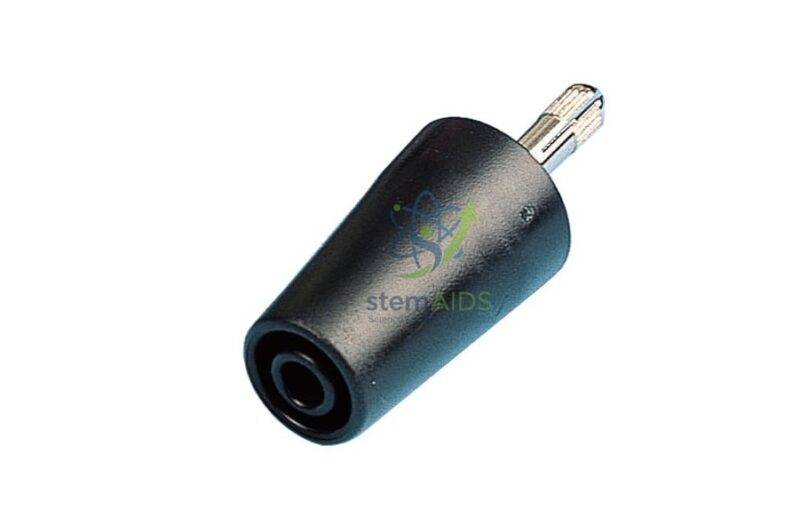
Quick Answer: The Standard Safety Adapter Ø 16 mm is a tapered insulating body with a plain banana pin at the narrow end and a shrouded socket at the wide end, as shown in the product photograph. It lets a safety lead be connected to older apparatus that has standard unshrouded sockets.
Bridging Two Generations of Sockets
Many school laboratories hold equipment from different periods. Older meters, rheostats and power supplies often have plain banana sockets or binding posts, while newer leads are of the shrouded safety type. A shrouded plug does not always fit a plain socket, and a plain plug does not belong in a safety socket. The standard safety adapter sits between the two: its exposed pin goes into the plain socket of the old instrument, and the safety lead then plugs into the shrouded socket on the adapter.
The Ø 16 mm in the title is a diameter. On a cylindrical adapter of this kind it most likely refers to the body at its wide end, which matters when several adapters have to sit side by side on a panel with closely spaced sockets. The tapered black body visible in the photograph gives a good grip for pushing the pin in and drawing it out without touching metal.
What the Adapter Does Not Change
The adapter changes the connector, not the safety rating of the old apparatus. The pin end remains a standard connection, and the instrument it plugs into still has only the protection it always had. The usual rule therefore applies: use the adapter on low-voltage circuits, the kind found in school electricity practicals, and keep mains-connected work to equipment designed for it. Paired with screw-terminal safety sockets on new panels, it lets a department move to safety leads gradually.
Specifications
| Product | Standard safety adapter |
| Title dimension | Ø 16 mm |
| Ends | Plain banana pin at one end, shrouded socket at the other, as in the product photograph |
| Body | Tapered black insulating body |
| Purpose | Connecting safety leads to equipment with standard unshrouded sockets |
| Pin and socket size | Confirm at enquiry |
Applications
- Connecting safety leads to older meters, rheostats and power supplies with plain sockets
- Mixed benches where new safety leads meet existing apparatus during a phased changeover
- Linking shrouded leads to binding posts on resistance boxes and component boards
- Teaching students the difference between standard and safety connector systems
Care & Handling
- Push the pin straight in and draw it straight out; levering sideways loosens the pin in the body
- Keep adapters in a labelled tray so they are not lost in the bottom of lead drawers
- Check that the spring contact on the pin still grips, because a slack pin causes intermittent readings
- Use the adapters only on circuits suitable for the old instrument they connect to
Why Choose LabEquip
Schools that are replacing plain leads with safety leads but keeping their existing instruments are the usual buyers of the standard safety adapter. LabEquip can supply adapters with single banana plugs and safety sockets, and the full range is under physics lab equipment; tell us your mix of equipment through our contact page.
Frequently Asked Questions
Why is an adapter needed between standard and safety leads?
Safety leads have shrouded plugs that do not always fit the plain sockets of older apparatus. The adapter provides a plain pin for the instrument and a shrouded socket for the lead, so both systems work together without improvised connections.
What does the Ø 16 mm refer to?
It is a diameter given in the product title. On an adapter of this shape it most likely refers to the wide end of the body, which decides how closely adapters can sit next to each other on a panel.
Does the adapter make old equipment safe for higher voltages?
No. It changes only the type of connection. The plain pin end and the instrument it plugs into keep their original rating, so the adapter should be used on low-voltage circuits.
Which way round is the adapter used?
The plain pin goes into the instrument socket, and the safety lead’s plug goes into the shrouded socket on the adapter. The adapter is not meant to be left hanging on the end of a lead, where its pin would be exposed.
Can the adapter be used with binding posts?
Usually yes, since most binding posts accept a banana pin in their top. Make sure the post is tightened down so the pin seats fully and the contact is firm.
How can a worn adapter be recognised?
A worn adapter shows as a pin that slides in with no resistance, a socket that no longer grips the lead’s plug, or a cracked body. Replace it rather than bending the pin’s spring contact, which weakens it further.
Last Updated: October 2026




Reviews
There are no reviews yet.