
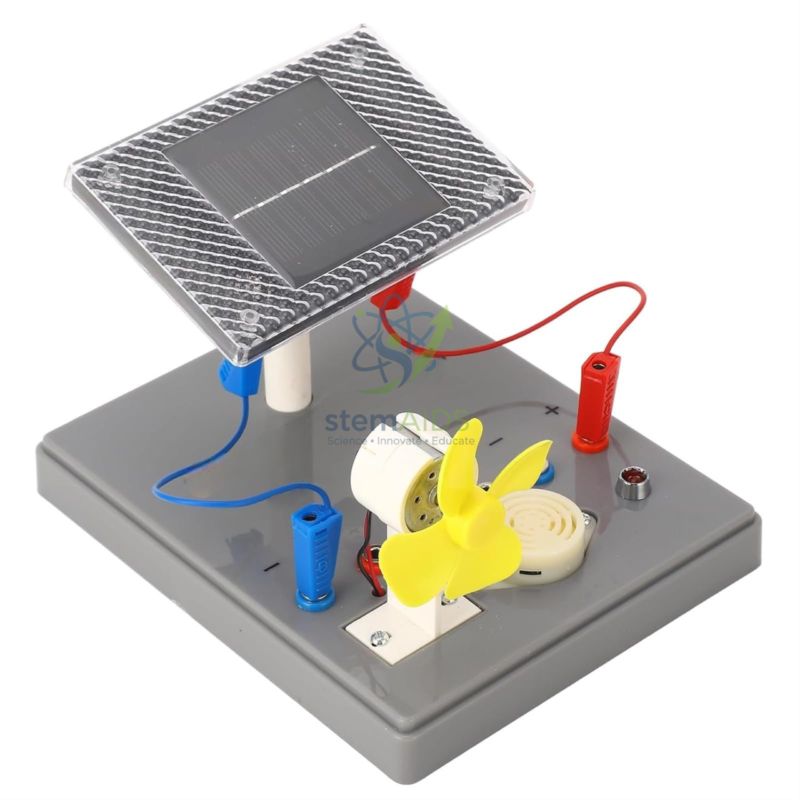
Quick Answer: The Solar Cell is a photovoltaic device that turns light directly into a direct-current electrical output, using a semiconductor p-n junction. In the physics lab a solar cell is used to study the photovoltaic effect, to plot its current-voltage curve and to power small loads from light alone.
How Light Becomes Current
A photovoltaic cell is a large-area p-n junction, most often made of silicon. Where the p-type and n-type layers meet, a built-in electric field forms across a thin depletion region. Light absorbed near this junction frees electron-hole pairs, and the built-in field sweeps the electrons one way and the holes the other. Join the two faces of the cell through an external circuit and those separated charges flow round it as a current, with no moving parts and no fuel.
Only photons carrying more energy than the semiconductor’s band gap can create these pairs, which is why a cell responds better to some colours than others and why part of each absorbed photon’s energy ends up as heat.
The Current-Voltage Curve and Maximum Power
The most informative experiment is to measure the output across a range of loads. With a voltmeter across the cell, an ammeter in series and a variable resistor as the load, students begin near open circuit, where the voltage is highest and the current almost zero, and work down towards short circuit, where the current is largest and the voltage small. Plotted, the readings give a characteristic that stays nearly flat and then bends sharply at a knee.
Multiplying each voltage by its current gives the power delivered, and that power peaks near the knee: the maximum power point. Finding it explains why commercial solar installations use electronics that keep each panel working at that point. Repeating the run with the lamp further away shows that the short-circuit current follows the light intensity closely while the open-circuit voltage changes far less.
Experiments With a Photovoltaic Cell
- Measuring the current-voltage characteristic and locating the maximum power point
- Showing how output changes with the angle of incidence of the light and with partial shading
- Comparing cells connected in series (more voltage) and in parallel (more current)
- Running a small buzzer, LED or low-voltage motor from light in renewable-energy lessons
Specifications
| Type | Photovoltaic (solar) cell |
| Principle | Photovoltaic effect at a semiconductor p-n junction |
| Output | Direct current, varying with light intensity and load |
| Typical experiments | I-V curve, maximum power point, angle and shading tests |
| Rated output, size and terminals | Confirm at enquiry |
Care & Handling
- Keep the face of the cell clean and unscratched; wipe it with a soft dry cloth, since dust and smears cut the light reaching the junction.
- Do not press on or flex the cell, as crystalline silicon is brittle and cracks easily.
- When a filament or halogen lamp is the light source, keep it far enough away that the cell does not warm up, because output falls as the cell heats.
Why Choose LabEquip
Physics departments setting up renewable-energy practicals buy photovoltaic cells together with meters, loads and small motors. LabEquip supplies them within our physics lab equipment range, alongside the light dependent resistor and BPW34 photodiode for comparing light sensors; send your class size through the contact page.
Frequently Asked Questions
Does a solar cell need direct sunlight to work?
No. Any light with enough photon energy produces some output, including a bench lamp. The current is roughly proportional to the light intensity, so sunlight gives far more than a classroom lamp, but indoor runs with a lamp at a fixed distance are easier to control and repeat.
Why does the voltage stay fairly steady while the current changes with brightness?
The current comes from charge carriers created by absorbed light, so it scales with the amount of light. The open-circuit voltage is set mainly by the junction and rises only slowly with intensity, so dimming the light cuts the current far more than the voltage.
How do I find the maximum power point?
Connect a variable resistor as the load, with an ammeter in series and a voltmeter across the cell. Record voltage and current at a series of resistor settings, multiply them to get the power for each, and plot power against voltage. The peak of that graph is the maximum power point at that light level.
What happens if I connect two cells in series or in parallel?
In series the voltages add while the current is that of one cell, provided both receive the same light. In parallel the currents add at about the voltage of one cell. Shading one cell of a series pair limits the current of both, which is why shading matters on real rooftops.
Can a solar cell charge a battery directly?
Only with care. Connected straight to a rechargeable battery, a cell can let the battery discharge back through it in the dark, so a blocking diode is placed in series, and the battery needs a charging method suited to its chemistry. In class it is simpler to power a small load directly.
Why does the output fall when the cell gets hot?
As a silicon cell warms, its open-circuit voltage falls, so the power available at the maximum power point drops even though the light has not changed. Keep a hot lamp well away from the cell to avoid misleading readings.
Last Updated: October 2026






Reviews
There are no reviews yet.