
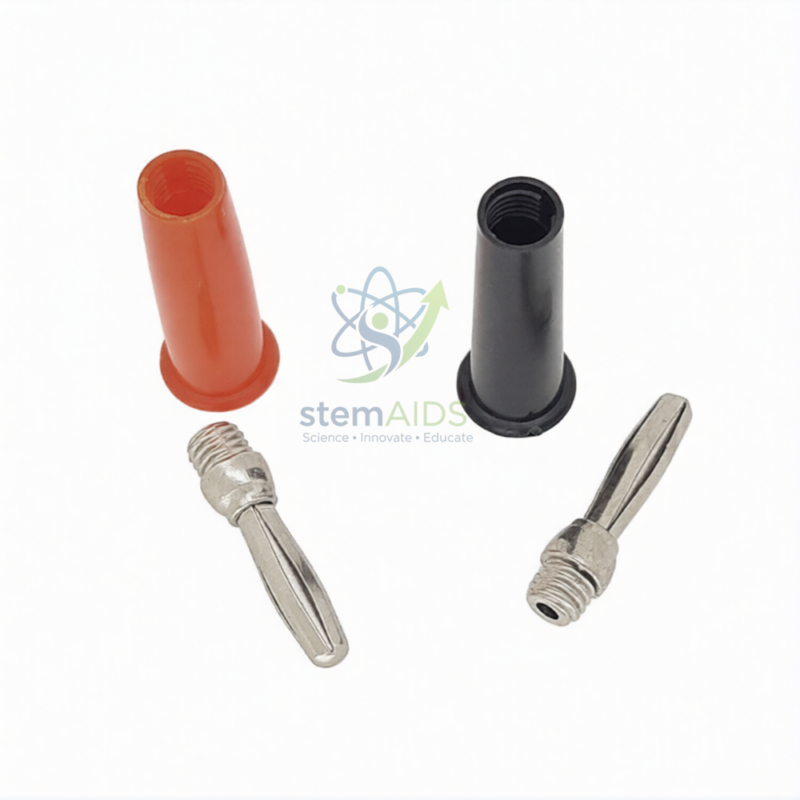
Quick Answer: Single banana plugs are plain plug connectors, each made of a metal contact pin and an insulating sleeve, that are fitted to the end of a wire to make or repair a laboratory lead. The product photograph shows the parts unassembled: two pins with fixing screws and red and black sleeves.
Making a Lead From Parts
The banana plug takes its name from the shape of its contact: a pin with springy strips that bulge slightly outward, so the pin presses against the inside of a socket and makes a firm, low-resistance contact without any locking mechanism. Single banana plugs let a technician build that contact onto any suitable wire. The wire is stripped, passed through the sleeve and clamped under the screw in the pin body, and the sleeve is then pushed or screwed over the joint so that only the pin protrudes.
Making leads this way has practical advantages. Leads can be cut to the length a particular bench needs, a lead with a damaged plug can be repaired instead of discarded, and special leads, such as a short link or a lead ending in a component, can be made up as required. The red and black sleeves keep the usual positive and negative colour scheme.
Plain Plugs and Safety Plugs
These are plain, unshrouded plugs: when they are inserted the pin is covered by the socket, but when they are withdrawn the metal pin is exposed. That is acceptable for the low voltages of school electricity practicals, and it is how most traditional apparatus was designed. Where a laboratory has moved to safety leads, shrouded plugs and sockets are used instead, and the standard safety adapter bridges the two systems. For ready-made plugs of this kind, see the banana plug connectors.
Specifications
| Product | Banana plugs, supplied as parts |
| Parts in the photograph | Metal contact pins with fixing screws, red and black insulating sleeves |
| Wire fixing | Screw clamp in the pin body |
| Type | Plain, unshrouded plug |
| Use | Making and repairing low-voltage laboratory leads |
| Pin size and quantity per pack | Confirm at enquiry |
Care & Handling
- Strip only enough insulation for the clamp, so no bare wire shows below the sleeve
- Tighten the screw firmly on twisted strands and tug-test the wire before fitting the sleeve
- Keep the pin’s spring strips clean and straight; a flattened pin gives a loose fit
- Use single banana plugs only on low-voltage circuits
Applications
- Making laboratory leads to custom lengths for benches and apparatus
- Repairing leads whose original plugs are broken
- Fitting plugs to component leads, sensors and coils for use with socket boards
- Teaching students to strip wire and make a sound mechanical and electrical joint
Why Choose LabEquip
Technicians who make and repair the department’s leads buy single banana plugs by the bag to keep benches supplied. LabEquip can add them to an order of wire and clips; tell us the colours and quantities through our contact page, and browse physics lab equipment.
Frequently Asked Questions
How is a banana plug fitted to a wire?
Strip a short length of insulation, twist the strands, pass the wire through the sleeve, clamp the bare end under the screw in the pin body and push or screw the sleeve back over the joint. Tug the wire to check that it is secure.
Why do banana plugs have springy strips on the pin?
The strips bow outward slightly and press against the socket wall, giving a firm, low-resistance contact that holds the plug in place without a lock.
Can these plugs be used with shrouded safety sockets?
Plain plugs are not designed for shrouded safety sockets and may not fit or seat properly. Use safety plugs and leads with safety sockets, or an adapter between the two systems.
What wire should be used to make leads?
Flexible stranded copper wire with good insulation suits laboratory leads, as it survives repeated bending. Choose a conductor size suited to the current the lead will carry.
Why are the sleeves red and black?
Colour coding marks polarity: red for positive or signal, black for negative or common. Keeping to the scheme helps students wire circuits correctly and check them quickly.
Can students assemble the plugs themselves?
Yes, under supervision it is a good practical exercise in wire stripping and making sound joints. Test each finished lead for continuity before it goes into use.
Last Updated: October 2026




Reviews
There are no reviews yet.