
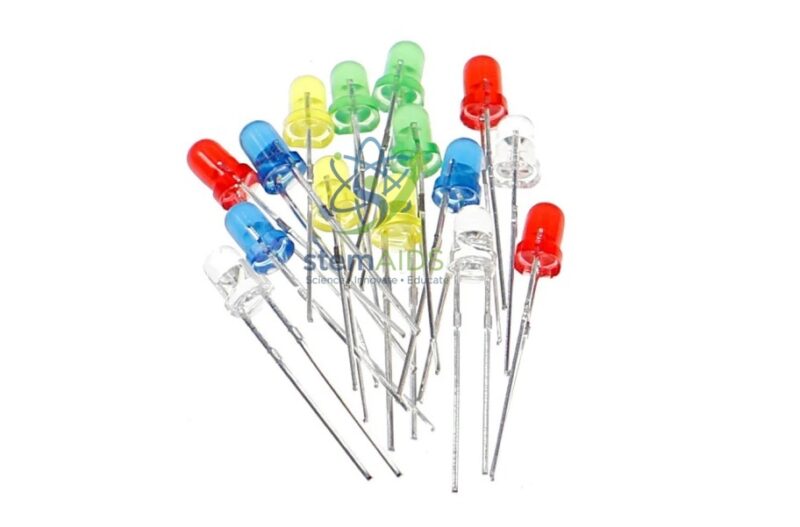
Quick Answer: The Round LED is a through-hole light-emitting diode with a domed round lens and two wire leads, the standard form used on breadboards and in student electronics; the listing photo shows these LEDs in several colours. It lights when current flows through it in the forward direction and must be used with a series resistor.
Identifying the Leads
A round LED has two leads of different length. The longer lead is the anode, which connects toward the positive side of the supply, and the shorter lead is the cathode. Most LEDs of this type also have a small flat on the rim of the lens next to the cathode, which is the reliable mark once the leads have been trimmed. Connected the wrong way round at low voltage, the LED simply stays dark.
Unlike a filament lamp, an LED cannot be connected straight across a battery. Once its forward voltage is reached, its current rises very steeply, so a resistor in series is needed to set the current. The value follows from Ohm’s law: subtract the LED’s forward voltage from the supply voltage and divide by the current wanted, both figures taken from the LED’s data.
Colour, Voltage and the Planck Constant
Different colours use different semiconductor materials, and the voltage at which an LED begins to emit rises as the wavelength gets shorter, from red through green to blue. Each photon carries energy E = hf, and that energy comes from an electron crossing the junction, so to a first approximation eV equals hc divided by the wavelength. Measuring the turn-on voltage for several colours of known wavelength and plotting voltage against the reciprocal of wavelength gives a straight line whose gradient leads to an estimate of the Planck constant, a popular advanced practical.
Applications
- Breadboard and project circuits that need indicator lights
- Teaching diode polarity and the need for a series resistor
- Estimating the Planck constant from the turn-on voltages of different colours
- Simple electronics such as flashing circuits, alarms and logic indicators
Specifications
| Type | Through-hole LED with round lens |
| Leads | Two wire leads; the longer lead is the anode |
| Lens | Round domed lens |
| Colours | Several colours shown in the listing photo |
| Diameter, colours supplied and quantity | Confirm at enquiry |
Care & Handling
- Always fit a series resistor; never connect a bare LED directly to a cell or power supply.
- Bend leads gently a short distance from the lens, not at the lens itself, to avoid cracking the seal.
- Store LEDs sorted by colour in labelled boxes, since unlit LEDs of similar tint are hard to tell apart.
- In very dry rooms, touch an earthed object before handling LEDs to avoid static discharge onto the leads.
Why Choose LabEquip
Loose LEDs are bought by schools, colleges and electronics clubs for breadboard work and advanced practicals. For younger classes LabEquip also lists the ready-protected red LED module and a digital multimeter for measurements, in its Physics Equipments category.
Frequently Asked Questions
How do I tell which leg of the LED is positive?
The longer leg is the anode and goes toward the positive side of the supply. The shorter leg is the cathode, usually also marked by a flat edge on the rim of the lens.
Why does an LED need a resistor?
An LED’s current rises very steeply once its forward voltage is reached, so without a resistor it can draw far more current than it can handle and fail. The resistor limits the current to a safe value.
How do I calculate the resistor value?
Subtract the LED’s forward voltage from the supply voltage, then divide by the current you want through the LED. Use the forward voltage and current from the LED’s data, and choose the next standard resistor value above the result.
Why do different colours need different voltages?
Shorter-wavelength light carries more energy per photon, and that energy comes from electrons crossing the junction. So blue and white LEDs need a higher forward voltage than red or yellow ones.
Can round LEDs be used to estimate the Planck constant?
Yes. Measure the voltage at which each colour just starts to glow, plot it against the reciprocal of the wavelength, and use the gradient, which equals the Planck constant multiplied by the speed of light divided by the electron charge.
Which colours and sizes are available?
These LEDs come in several colours and lens diameters, and the listing photo shows a mix of colours. The colours, size and quantity required can be confirmed when you enquire.
Last Updated: October 2026




Reviews
There are no reviews yet.