
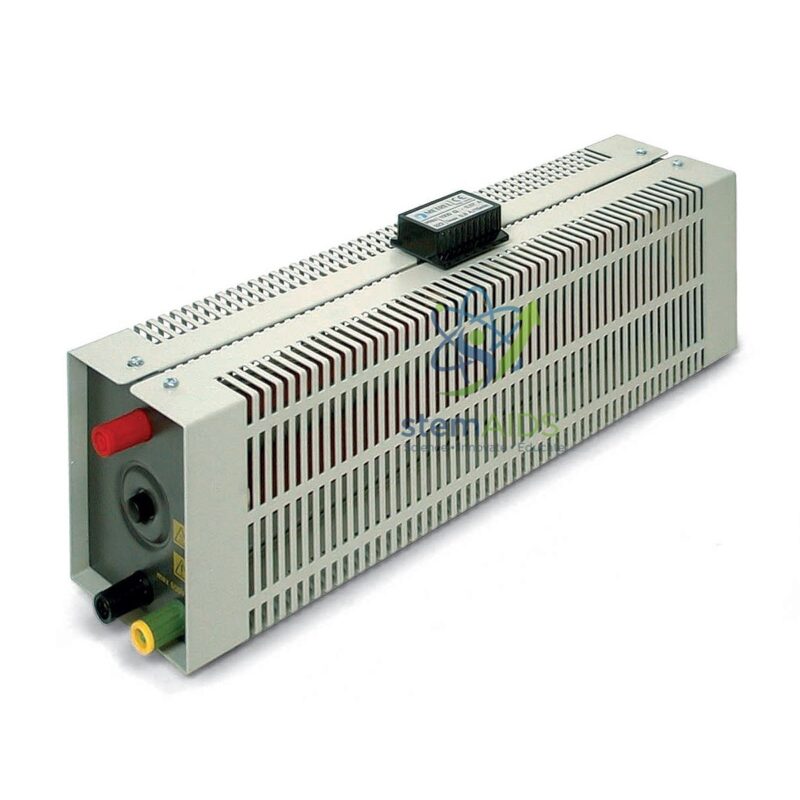
Quick Answer: The Rheostat 320 W is a sliding tubular variable resistor with a power rating of 320 W, shown with a perforated protective guard over the winding. Moving the slider along its bar changes how much of the resistance wire is in the circuit, so a rheostat 320 W can regulate larger currents than small bench rheostats without overheating.
Construction of a Sliding Rheostat
A sliding rheostat consists of a long resistance wire wound in a single layer around an insulating tube. The wire surface is coated or oxidised so that neighbouring turns stay insulated from each other except along a narrow track on top, where a spring-loaded slider rubs on bare wire. The slider runs on a metal bar fixed above the tube, and connections are usually made at the two ends of the winding and at the end of the slider bar.
The perforated guard on this model does two jobs: it keeps fingers and loose leads away from a winding that can become hot, and it lets air circulate so heat escapes. A 320 W rating means the winding can dissipate that much heat continuously under normal ventilation, which is what allows it to handle large currents.
Working Out the Safe Current
Because the power dissipated in a resistance is P = I²R, the maximum current a rheostat can carry is I = √(P/R), where R is its full resistance as marked on its label. The wire is the same along its whole length, so that current is the limit at every slider position, even when only a few turns are in use. A high-power rheostat therefore earns its place where the current would quickly overheat a small one: as a variable load on a power supply, limiting the starting current of a motor, or controlling the field current of a demonstration dynamo.
Applications
- Acting as an adjustable load when testing power supplies, batteries and generators
- Controlling current in motor, electromagnet and dynamo demonstrations
- Regulating current in Ohm’s law and heating-effect experiments that need larger currents
- Providing a high-power potential divider for lamp and heater circuits
Care & Handling
- Check the marked resistance and work out the maximum current before connecting the rheostat.
- Leave space around the guard for air to circulate, and never cover it with papers or cloth.
- Do not touch the guard or winding after high-current use until it has cooled.
- Keep the slider bar and winding track clean so the slider makes firm, spark-free contact.
Specifications
| Type | Sliding tubular rheostat (variable resistor) |
| Power rating | 320 W, as stated in the product name |
| Guard | Perforated protective cover over the winding, as pictured |
| Adjustment | Slider running along a bar above the winding |
| Resistance value and maximum current | Confirm at enquiry |
Why Choose LabEquip
High-power rheostats are bought by colleges and engineering laboratories that run motors, dynamos and power-supply tests, where currents exceed what a student rheostat can handle. For lighter work LabEquip also lists the Rheostat 160 W in its physics lab equipment range; send voltage and current needs through the contact page.
Frequently Asked Questions
What does the 320 W rating mean?
It is the power the winding can turn into heat continuously without overheating, under normal ventilation. Together with the resistance value it fixes the largest current the rheostat can safely carry.
How do I calculate the maximum current?
Divide the power rating by the full resistance marked on the rheostat and take the square root, since P = I²R. That current must not be exceeded at any slider position.
Can the rheostat be used as a potential divider?
Yes. Connect the two ends of the winding across the supply and take the output between the slider and one end. Current then flows through the whole winding all the time, which adds to the heat produced.
Why does the rheostat get hot?
All the electrical energy it removes from the circuit becomes heat in the wire. At high currents this heating is substantial, which is why the guard is ventilated and why the rheostat should stand where air can flow freely.
When is a high-power rheostat needed instead of a smaller one?
Choose a high-power rheostat when the circuit current is large, for example with motors, heaters, high-current lamps or power-supply load tests. For small student circuits a lower-power rheostat or rotary variable resistor is lighter and easier to set finely.
Why does the slider sometimes spark?
A spark appears when the slider loses contact for a moment under load, often because of dirt or oxide on the track. Clean the track gently with a dry cloth, move the slider smoothly, and avoid sliding it under heavy current with inductive loads such as motors.
Last Updated: October 2026









Reviews
There are no reviews yet.