
Quick Answer: The Reversible Demonstration Alternator is a clear-covered machine in which magnets and coils move relative to each other, generating alternating current when the rotor is turned; supplied with alternating current instead, the reversible alternator works as a motor. It shows both directions of electromechanical conversion with one device.
Why an Alternator Gives Alternating Current
In the reversible demonstration alternator each coil sees a north pole pass, then a south pole, as the rotor turns. The magnetic flux through the coil therefore rises, falls, reverses and returns, and the induced EMF follows the same pattern: positive, then negative, once for every pair of poles that passes. The output frequency equals the number of pole pairs multiplied by the revolutions per second.
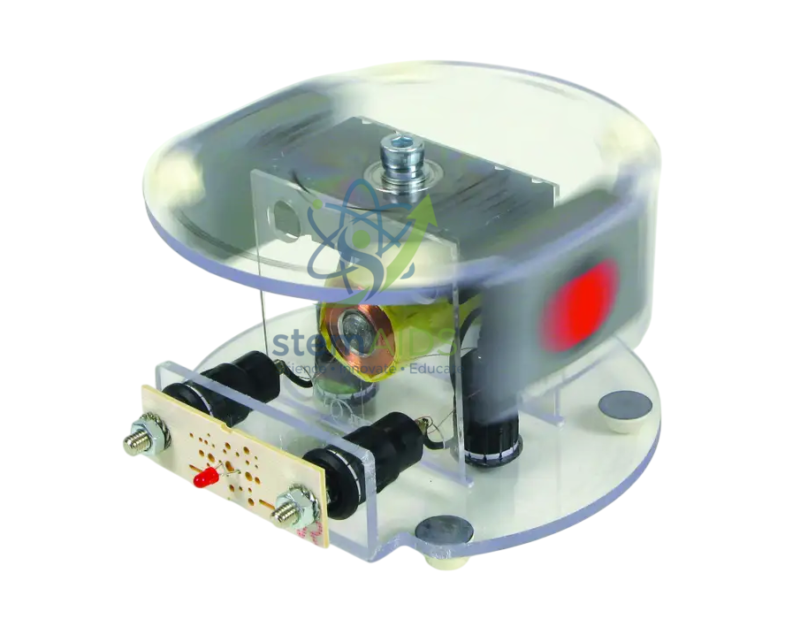
The photograph shows the moving parts and the coils under a transparent dome on a round base, so students can watch the rotor while a meter or oscilloscope shows the voltage it produces.
Running the Machine in Reverse
Feed the coils with alternating current and the process runs backwards. The current produces a magnetic field that changes direction in step with the supply, and the rotor magnets lock onto it, turning at exactly the speed that matches the supply frequency. This is a synchronous motor: its speed is fixed by frequency, not by load.
A synchronous motor of this kind cannot start itself from rest on a fixed-frequency supply, because the field reverses too quickly for the rotor to follow. A gentle spin by hand brings the rotor close to speed, and then it pulls into step. If it is loaded too heavily it falls out of step and stops.
Uses in Teaching
- Generating alternating current and viewing the waveform on an oscilloscope
- Relating output frequency to rotor speed and number of poles
- Running the same machine as a synchronous motor and showing that its speed is tied to supply frequency
- Comparing alternator output with the commutated output of a dynamo
Care & Handling
- Keep the clear cover in place whenever the rotor turns
- Use only a low-voltage AC supply suitable for the machine when running it as a motor
- Spin the rotor by hand gently; do not force it against a stop
- Wipe the cover with a soft damp cloth only, as solvents can cloud clear plastics
Specifications
| Device | Reversible alternator for demonstration |
| Modes | AC generator when turned; motor when supplied with AC |
| Construction | Rotor and coils visible under a clear cover |
| Mounting | Round base for bench or front-desk use |
| Drive arrangement and supply rating | Confirm at enquiry |
Why Choose LabEquip
Physics departments buy a reversible alternator because one machine covers both the generator and the motor halves of the syllabus. LabEquip offers it with the open electric dynamo among its physics equipment; questions about drive and supply arrangements can be sent through the contact page.
Frequently Asked Questions
What does reversible mean for this alternator?
It means the machine works in both directions of conversion. Turning the rotor makes it a generator of alternating current, and supplying its coils with alternating current makes it run as a motor.
How is the output frequency related to rotor speed?
Frequency equals the number of pole pairs on the rotor multiplied by the number of revolutions per second. A rotor with two pole pairs turning five times a second gives ten cycles per second.
Why does the alternator need a push to start as a motor?
On a fixed-frequency supply the field reverses so quickly that a stationary rotor is pushed one way and then the other, with no net turning. A spin by hand brings the rotor near the right speed so it can lock in step.
How is an alternator different from a dynamo?
An alternator delivers the alternating EMF directly, while a dynamo uses a commutator to turn it into direct current. Large power stations use alternators because alternating current can be changed in voltage with transformers.
What can be connected to show the output?
An oscilloscope shows the waveform, and an AC voltmeter shows its size. Two LEDs connected in opposite directions, with a series resistor, flash alternately and show the reversals without any meter.
Does the clear cover need to stay on?
Yes. The cover keeps fingers away from the rotor and keeps dust off the coils and bearings, while still letting students see how the machine works.
Last Updated: October 2026




Reviews
There are no reviews yet.