
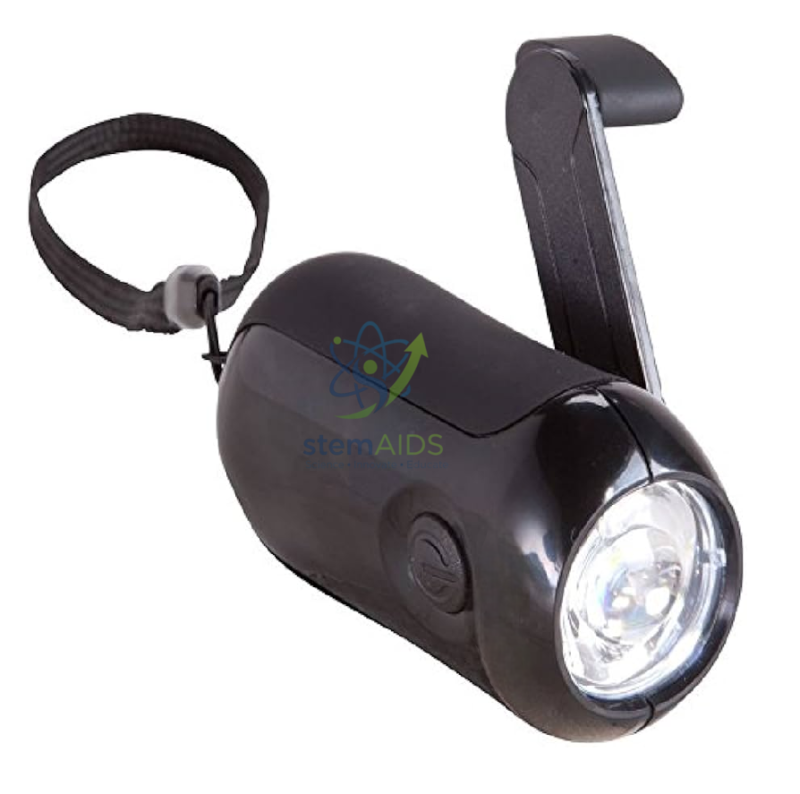
Quick Answer: The rechargeable LED dynamo lamp is a hand-crank torch: turning the folding handle drives a small generator that charges an internal store, which then powers LEDs. It makes electromagnetic induction and the chain of energy transfers visible in a single object students can hold.
From a Turning Handle to Light
Inside the rechargeable LED dynamo lamp, the crank turns a gear train that spins a small generator much faster than the hand moves. In the generator, magnets and coils move relative to each other, and the changing magnetic flux through the coils induces a voltage, as Faraday’s law describes. The output is rectified and fed to the internal storage element, from which the LEDs draw a steady current even after cranking stops.
The energy chain is a favourite for discussion: chemical energy in the muscles becomes kinetic energy of the handle and gears, electrical energy from the generator, stored energy in the lamp, and finally light, with heat and sound lost at every step. Students can follow it with their hands, and the gear noise and the warmth of a well-cranked lamp show where some of the losses go.
Feeling Lenz’s Law
Turning the handle takes noticeably more effort than spinning a generator whose terminals are left open. While the lamp is charging, the current in the generator coils produces a magnetic force that opposes the motion, exactly as Lenz’s law predicts, so students feel the energy cost of producing electricity rather than just reading about it. The bicycle dynamo assembly, turned with nothing connected and then with a lamp across it, shows the same contrast on a larger scale.
Specifications
| Product | Rechargeable LED dynamo lamp (hand-crank torch) |
| Light source | LEDs |
| Generator | Hand crank driving a small internal generator through gears |
| Energy storage | Internal rechargeable store powering the LEDs after cranking |
| Form in the photograph | Black torch body with folding crank and wrist strap |
| Storage type and light time per minute of cranking | Confirm at enquiry |
Lessons and Uses
- Demonstrating electromagnetic induction and generators in a handheld object
- Energy transfer chains from muscle work to light, with losses identified
- Feeling Lenz’s law as resistance at the crank
- A torch that needs no disposable batteries for field work and power cuts
Care & Handling
- Turn the crank steadily rather than in fast jerks, which strains the gears
- Fold the handle away before storing the lamp so it does not snap off
- Crank the lamp every few months during storage so the internal store does not run completely flat
- Keep the lamp dry and do not open the housing
Why Choose LabEquip
Teachers looking for one object that links generators, energy stores and light buy the rechargeable LED dynamo lamp as a class demonstrator or a set for group work. LabEquip can supply it alongside other physics lab equipment; for a battery torch with many LEDs see the 24-LED flashlight, and send quantities through our contact page.
Frequently Asked Questions
Does the dynamo lamp need batteries?
It has an internal rechargeable store that is charged by turning the crank, so no disposable batteries are needed. The store keeps the LEDs lit for a while after cranking stops.
How does turning the handle make electricity?
The crank spins magnets and coils past each other inside a small generator. The changing magnetic flux through the coils induces a voltage, and the resulting current charges the store that powers the LEDs.
Why is the handle hard to turn?
When the generator delivers current, the current in its coils produces a magnetic force that opposes the rotation, as Lenz’s law states. The work done against that force is the energy that ends up as electrical energy, plus losses.
Why do the gears make the generator spin faster than the handle?
A generator’s output voltage rises with its speed. The gear train turns the slow motion of the hand into fast rotation of the generator, so a comfortable cranking rate gives a useful voltage.
Can students measure the energy produced?
Inside the sealed lamp this is difficult. A simpler route is to compare cranking time with the time the lamp stays lit, or to use an open generator model with meters for quantitative work.
Is it a useful emergency light?
Yes. Because it can be recharged by hand, it stays usable when batteries are flat, which makes it handy for field trips and power cuts as well as lessons.
Last Updated: October 2026






Reviews
There are no reviews yet.