
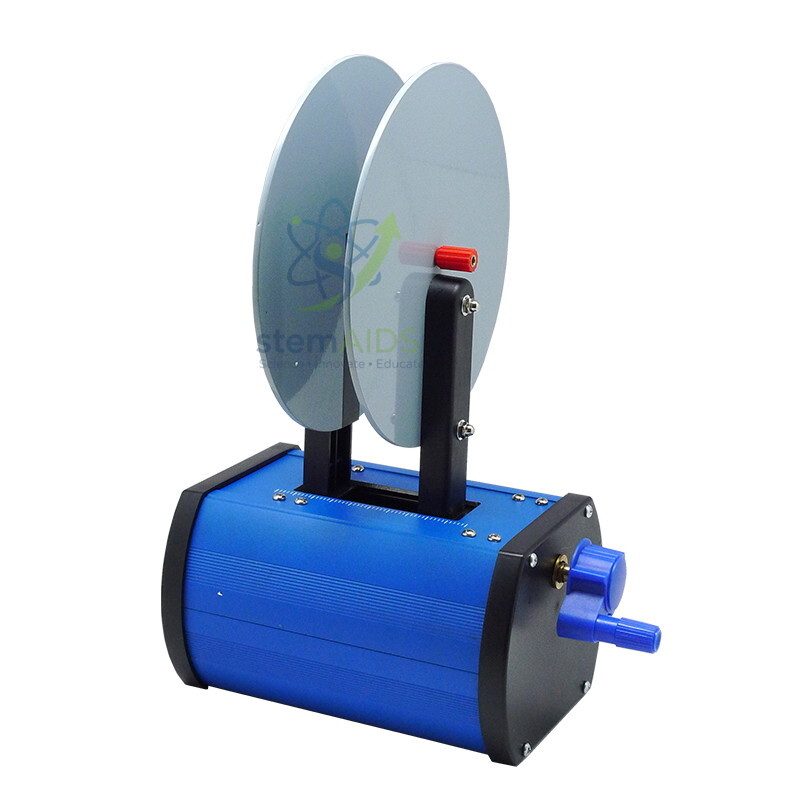
Quick Answer: This parallel-plate capacitor and dielectrics set consists of two circular metal plates held face to face on a base, with sheets of insulating material that can be placed between them. It is used to show how capacitance depends on plate area, plate separation and the dielectric, the relationship C = ε₀εᵣA/d.
Capacitance From Geometry
A parallel-plate capacitor stores charge on two conductors separated by an insulator. Its capacitance grows with the area of the plates facing each other and shrinks as the gap widens: C = ε₀εᵣA/d, where ε₀ is the permittivity of free space and εᵣ the relative permittivity of whatever fills the gap. Air has εᵣ very close to 1; plastics, glass and paper have larger values.
In the product photograph the two plates stand upright, side by side, on a blue base unit. Because the plates are large and the gap can be made small, the capacitance is big enough to measure with suitable instruments, while every part of the arrangement stays visible.
What a Dielectric Does
Slide an insulating sheet between the plates and the molecules in it become slightly polarised, lining up against the field. This partly cancels the field between the plates, so for the same charge the voltage is lower, and the capacitance, Q/V, is higher. The factor by which it rises is the relative permittivity of the sheet.
Two classic versions of the experiment show this. With the plates charged and then isolated, an electrometer shows the voltage falling as the dielectric goes in. With the plates kept connected to a supply, more charge flows on instead, which a coulomb meter can measure.
Applications
- Showing capacitance falling as plate separation increases
- Comparing capacitance with air and with different dielectric sheets between the plates
- Estimating the relative permittivity of a sheet material
- Demonstrating the voltage drop on isolated charged plates when a dielectric is inserted
Specifications
| Product | Parallel-plate capacitor with dielectric sheets |
| Plates | Two circular metal plates held face to face |
| Mounting | Base unit, as photographed |
| Dielectrics | Insulating sheets for insertion between the plates |
| Quantities studied | Capacitance against separation, area and dielectric |
Care & Handling
- Handle the plates by their insulated mountings to keep finger grease off the surfaces
- Store the dielectric sheets flat so they stay uniform in thickness
- Discharge the plates before handling after any charging experiment
- Work in a dry room; damp air lets charge leak away and spoils electrostatic readings
Why Choose LabEquip
Advanced-level and college physics courses use a parallel-plate set to turn the capacitance formula into measurable effects. LabEquip offers it with the rail-mounted plate capacitor and the capacitor charging module among its physics equipment; questions can be sent through the contact page.
Frequently Asked Questions
Why does capacitance fall when the plates are moved apart?
Capacitance is inversely proportional to plate separation. With a wider gap, the same voltage produces a weaker field between the plates, so less charge is held for each volt.
What does a dielectric sheet change?
It increases the capacitance by a factor equal to the relative permittivity of its material. The polarised molecules in the sheet reduce the field between the plates for a given charge.
Why does the voltage on isolated charged plates drop when a dielectric is inserted?
The charge cannot leave isolated plates, so it stays constant. The capacitance rises with the dielectric, and since voltage equals charge divided by capacitance, the voltage falls.
Which instrument measures such a small capacitance?
A capacitance meter with a low range, an electrometer or a coulomb meter is used. Keep the connecting leads short, because the leads themselves add a little capacitance.
Why does the dielectric sheet need to fill the gap?
The simple formula assumes the material fills the whole space between the plates. A sheet thinner than the gap leaves an air layer in series with it, and the capacitance rises less than expected.
How is this set different from the plate capacitor on stands?
This set keeps both plates on a compact base and focuses on the effect of different dielectrics. The plate capacitor on stands mounts its plates on sliding holders so the separation can be set step by step for graphs.
Last Updated: October 2026






Reviews
There are no reviews yet.