
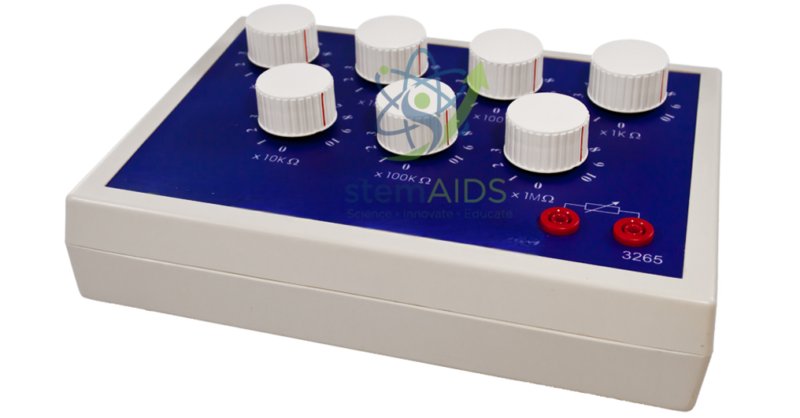
Quick Answer: The Peaktech item listed here is a Peaktech resistance decade box: a bench case with several rotary decade dials, each marked with an ohm multiplier, and a pair of output terminals, as pictured. Setting the dials selects an exact resistance at the terminals, so the box acts as an adjustable, known resistor for testing and calibration work.
Building a Value from the Dials
Each dial is one decade, selecting a digit from zero upward, and its multiplier, printed beside it on the panel, sets the place value of that digit. The resistance between the output terminals is the sum of every dial’s digit multiplied by its multiplier. With several decades in one case, a value can be set to many significant figures without changing any wiring.
That is the main difference from single-dial or modular units: one compact case spans a wide range, and the connections between decades are fixed inside the case, which helps keep the residual resistance with all dials at zero small and consistent.
Where a Decade Box Earns Its Keep
Electronics benches use a resistance decade box to check that an ohmmeter or multimeter reads correctly across its ranges, to find the right value for a resistor in a prototype before soldering one in, and to stand in for a resistive sensor. A thermistor or resistance thermometer changes resistance with temperature, so setting the box to the sensor’s resistance at a given temperature lets a reading circuit or controller be tested without heating anything. In physics teaching, the same box serves as the known resistance in bridge circuits and as a precise load in potential-divider studies.
Applications
- Checking multimeter and ohmmeter readings against set resistance values
- Simulating thermistors and resistance thermometers when testing measurement circuits
- Trying resistor values in prototype circuits before choosing a fixed part
- Providing the known arm in Wheatstone and metre bridge experiments
Specifications
| Brand | Peaktech, as named in the product title |
| Type | Multi-dial resistance decade box in a bench case |
| Controls | Rotary decade dials with ohm multipliers marked on the panel, as pictured |
| Output | Pair of terminals for the selected resistance |
| Model, resistance range, tolerance and power rating | Confirm at enquiry |
Care & Handling
- Keep within the box’s power rating; set a high value first and reduce it, especially when a supply is connected.
- Change dial settings with the circuit unpowered when possible, to protect the switch contacts.
- Keep the panel and terminals clean and dry, and avoid solvents on the printed markings.
- Store the box in its case or a dry cupboard, away from heavy items that could press on the dials.
Why Choose LabEquip
A bench decade box of this kind is bought by electronics and instrumentation laboratories, polytechnics and colleges that test meters and circuits regularly. LabEquip lists it with other resistance references such as the modular resistance box in the Physics Equipments category; confirm the exact model through the contact page.
Frequently Asked Questions
Is this a resistance or a capacitance decade box?
The dials on the pictured unit are marked with ohm multipliers and the output is shown with a resistor symbol, so it is a resistance decade box. If a capacitance decade box is needed instead, that should be specified separately.
How is the output resistance worked out from the dials?
Multiply each dial’s setting by the multiplier printed beside it and add the results. For example, a dial at 3 with a multiplier of one hundred ohms contributes three hundred ohms to the total.
Can the decade box simulate a temperature sensor?
Yes, for resistive sensors. Set the box to the resistance the sensor would have at a chosen temperature, connect it in place of the sensor, and check that the instrument or controller shows the expected temperature.
Why does the box show a small resistance with every dial at zero?
Switch contacts and internal wiring always have some resistance. This residual value matters only at low settings, where it should be measured and subtracted.
Can students use a bench decade box?
Yes, under supervision. It is robust enough for bench work, but students should keep currents low, avoid connecting it straight across a power supply at a low setting, and turn the dials gently.
What accuracy can I expect?
Accuracy depends on the tolerance of the internal resistors and is stated for each model by its maker. Decade boxes are usually built with closer-tolerance resistors than ordinary fixed resistors, which is why they serve as references in teaching labs.
Last Updated: October 2026





Reviews
There are no reviews yet.