
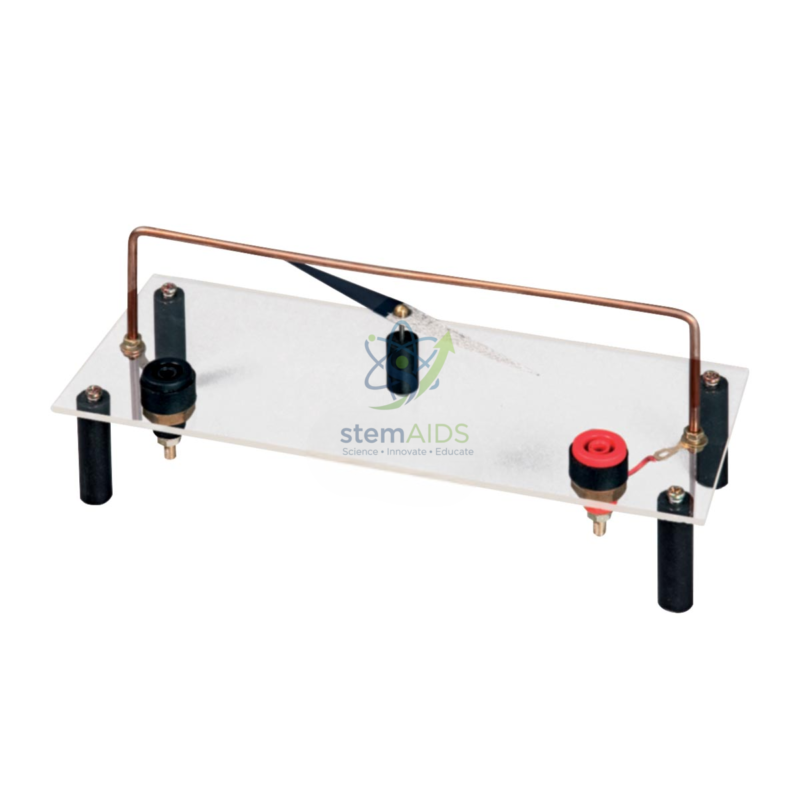
Quick Answer: The Oersted needle is a transparent base on four legs carrying a pivoted magnetic needle, with a copper wire bridge running over it between two terminal sockets. Passing a current through the wire deflects the needle, repeating Hans Christian Oersted’s 1820 discovery that an electric current produces a magnetic field.
Repeating Oersted’s Observation
Before switching on, turn the base so that the wire lies along the needle, pointing north and south. When a current flows, the needle swings towards an east-west direction; the larger the current, the closer it gets. Reverse the leads and it swings the other way. In a single step the experiment shows that a current has a magnetic field and that the direction of that field depends on the direction of the current.
The needle settles where Earth’s horizontal field and the field of the wire combine, so the deflection is a balance between the two. Here the wire runs above the needle; a wire below the needle would deflect it the opposite way, because the circular field around a wire points in opposite directions above and below it.
Design of This Version
The product photograph shows the copper conductor bent into a bridge over a clear plate, the needle on a central pivot beneath it, and a black and a red socket for the supply. The transparent plate lets students see the needle and its pivot from any side, which helps when the apparatus is passed round a group.
Specifications
| Apparatus | Pivoted magnetic needle below a copper wire bridge |
| Base | Transparent plate on four legs |
| Connections | Red and black terminal sockets, as pictured |
| Supply | Low-voltage DC with a current limit |
| Principle | Magnetic effect of an electric current |
Uses in Class
- Showing the magnetic effect of an electric current
- Reversing the current to reverse the deflection
- Comparing deflections for a small and a larger current
- Using the needle as a simple current detector in other circuits
Care & Handling
- Limit the current with a rheostat or resistor, because the copper bridge is almost a short circuit on its own
- Switch on only long enough to observe the deflection
- Keep magnets and steel objects away so the needle is not remagnetised
- Carry the apparatus level so the needle does not jump off its pivot
Why Choose LabEquip
The Oersted needle is a first experiment in electromagnetism for school physics, and its clear base suits demonstrations at the front of a class. LabEquip also offers the magnetic needle on stand and the straight wire field apparatus in its physics lab equipment range.
Frequently Asked Questions
Why should the wire be aligned north-south before switching on?
The field of the wire is horizontal and at right angles to the wire. With the wire north-south, that field points east-west, at right angles to the needle, which gives the largest and clearest deflection.
Why does the needle not turn fully to east-west?
Earth’s magnetic field still pulls the needle towards north. The needle settles along the combined field, so a larger current gives a deflection closer to 90 degrees.
What happens if the current is reversed?
The field around the wire reverses, so the needle swings by the same amount to the other side. This shows that the magnetic field depends on the direction of the current.
Why is a current limit needed?
The copper bridge has a very low resistance. Connected straight across a battery or supply it would draw a very large current, heat up and flatten the battery, so a series resistor or rheostat is used.
Who was Oersted?
Hans Christian Oersted was a Danish physicist who in 1820 noticed that a current in a wire moved a nearby compass needle. It was the first evidence linking electricity and magnetism.
Can the needle detect current in other circuits?
Yes, as a simple galvanoscope. Any deflection shows that a current is flowing and which way, although the needle gives no calibrated reading.
Last Updated: October 2026





Reviews
There are no reviews yet.