
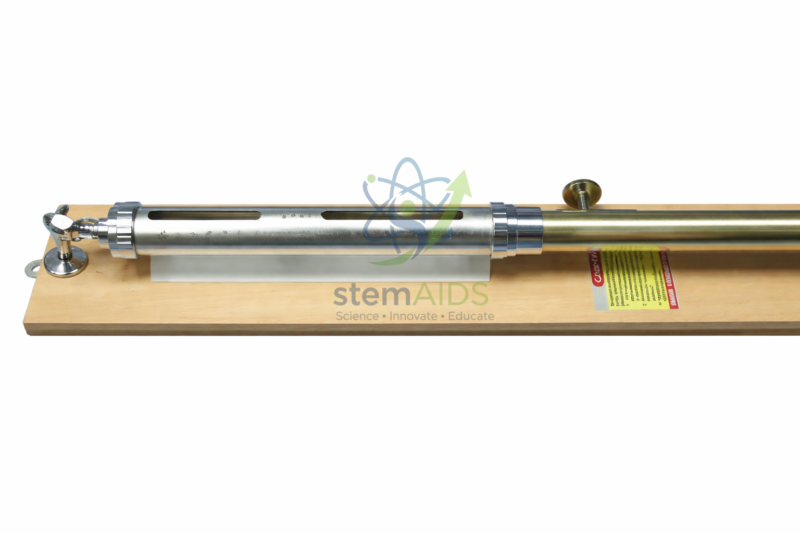
Quick Answer: The Mercury Barometer is a liquid-column instrument that measures atmospheric pressure from the height of mercury the air can support in a sealed glass tube. As pictured, the tube is housed in a metal case with a reading window and mounted on a wooden backboard with a hanging hook, for wall use in a laboratory.
How a Column of Mercury Measures the Air
In 1643 Evangelista Torricelli filled a glass tube closed at one end with mercury and inverted it into a dish of mercury. The column fell until it stood at a certain height, leaving a near-vacuum above it. The weight of that column per unit area balances the pressure of the atmosphere on the open mercury surface, so p = ρgh, where ρ is the density of mercury, g the gravitational field strength and h the vertical height of the column.
Mercury is used because it is so dense, about 13.6 times denser than water. At standard atmospheric pressure the column stands about 760 mm high, while a water barometer would need a tube more than ten metres tall. That is why pressure has long been quoted in millimetres of mercury, and one standard atmosphere equals 760 mmHg.
Reading the Barometer Correctly
The instrument must hang truly vertical, because a tilted tube gives a longer column without any change in vertical height. Read the top of the mercury meniscus, which curves upward, with the eye level with it so there is no parallax; where a vernier or sliding index is fitted, set its lower edge just touching the top of the curve. Some designs also require the mercury level in the cistern to be set to a fixed zero mark before each reading.
For accurate work the reading is then corrected. Mercury and the metal scale both expand with temperature, so a thermometer reading taken beside the instrument is used to reduce the value to a standard temperature. Weather services also reduce readings to sea level, because pressure falls with height, which lets stations at different altitudes be compared.
Applications
- Measuring atmospheric pressure for school weather records and meteorology projects
- Checking aneroid barometers and pressure sensors against a liquid column
- Teaching pressure in fluids, p = ρgh, and Torricelli’s experiment
- Relating changes in air pressure to weather patterns and to boiling-point experiments
Specifications
| Type | Mercury-in-glass (liquid-column) barometer |
| Quantity measured | Atmospheric pressure, read as the height of the mercury column |
| Mounting | Wall-hung on a wooden backboard, as pictured |
| Reading aid | Scale and reading window on a metal tube case, as pictured |
| Scale units, vernier and cistern type | Confirm at enquiry |
Care & Handling
- Mercury is toxic and its vapour is harmful if inhaled. Keep the mercury barometer upright and fixed securely to a wall, away from heat sources, traffic and vibration.
- Never tilt, lay down or transport the instrument without following its instructions for securing the mercury; a sudden movement can break the tube.
- Keep a mercury spill kit nearby and follow your institution’s spill procedure if the tube breaks; never use a vacuum cleaner or broom on spilled mercury.
- Some countries restrict the sale or use of mercury-filled instruments, so check local rules before ordering, and dispose of an old barometer as hazardous waste.
Why Choose LabEquip
Colleges, meteorology departments and schools that want a reference instrument for pressure readings choose a liquid-column barometer over a dial gauge. LabEquip can also supply an aneroid barometer for student handling and the Magdeburg hemisphere for showing the force of air pressure, with more items in the Physics Equipments range; ask about any of them through the contact page.
Frequently Asked Questions
Why is mercury used instead of water in a barometer?
Mercury is about 13.6 times denser than water, so the air supports a column roughly 760 mm high instead of more than ten metres. Mercury also has a low vapour pressure, so the space above the column stays close to a vacuum.
How is a mercury barometer different from an aneroid barometer?
The mercury instrument balances air pressure against a column of liquid, which makes it a reference standard. An aneroid barometer uses a sealed metal capsule that flexes with pressure; it is portable and mercury-free but has to be set against a reference.
What should be done if mercury is spilled?
Clear the area, ventilate the room and follow the institution’s mercury spill procedure, using a spill kit to collect the droplets. Do not touch mercury with bare hands, and never sweep or vacuum it, which spreads the vapour.
Why must the barometer hang vertically?
Pressure balances the vertical height of the column, not its length along the tube. If the tube tilts, the mercury runs further along it and the scale, which is set along the tube, gives a reading that is too high.
Why do readings need a temperature correction?
Both the mercury and the scale expand when warm, so the same air pressure gives a slightly different reading at a different temperature. Correcting to a standard temperature makes results comparable across seasons.
Is this barometer suitable for school students to use?
Students can read it under supervision, but the instrument should stay fixed on the wall and only trained staff should move or service it. Many schools pair it with an aneroid barometer that students can handle freely.
Last Updated: October 2026




Reviews
There are no reviews yet.