
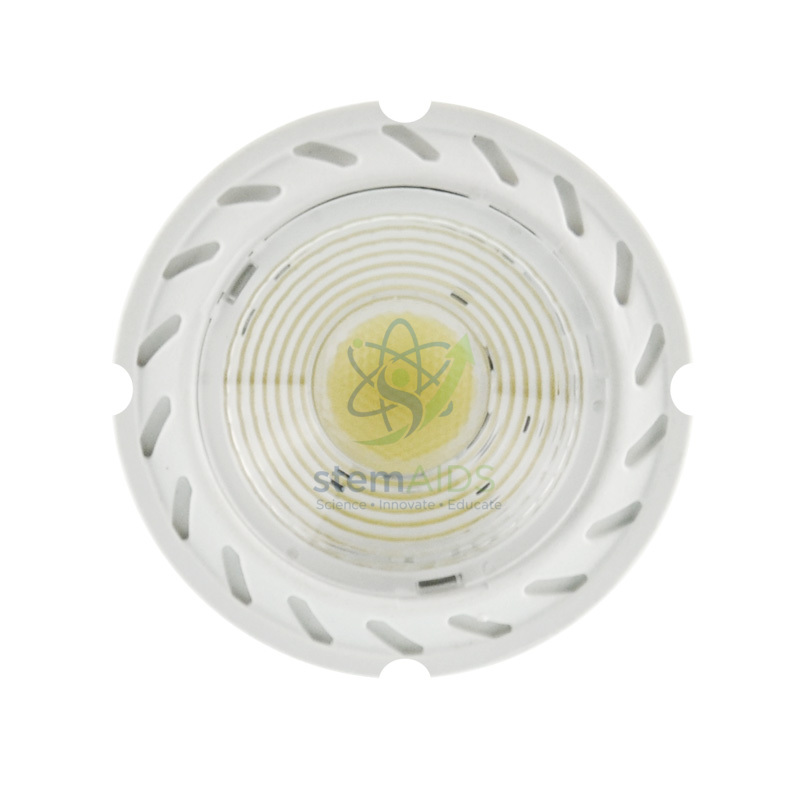
Quick Answer: The LED E14 replacement bulb is an LED lamp with the E14 small Edison screw base, made to replace a worn or older lamp in apparatus and lamps that use E14 holders. In the product photograph the lamp face shows a single LED behind a lens, set in a ribbed surround.
Where E14 Lamps Are Found
E14 is the smaller of the two common Edison screw sizes, with a thread roughly half as wide as the familiar E27 household cap; the letter stands for Edison and the figure gives the thread diameter in millimetres. In laboratories the size turns up in desk and bench lamps, light boxes, illuminators and older apparatus. When one of those lamps fails, an LED replacement restores the light while using less power and running cooler than the filament or halogen lamp it replaces.
Replacement in apparatus raises points that do not arise with a household lamp. The new lamp must fit inside the housing, its light must leave in the right direction, and its voltage must match the supply inside the apparatus, which may be mains or a low voltage from a transformer. The front-facing design in the photograph suits fittings where light should be thrown forward, such as a spot lamp or an illuminator.
Changing to LED in an Optics Lamp
Where an E14 lamp lights a housing used for optics demonstrations, the lamp is the source for shadow work, lens experiments and colour mixing. An LED source is smaller and cooler than a halogen capsule, so the housing stays comfortable to handle during a lesson, but it may sit at a different position relative to the slit or lens. After fitting the new bulb, check that the image or beam is still sharp and adjust the lamp position if the housing allows. Students can also compare the spectrum of the LED with that of the old lamp using a diffraction grating.
Specifications
| Product | LED replacement bulb with E14 base |
| Base | E14 small Edison screw |
| Light source | LED behind a front lens, as in the product photograph |
| Purpose | Replacing filament or halogen E14 lamps in lamps and apparatus |
| Heat | Runs cooler than the filament or halogen lamp it replaces |
| Voltage, power and outline dimensions | Confirm at enquiry |
Care & Handling
- Isolate the apparatus from the supply and let the old lamp cool before removing it
- Check that the new bulb fits inside the housing without touching reflectors or lenses
- Match the voltage of the LED E14 replacement bulb to the supply inside the apparatus
- Keep the front lens clean with a soft dry cloth so the beam is not dulled
Applications
- Replacing failed lamps in E14 desk and bench lamps
- Re-lamping light boxes and illuminators that use E14 holders
- Comparing LED and filament spectra with a diffraction grating
- Low-heat illumination over specimens or apparatus that should not be warmed
Why Choose LabEquip
Technicians maintaining lamps, light boxes and older apparatus with E14 holders are the main buyers of this replacement bulb. LabEquip can match voltage and size to your equipment if you send the old lamp’s markings through our contact page; related bulbs include the LED bulb with E27 base, and the physics lab equipment range lists the apparatus.
Frequently Asked Questions
What is the difference between E14 and E27 bases?
Both are Edison screw caps, but the E14 thread is roughly half the diameter of the E27 thread. They are not interchangeable without an adapter, and an adapter should only be used if the lamp housing has room for it.
How do I choose the right replacement?
Read the markings on the old lamp or the apparatus: voltage, power and base. Also measure the space available in the housing. A replacement with the same base but a different voltage or shape may not work or may not fit.
Will an LED replacement be as bright as the old halogen lamp?
Brightness depends on the particular LED lamp, not only its power, since LEDs give much more light per watt. A lower-wattage LED lamp can match a higher-wattage filament lamp, but the beam pattern may differ.
Can the LED bulb be used inside an enclosed lamp housing?
Yes, provided there is some ventilation around the base. The LED itself runs cool, but the electronics in the base dislike being kept hot for long periods.
Is the lamp suitable for experiments that need a point source?
A single LED behind a lens is fairly compact, which helps in shadow and ray work. For precise optics a dedicated point source or a slit is still needed, and the lamp position may need adjusting after a change of bulb.
Why change to LED in apparatus at all?
LED lamps draw less power and give off far less heat, so housings stay cooler and are more comfortable for students to handle. They also reduce the chance of scorching nearby materials.
Last Updated: October 2026









Reviews
There are no reviews yet.