
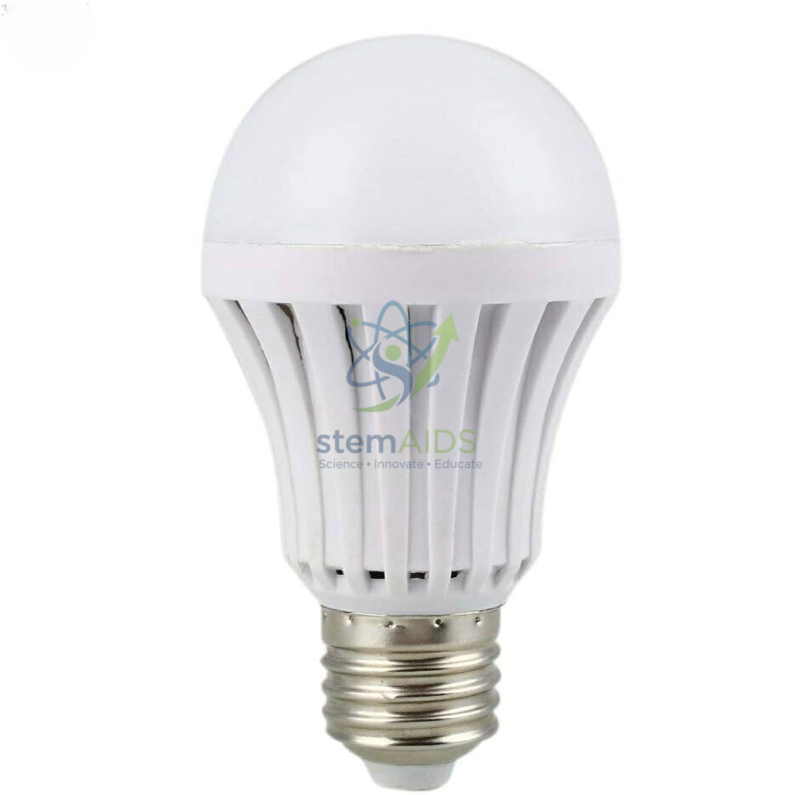
Quick Answer: This LED bulb with E27 base is a household-style lamp with a frosted dome and the standard E27 screw cap, using light-emitting diodes as its light source. In the laboratory an E27 LED bulb serves as a lamp for E27 holders and desk lamps, and as a subject in lessons on how LEDs make white light.
How the Bulb Makes White Light
Behind the frosted dome visible in the product photograph sit a number of LED chips on a small circuit board. In most white LED lamps the chips emit blue light, and a yellow phosphor coating converts part of it to longer wavelengths; the mixture looks white to the eye. Viewing the lamp through a diffraction grating or a hand spectroscope shows this clearly: a bright blue band and a broad glow covering green, yellow and red, quite unlike the continuous spectrum of a filament or the separate lines of a discharge lamp.
The base holds a driver circuit that converts the supply into the steady current the LEDs need. That electronics is why the base, not the dome, is where an LED lamp gets warm, and why LED lamps prefer fittings with some ventilation. It also explains why some LED lamps flicker on a dimmer designed for filament lamps.
Supply Voltage and Safe Use
An E27 lamp of this kind is normally made for mains voltage, and its rating should be checked before it is fitted. In a school laboratory that means it belongs in a properly made lamp holder or a lamp for E27 bulbs, not in an improvised socket on a bench circuit board. Teachers who want students to measure the power drawn can use a plug-in energy meter between the wall socket and the lamp, so nobody handles mains wiring.
Uses in the Laboratory
- Lamp for E27 desk lamps and holders used for illumination on the bench
- Spectrum observation with a diffraction grating, comparing LED, filament and discharge sources
- Measuring lamp power with a plug-in energy meter to compare lamp types
- Light source for plant growth and photosynthesis set-ups where low heat matters
Specifications
| Product | LED bulb with E27 screw base |
| Base | E27 Edison screw |
| Shape in the photograph | Frosted dome, household lamp shape |
| Light source | LED chips with internal driver circuit |
| Fits | E27 lamp holders and desk lamps |
| Voltage and power rating | Confirm at enquiry |
Care & Handling
- Switch off and let the E27 LED bulb cool before unscrewing it
- Fit it only in holders and lamps rated for its voltage, and never in an open bench circuit
- Keep it dry and away from sinks and wet benches unless the fitting is designed for that
- Grip the dome and base evenly when screwing it in, without twisting one against the other
Why Choose LabEquip
Schools fitting out desk lamps and lamp holders, and teachers comparing lamp technologies, are the usual buyers of this bulb. LabEquip can supply it with the matching desk lamp and E27 sockets; send your requirement through the contact page or see more physics lab equipment.
Frequently Asked Questions
Why does an LED lamp look white if the chips are blue?
Most white LED lamps use blue-emitting chips coated with a phosphor that turns part of the blue into yellow and red light. The eye sees the mixture as white. A spectroscope shows both parts: a narrow blue band and a broad band across the longer wavelengths.
Can this bulb be used on a low-voltage bench supply?
A household-style lamp with this base is normally designed for mains voltage and will not light properly on a low-voltage bench supply. For low-voltage circuits, use lamps made for that voltage.
Is it suitable for a dimmer?
Only if the lamp is described as dimmable, and even then the dimmer must suit LED loads. A non-dimmable LED lamp on a dimmer may flicker or buzz.
How do LED and filament lamps compare in an energy lesson?
For similar light output an LED lamp uses a much smaller electrical power, because a filament lamp converts most of its input into heat. A plug-in energy meter shows the difference directly, without anyone touching mains wiring.
Why does the base get warm but not the dome?
The LED chips and the driver electronics produce heat at the base, where it is conducted away. Very little infrared leaves the front, unlike a filament lamp, so the dome stays comparatively cool.
Can the bulb be used for plant growth experiments?
Yes, as a light source with little radiant heat, which helps when comparing light levels without warming the plants. Its spectrum differs from sunlight, which is itself a useful point to discuss in the results.
Last Updated: October 2026



Reviews
There are no reviews yet.