
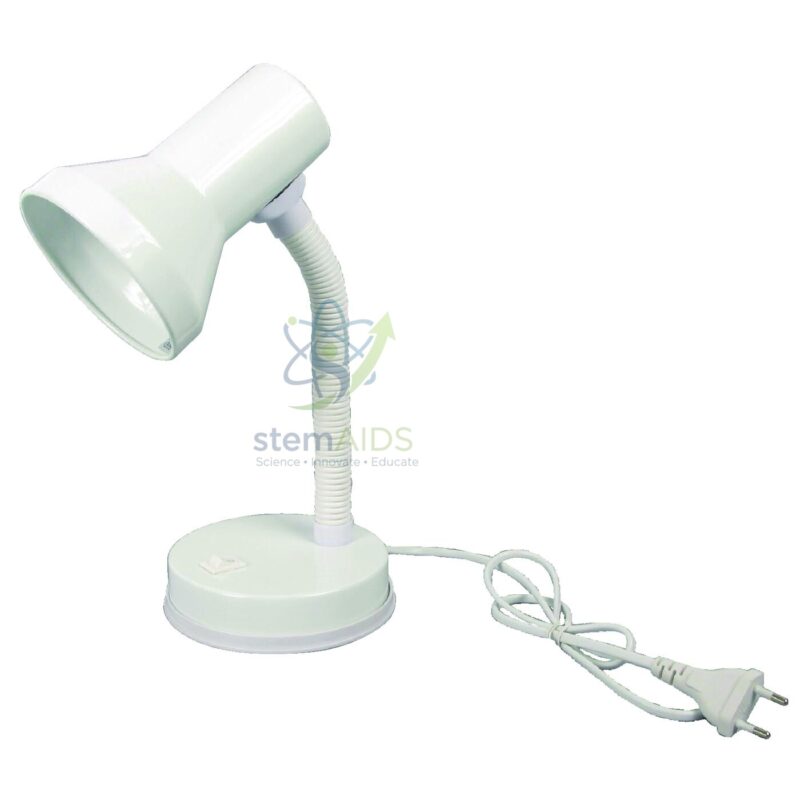
Quick Answer: The lamp for E27 bulb is a desk-style lamp on a round base with a shade, an adjustable neck and a mains cable, made to hold a standard E27 screw bulb. On the lab bench it provides a movable light source for optics practicals, plant experiments and close work.
A Light Source You Can Aim
Much of school optics needs a light that can be pointed and moved: casting shadows, lighting an object for a lens to image, or shining on a solar cell or light-dependent resistor at a set distance. The lamp shown in the product photograph has a white shade on an adjustable neck above a round base, so the beam can be turned towards the apparatus and lowered to bench height.
Because the bulb is a standard E27 type, the light source can be changed to suit the experiment. An LED bulb gives bright light with little heat, which suits plant and photosynthesis work. A filament bulb, where one is still available, gives a continuous spectrum for comparison, provided its power is within the lamp’s rating.
Distance, Brightness and the Inverse-Square Idea
A movable lamp is the simplest way to show how illumination falls with distance. With a light meter, a light sensor or a solar cell on a metre rule, students record readings as the lamp is moved back in steps. The readings fall off quickly; for a small source far enough away they follow roughly one over distance squared, and plotting the reading against one over distance squared gives a near-straight line. The shade of a desk lamp makes the source less point-like at short range, which is itself a useful discussion of why measured results depart from the ideal law.
Specifications
| Product | Desk-style lamp for E27 screw bulbs |
| Lamp holder | E27 Edison screw |
| Form in the photograph | White shade on an adjustable neck, round base, mains cable and plug |
| Bulb | Fitted separately; use a bulb within the lamp rating |
| Supply | Mains, through its own plug |
| Maximum bulb wattage and switch type | Confirm at enquiry |
Applications
- Movable light source for shadows, lens imaging and colour work at bench height
- Light intensity versus distance practicals with a light meter, sensor or solar cell
- Lighting for plant growth and photosynthesis experiments, fitted with an LED bulb
- Task lighting for dissection, reading scales and other close work
Care & Handling
- Fit only E27 bulbs within the lamp’s rated maximum, and never an infrared heating bulb unless the fitting is rated for it
- Unplug the lamp before changing the bulb, and let a hot bulb cool first
- Route the cable so it cannot be pulled by passing students or dragged through water
- Inspect the plug, cable and holder regularly as part of the school’s electrical checks
Why Choose LabEquip
Teachers who need a light source that can be aimed and moved without clamps, and technicians replacing tired bench lamps, buy this lamp. LabEquip can supply it with an LED bulb with E27 base; see also the table lamp in our physics lab equipment range, or ask through the contact page.
Frequently Asked Questions
Which bulbs can be fitted to the lamp?
Any E27 screw bulb whose power is within the lamp’s rated maximum and whose voltage matches the mains supply. LED bulbs are the usual choice because they run cool and draw little power.
Can an infrared heating bulb be used in this lamp?
Not unless the lamp is rated for it. Heat lamps produce a lot of heat at the holder and usually need a ceramic holder and a fitting designed for their power. Use a dedicated heat-lamp fitting for infrared work.
How is the lamp used for an inverse-square experiment?
Place a light sensor or solar cell at a fixed point, aim the lamp at it along a metre rule, and record readings as the lamp is moved back. Plot the reading against one over distance squared; the line is closest to straight at larger distances, where the lamp behaves most like a point source.
Is it suitable for plant experiments?
Yes. Fitted with an LED bulb it gives useful light with little heat, so the plants are not warmed as the lamp distance changes. Keep the distance the same for every group, or vary it deliberately as the independent variable.
Why use an aimed lamp rather than room lighting for optics work?
Room lighting comes from many directions, which blurs shadows and lowers contrast in images. A single aimed lamp gives one clear source, so shadows are sharp and images formed by lenses stand out, especially with the room lights dimmed.
What safety checks apply?
Treat it like any mains appliance: check the plug and cable before use, keep it away from water and flammable materials, and unplug it before changing the bulb. Follow the school’s routine for inspecting portable electrical equipment.
Last Updated: October 2026









Reviews
There are no reviews yet.