



Sale
In Stock
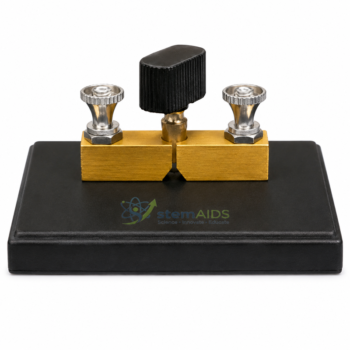
Pencil Jockey Physics Model
Original price was: ₹90.00.₹35.00Current price is: ₹35.00.
The Pencil Jockey Physics Model is a physics laboratory contact accessory used for making temporary electrical contact at selected points on a resistance wire during bridge and potentiometer experiments. It is intended for students, physics teachers and laboratory users conducting practical work involving resistance comparison, balance-point determination and electrical measurements.
Product Description
A pencil jockey is commonly used with apparatus such as a metre bridge, Wheatstone bridge or potentiometer. During an experiment, its contact point is touched gently against a resistance wire so the user can test a specific position without permanently connecting the circuit at that location.
The exact contact-tip material, handle material, terminal arrangement, dimensions and compatibility of this STEMAids item are [confirm]. These specifications should not be inferred from similar products made by other manufacturers. Explore related Physics Laboratory Products for complementary practical apparatus.
Key Features
- Point-contact operation: designed for making temporary electrical contact with a resistance or bridge wire.
- Physics practical support: suitable for metre bridge, Wheatstone bridge and potentiometer work where specified by the experiment.
- Balance-point investigation: enables students to test different positions along a wire while searching for a null or balance condition.
- Resistance experiments: supports practical study of resistance comparison and unknown-resistance determination when used with the appropriate apparatus.
- Manual laboratory control: allows the student to select the contact position directly during an experiment.
- Reusable accessory: intended for repeated supervised laboratory practicals, subject to the confirmed construction.
- Physical specifications: contact material, connector type, handle construction and dimensions are [confirm].
Technical Specifications
|
Specification |
Detail |
|
Product Name |
Pencil Jockey Physics Model |
|
Brand |
STEMAids |
|
Product Type |
Physics laboratory contact accessory |
|
Primary Application |
Temporary electrical contact on resistance or bridge wire |
|
Typical Experiment Compatibility |
Metre bridge, Wheatstone bridge and potentiometer experiments, subject to apparatus compatibility |
|
Capacity |
Not applicable |
What’s Included in the Kit
- Pencil jockey contact accessory
- Contact point or probe
- Insulated or gripping handle
- Electrical terminal or connection provision
- Lead or connecting cable
- Instruction sheet
Applications / Uses
- Metre bridge resistance experiments.
- Wheatstone bridge practical work.
- Potentiometer balance-point experiments.
- Resistance comparison and unknown-resistance determination.
- Electrical circuit demonstrations in school and college physics laboratories.
- Practical training in accurate point-contact techniques.
- Complementing STEMAids Measuring Instruments.
How to Use the Pencil Jockey Physics Model
- Set up the metre bridge, Wheatstone bridge or potentiometer experiment according to the approved laboratory procedure.
- Connect the jockey to the appropriate detector or circuit terminal where required by the apparatus.
- Hold the jockey by its intended gripping section.
- Touch the contact point gently to the resistance wire at the required position.
- Observe the galvanometer, detector or other measuring instrument used in the experiment.
- Move the contact point progressively along the wire to identify the required balance or measurement position.
- Remove the jockey from the wire after each reading rather than pressing or dragging it unnecessarily.
Safety note: Use only with the low-voltage laboratory circuits specified for the experiment. Do not use the jockey on mains-voltage conductors. Apply light contact pressure to avoid damaging, scratching or deforming the resistance wire.
Care & Maintenance
- Keep the contact point clean so electrical contact remains consistent.
- Avoid excessive pressure that could damage either the probe or bridge wire.
- Keep the accessory dry and free from corrosive laboratory chemicals.
- Inspect the contact point, handle and electrical connection before practical sessions.
Why Choose STEMAids
STEMAids is the STEM education brand of Eduscope Smart Learning Solutions Private Limited, a New Delhi-based manufacturer of STEM kits and educational laboratory equipment. Its Physics catalogue covers mechanics, electricity and magnetism, optics, heat, sound, measuring instruments and related practical apparatus. The company publishes ISO 9001:2015 certification, Udyam manufacturing registration and an active Importer-Exporter Code. Browse related Electrical and Electronics resources for additional circuit-learning equipment.
Frequently Asked Questions
What is a pencil jockey in physics?
A pencil jockey is a hand-held contact accessory used to touch selected points on a resistance wire during electrical experiments. It is commonly associated with metre bridge, Wheatstone bridge and potentiometer practicals.
What is the pencil jockey used for in a metre bridge?
It is used to make temporary contact at different positions along the metre bridge wire while locating the balance point. The user should touch the wire lightly rather than scrape or press it heavily.
Is a pencil jockey a measuring instrument?
It does not normally provide a measurement by itself. It acts as a contact probe within a larger experimental circuit that includes measuring or null-detection apparatus.
Can a pencil jockey be used with a potentiometer?
Yes, a jockey is commonly used to establish temporary contact along a potentiometer wire when locating a balance point, provided the accessory is compatible with the apparatus.
What is the contact tip made of?
The contact-tip material of this exact STEMAids product has not been verified. It should be listed only after checking the approved product specification.
Does the Pencil Jockey Physics Model have certification?
No product-specific certification has been verified. Manufacturer-level certifications should not automatically be represented as certification of this laboratory accessory.
Bestsellers

Sale

Sale
Sale

Sale

Sale

Sale

