
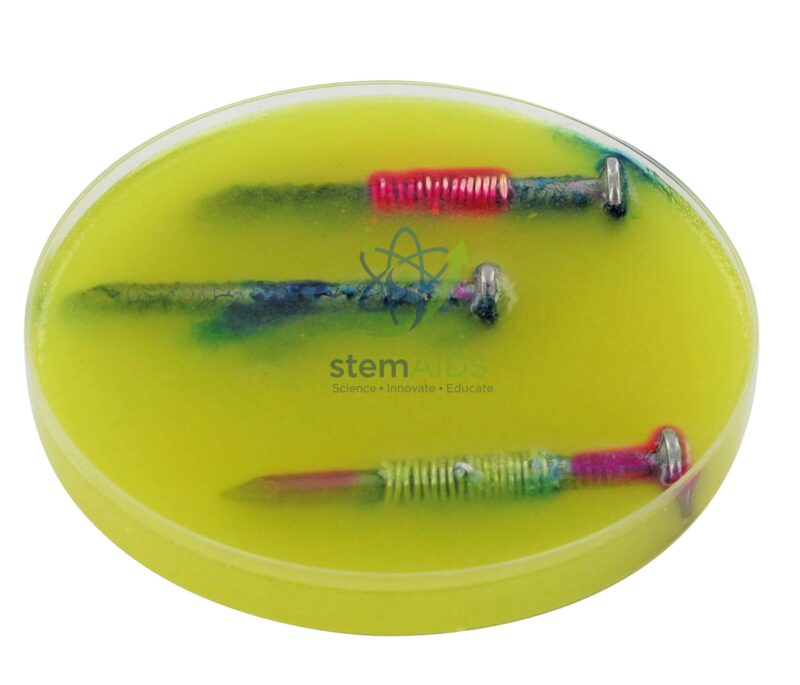
Quick Answer: The iron protection and corrosion kit lets students watch iron corrode in a dish of indicator gel, with nails or iron pieces wrapped in other metals, as pictured. The iron corrosion kit shows which parts of the iron corrode, how a more reactive metal such as zinc protects iron, and how a less reactive metal such as copper speeds up rusting.
Corrosion as an Electrochemical Cell
Rusting is not just iron reacting with air. Where iron is in contact with water and dissolved oxygen, some areas of the metal give up electrons and dissolve as iron(II) ions, while other areas pass those electrons to oxygen and water, forming hydroxide ions. The metal is acting as a tiny cell, with anode and cathode regions on the same piece of iron.
The indicator gel in the photograph makes both halves visible. In the classic ferroxyl test, a hexacyanoferrate(III) salt turns blue where iron(II) ions appear, marking the corroding areas, and phenolphthalein turns pink where hydroxide ions form. After some hours the heads and tips of nails, where the metal was stressed during manufacture, usually show the most blue.
Protection and Accelerated Corrosion
Wrapping a nail with a strip of a more reactive metal such as zinc or magnesium makes that metal the anode. It corrodes instead, and the iron around it shows pink rather than blue: this is sacrificial protection, the principle behind galvanising and the zinc blocks fixed to ship hulls. Wrapping a nail with copper has the opposite effect, because now the iron is the more reactive metal and corrodes faster, with strong blue around it.
Specifications
| Product | Iron protection and corrosion kit |
| Shown in photograph | Petri dish of yellow indicator gel with nails wrapped in different metal wires |
| Principle | Electrochemical corrosion shown by colour changes in an indicator gel |
| Comparisons | Bare iron, iron with a more reactive metal, iron with a less reactive metal |
| Reagents and metals included | Confirm at enquiry |
Lessons and Investigations
- Showing the anode and cathode regions on a single corroding nail
- Demonstrating sacrificial protection with zinc or magnesium in contact with iron
- Showing faster corrosion when iron touches copper
- Linking classroom results to galvanising, tin plating and ship-hull protection
Care & Handling
- Read the safety data sheet for each reagent and wear eye protection when preparing the gel
- Label dishes clearly and keep them covered while the colours develop
- Dispose of used gel and reagents as the safety data sheets direct, not down the sink in bulk
- Clean or replace nails between runs, as corrosion products affect the next result
Why Choose LabEquip
Chemistry and physics teachers use this kit because it shows an invisible electrochemical process as clear colour patterns in a single lesson. LabEquip supplies it with plate electrodes for related cell experiments and other physics lab equipment; contact LabEquip to confirm what the kit contains.
Frequently Asked Questions
What do the blue and pink colours mean?
Blue shows where iron(II) ions are forming, so the iron is corroding there. Pink shows where hydroxide ions are forming, which is where oxygen and water gain electrons.
Why does zinc stop the iron corroding?
Zinc is more reactive than iron, so it gives up electrons first and corrodes instead. The iron receives electrons and is protected, which is called sacrificial protection.
Why does copper make iron corrode faster?
Copper is less reactive than iron. When they touch in a damp environment, iron becomes the anode of the cell and loses electrons faster.
Why do the ends of a nail corrode first?
The head and tip were bent and compressed when the nail was made. Stressed metal is more easily oxidised, so those areas usually become anodes.
How long does the experiment take?
Colours begin to appear within an hour or so and become clear over several hours or overnight, so the dishes are often set up in one lesson and examined in the next.
Is oxygen needed for iron to rust?
Yes. Both water and oxygen are needed. In boiled water covered with oil, which keeps oxygen out, iron nails rust very little.
Last Updated: October 2026





Reviews
There are no reviews yet.