
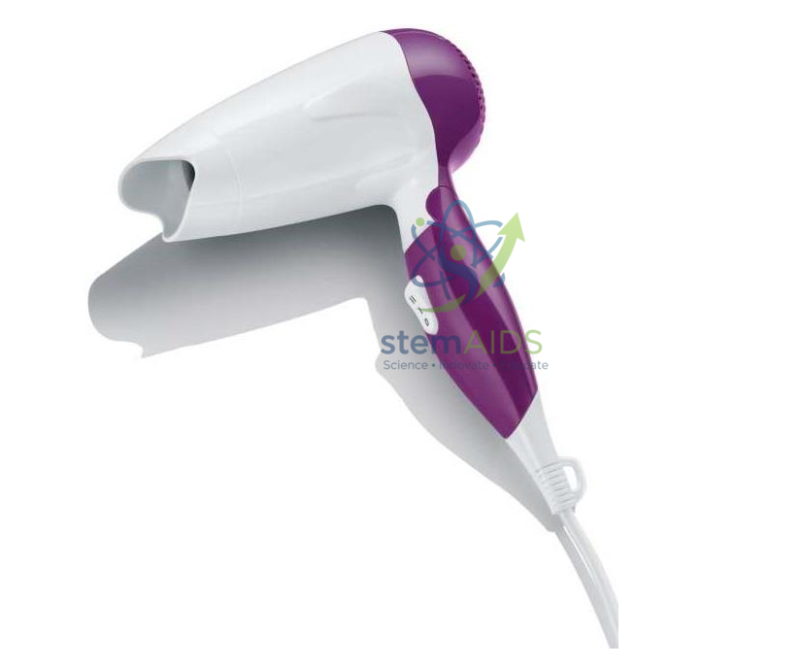
Quick Answer: This hot air blower is a handheld, mains-powered unit of the hair-dryer type with a folding handle, as pictured, in which a fan drives air over an electrically heated element. In the lab, a hot air blower provides a gentle stream of warm air for drying chromatograms and wet apparatus and for demonstrations of convection, expansion and evaporation.
How the Blower Heats Air
Inside the body, a small motor turns a fan that draws air in at the back and pushes it out through the nozzle. On its way the air passes over a coil of resistance wire, which heats up as current flows through it. The faster the air moves and the cooler it enters, the less its temperature rises, which is why a blower at full speed feels cooler than at low speed with the same heat setting.
For physics teaching the unit is a compact example of two energy transfers in one device: electrical energy becomes kinetic energy of the moving air through the fan, and thermal energy through the heating element. Students can compare the two by running the blower with the heat on and off and discussing which part draws most of the power.
How It Differs From a Heat Gun
Industrial heat guns produce much hotter air for stripping paint or shrinking tubing. A hair-dryer type blower runs far cooler, which makes it suitable for warming rather than heating strongly: drying a paper or TLC chromatogram without scorching it, warming the air in a flask so that a balloon over its neck inflates, or making a tissue-paper hot-air balloon rise. Where a cold air stream is needed, for example to float a ball in a jet of air, the cool setting does that job.
Specifications
| Product | Hot air blower, hair-dryer type |
| Shown in photograph | Handheld unit with folding handle and front nozzle |
| Working parts | Motor-driven fan and electrically heated element |
| Air delivered | Warm air, and cool air where a cool setting is fitted |
| Power rating, settings and plug type | Confirm at enquiry |
Demonstrations and Lab Uses
- Drying paper and TLC chromatograms gently after the solvent has evaporated in a fume cupboard
- Showing thermal expansion of air with a balloon stretched over a flask
- Launching a tissue-paper hot-air balloon to demonstrate convection and density
- Speeding up evaporation in experiments on drying and cooling
- Floating a light ball in an air jet to discuss air flow and pressure
Care & Handling
- Never use the blower near flammable solvent vapours; the heating element and motor can ignite them
- Keep the air inlet and nozzle unobstructed so the unit does not overheat
- Unplug the blower, let it cool and wind the cable loosely before storing
- Do not use it with wet hands or near sinks and water baths
Why Choose LabEquip
Physics and chemistry teachers keep a hot air blower on the prep-room shelf because it covers drying jobs and several quick convection demonstrations. LabEquip supplies it with the separate air blower and other physics lab equipment; contact LabEquip to confirm the plug type for your sockets.
Frequently Asked Questions
Can the blower be used to dry TLC plates straight after development?
Only after the solvent has evaporated in a fume cupboard. Blowing hot air across a plate still wet with a flammable solvent risks ignition from the element or motor.
How is a hot air blower different from a heat gun?
A heat gun produces much hotter air for paint stripping or heat shrinking. A hair-dryer type blower gives warm air, which suits drying and gentle demonstrations.
Why does the air feel cooler at high fan speed?
With the same heater output, more air passing per second means each portion of air gains less heat, so its temperature rise is smaller.
Can it be used to dry glassware?
It can speed up drying of rinsed glassware, but do not heat volumetric glassware, and never dry glassware rinsed with flammable solvent this way.
What demonstrations use the cool setting?
A cool air jet can hold a light ball suspended in mid-air, showing how the moving air stream keeps the ball centred.
Is it safe for students to use?
Under supervision, yes, as with any mains appliance. Check the cable and plug before use, keep it away from water, and switch off and unplug after use.
Last Updated: October 2026




Reviews
There are no reviews yet.