
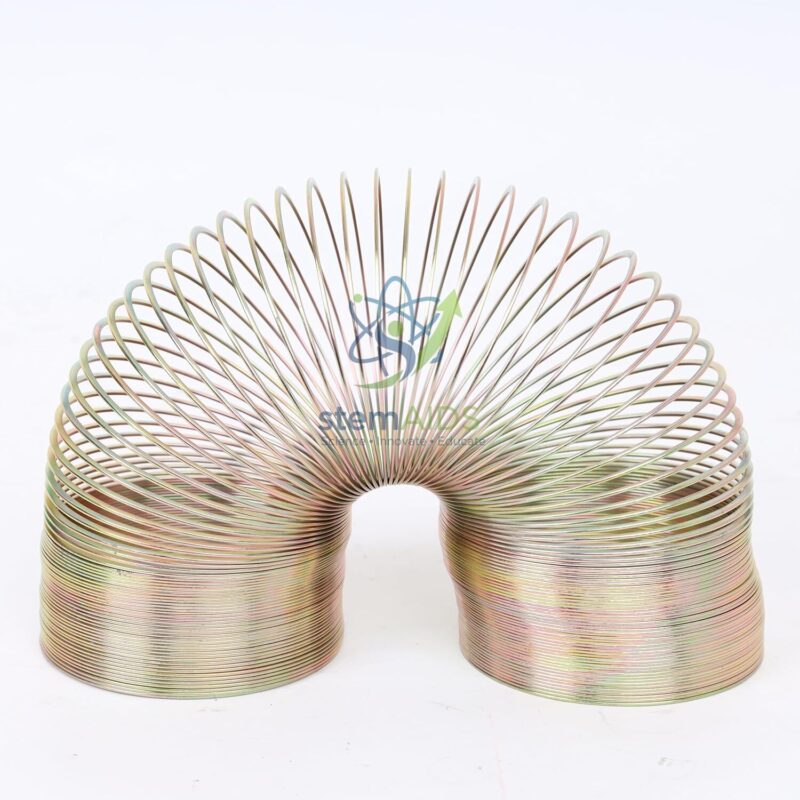
Quick Answer: The Helical Spring for Longitudinal Waves is a long, loosely coiled spring that is stretched along a bench or floor so that pulses and continuous waves can be sent along it. Pushing one end makes compressions and rarefactions travel along the coils, giving a full-size model of how sound travels through a medium.
Sending Longitudinal and Transverse Pulses
Two students hold the ends and stretch the spring along a smooth floor or a long bench. A quick push and pull along the length of the spring sends a compression travelling to the far end: a region where the coils crowd together, followed by a rarefaction where they spread apart. A small piece of tape on one coil shows that each coil only moves back and forth a little as the pulse passes; it does not travel along with it.
Flicking one end sideways instead sends a transverse pulse, so the same spring shows both kinds of wave and makes the contrast obvious.
Reflection and Standing Waves
When a transverse pulse reaches an end held firmly, it comes back upside down; when it reaches a free end, such as a long, light thread tied to the last coil, it returns the same way up. Moving one end steadily at the right rate builds up standing waves, with coils at some points, the nodes, staying almost still while others oscillate strongly. Longitudinal standing waves on the spring model the air in a sounding pipe.
Measuring Wave Speed
With the spring stretched to a measured length, a pulse is timed over several trips to the end and back using a digital stop watch; timing several trips reduces the effect of reaction time. Stretching the spring further raises the tension and changes the speed, and for continuous waves the wavelength and frequency can be combined using v = fλ. The material, length and coil size of this spring can be confirmed at enquiry.
Demonstrations
- Showing compressions and rarefactions as a model of sound
- Comparing longitudinal and transverse pulses on the same medium
- Demonstrating reflection at fixed and free ends and building standing waves
- Timing pulses to estimate wave speed and its dependence on tension
Specifications
| Type | Long helical spring for wave demonstrations |
| Waves shown | Longitudinal and transverse pulses, reflections and standing waves |
| Set-up | Stretched along a floor or long bench between two people or a fixed point |
| Useful extras | Tape markers, a stopwatch and a measuring tape |
| Material, length and coil diameter | Confirm at enquiry |
Care & Handling
- Do not stretch the helical spring for longitudinal waves so far that the coils stay permanently opened out.
- Never let go of a stretched end; walk the two ends together before releasing.
- Untangle knots slowly and store the spring coiled and tied so the turns do not interlock.
- Dry a metal spring after use in a damp room to prevent rust.
Why Choose LabEquip
Physics teachers buy long springs because a wave you can see moving along a real medium convinces students far more than a diagram. LabEquip lists this spring with its physics lab equipment; the longitudinal and transverse waves device shows the same particle motion in a compact model. Ask about quantities through the contact page.
Frequently Asked Questions
How do you make a longitudinal wave on the spring?
Stretch the spring and move one end quickly forwards and back along its length. A compression followed by a rarefaction travels along the coils to the other end.
Why tie a marker to one coil?
The marker shows that each coil only moves to and fro about its own position as the wave passes. The wave travels, but the coils do not travel with it.
What happens to a pulse at a fixed end?
A transverse pulse reflects inverted from a firmly held end, so a crest returns as a trough. At a free end it reflects the same way up.
How can the wave speed be measured?
Measure the stretched length, then time a pulse over several trips along the spring and back. Total distance divided by total time gives the speed; timing many trips reduces reaction-time error.
Why is this a good model of sound?
Sound in air is a longitudinal wave of compressions and rarefactions, just like the pulses on the spring. The spring makes the pattern large and slow enough to see.
Why should a stretched spring not be released suddenly?
It snaps back fast, can hit someone and often tangles into knots that are hard to undo. Always bring the ends together gently before letting go.
Last Updated: October 2026




Reviews
There are no reviews yet.