
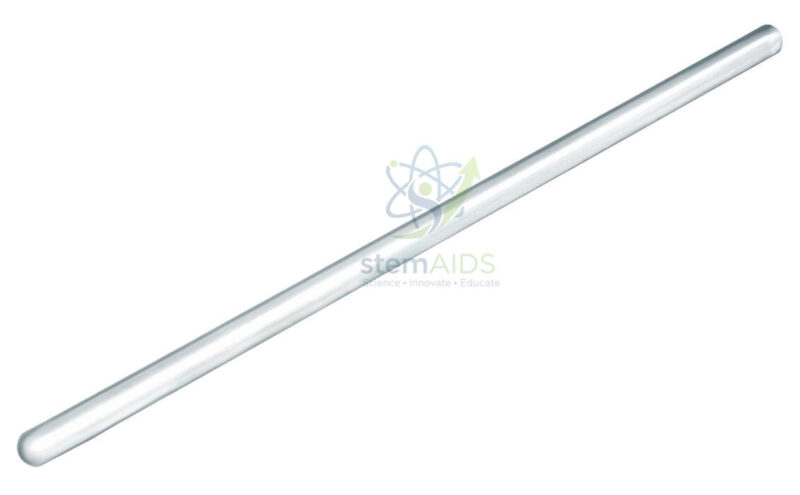
Quick Answer: The Glass Rod listed here is a clear glass rod used in electrostatics as a charging rod: rubbed with silk, it becomes positively charged. A glass rod for electrostatics gives teachers a reliable positive reference charge to set against the negative charge of a rubbed ebonite rod.
Why Glass Takes a Positive Charge
When glass and silk are rubbed together, electrons move from the glass to the silk, leaving the glass with a net positive charge and the silk with an equal negative charge. Eighteenth-century experimenters called this vitreous electricity, to distinguish it from the resinous electricity of rubbed amber and resin, and the sign convention introduced by Benjamin Franklin labels the charge on glass rubbed with silk as positive.
Glass is a good insulator in bulk, but its surface readily adsorbs a thin film of water from the air. That film conducts, so glass loses its charge quickly in humid weather. Clean, dry, slightly warm glass charges much better than glass straight from a cold cupboard.
Technique with the Rod
Hold the rod at one end, wrap a dry silk cloth around the other end and rub briskly along a short length. Test the charge at once on a pith-ball pendulum or an electroscope. To charge an electroscope positively, touch the rubbed end on the cap; to charge it negatively by induction, hold the rod near the cap, earth the cap briefly with a finger, remove the finger and then the rod.
Experiments
- Providing a positive reference charge for testing the sign of other charged objects
- Showing attraction between a glass rod and a rubbed ebonite rod on an electrostatic pivot
- Charging electroscopes by contact and by induction
- Comparing how well charge is held in dry and humid conditions
Specifications
| Material | Glass |
| Form | Plain clear rod, as pictured |
| Charge when rubbed with silk | Positive |
| Paired with | Silk cloth; tested with electroscopes and pith balls |
| Length and diameter | Confirm at enquiry |
Care & Handling
- Inspect the rod before each use and discard it if it is chipped or cracked.
- Wash off grease with warm soapy water, rinse with clean water and dry thoroughly before storage.
- Store the rod in a padded box or rack so it cannot roll off a bench.
- Warm the rod gently before a demonstration on a damp day, avoiding direct flame.
Why Choose LabEquip
A glass rod is a basic item in every electrostatics kit, bought in sets for class practicals so each group has a positive reference. LabEquip pairs it with a silk cloth piece and the ebonite rod for the negative charge; more items are in the Physics Equipments category.
Frequently Asked Questions
Why must silk be used with a glass rod?
Silk and glass are well separated in the triboelectric series, so rubbing them together transfers a clear, repeatable charge, with the glass becoming positive. Other cloths can work, but silk is the traditional pairing that gives a dependable positive reference.
Why does the rod lose its charge so fast on some days?
Glass attracts a thin film of moisture from humid air, and that film conducts charge away. Clean and dry the rod, warm it slightly and work away from open windows or steam to keep the charge longer.
Can this rod also be used for stirring in chemistry?
It is a plain glass rod, so it could physically stir a solution, but rods kept for electrostatics should stay clean and grease-free. Keep separate rods for chemistry so chemical residues do not spoil the charging surface.
How can I show the rod carries a positive charge?
Charge an electroscope negatively with an ebonite rod rubbed with wool, then bring the rubbed glass near the cap: the deflection falls, showing an opposite charge. On a pivot, the glass and a rubbed ebonite rod attract each other for the same reason.
Is a glass rod safe for students to use?
Yes, with normal care for glassware. Students should check for chips, hold the rod firmly and avoid knocking it against benches; any broken glass should be swept up, not picked up by hand.
What else is needed for glass rod experiments?
A dry silk cloth to charge the rod, and something to detect the charge, such as an electroscope, a pith-ball pendulum or an electrostatic pivot. An ebonite rod rubbed with wool provides the opposite charge for comparison.
Last Updated: October 2026




Reviews
There are no reviews yet.