
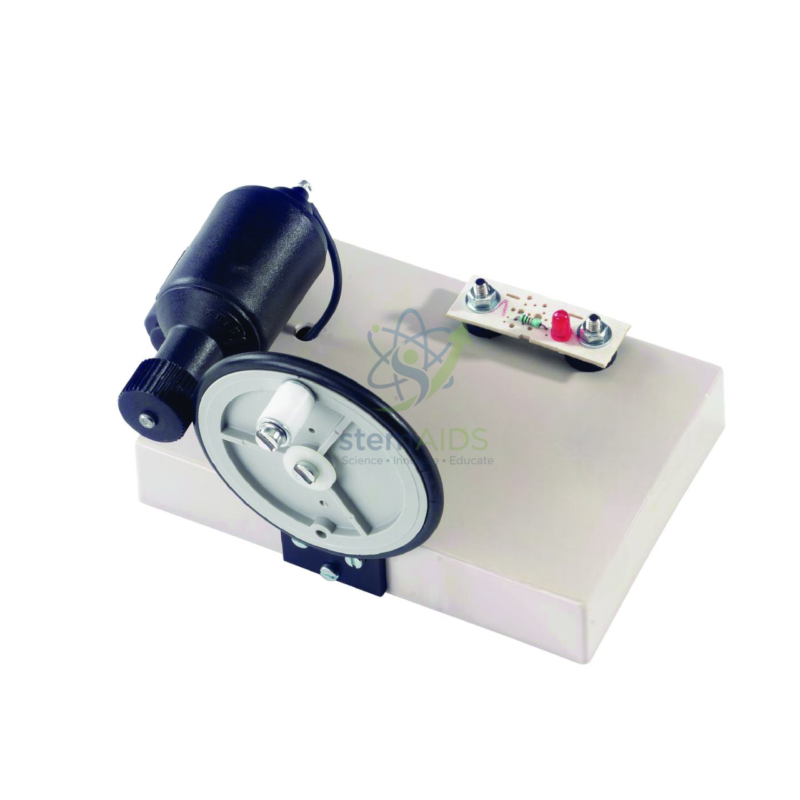
Quick Answer: The Generator on Stand is a small electrical generator mounted on a base with a large drive pulley, so that turning the pulley produces a voltage that can light a small load. Teachers use the generator on stand to show mechanical energy becoming electrical energy and to measure how the output depends on speed.
From Turning Pulley to Output Voltage
In the product photograph the generator on stand sits on a white base with a large pulley wheel at the front and a small load board beside it. The large pulley lets a slow turn by hand, or a belt from another drive, spin the generator shaft much faster, which matters because the voltage a generator produces depends on how fast its coil and magnets move relative to each other.
Faraday’s law sets the rule: the induced EMF equals the rate of change of magnetic flux linkage. Double the speed and the flux changes twice as fast, so the open-circuit voltage roughly doubles. Students can plot voltage against speed and get a straight line through the origin.
Feeling Lenz’s Law at the Pulley
With nothing connected, the pulley turns easily because no current flows. Connect a lamp and the effort needed increases at once; connect a lower-resistance load and it increases again. The current in the coil produces its own magnetic field, and by Lenz’s law that field opposes the motion causing it. The extra effort is the mechanical work being turned into electrical energy, so energy conservation is something students can feel, not just write down.
Classroom Uses
- Lighting a small lamp and showing that brightness rises with turning speed
- Plotting open-circuit output voltage against pulley speed
- Comparing the turning effort with no load, a lamp, and a lower resistance to demonstrate Lenz’s law
- Estimating the electrical power produced from voltage and current readings
Care & Handling
- Turn the pulley steadily rather than in jerks to protect the shaft and bearings
- Keep fingers and loose sleeves away from the pulley rim and any belt
- Do not leave the output short-circuited; use a lamp or resistor as the load
- Store the unit with the pulley free of strain and dust
Specifications
| Device | Electrical generator mounted on a stand |
| Drive | Large pulley wheel for hand or belt drive |
| Output | Terminals for a small load or measuring instruments |
| Mounting | Flat base for bench use |
| Output type and rating | Confirm at enquiry |
Why Choose LabEquip
Lower-secondary and secondary schools choose a stand-mounted generator for introducing electromagnetic induction because the whole energy story happens in front of the class. LabEquip lists it next to the motor-generator, which couples two machines, within its physics equipment; class quantities can be requested on the contact page.
Frequently Asked Questions
Does this generator produce AC or DC?
That depends on whether the machine has a commutator. Connect a centre-zero meter or an oscilloscope: a reading that stays on one side means DC output, while a reading that swings both ways each turn means AC.
Why does the pulley get harder to turn when a lamp is connected?
Current now flows in the coil and creates a magnetic field that opposes the motion, as Lenz’s law predicts. The extra effort is the work being converted into electrical energy in the lamp.
How can students measure the link between speed and voltage?
Count the pulley turns over a timed interval, or use a tachometer, while reading the open-circuit voltage. Repeating at several speeds and plotting voltage against speed gives a straight line through the origin.
What load should be connected to the output?
A small filament lamp, an LED module with its own resistor, or a resistor with an ammeter and voltmeter. A heavy load only makes the pulley very hard to turn without adding anything to the lesson.
How is this different from the two-machine motor-generator?
This unit is driven mechanically from outside, by hand or belt. The motor-generator couples two machines so that one, supplied electrically, drives the other, which lets the whole electrical-mechanical-electrical chain be measured.
Can the generator be run as a motor?
Many small permanent-magnet machines are reversible and will turn when supplied with a low DC voltage. Do this only within the supply rating given for the unit, and expect the pulley to turn slowly because of its size.
Last Updated: October 2026




Reviews
There are no reviews yet.