
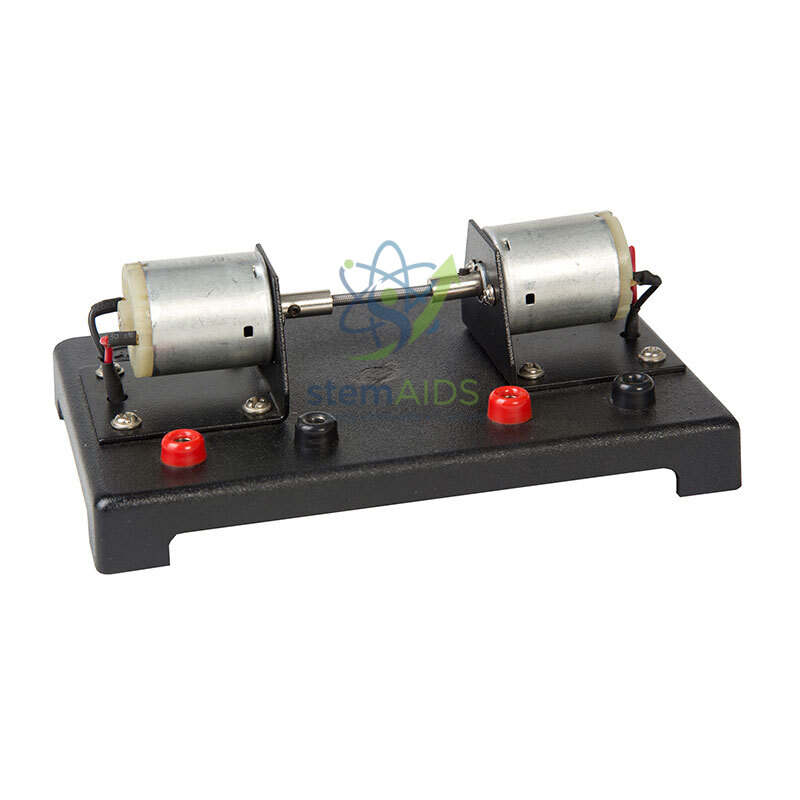
Quick Answer: The motor-generator on stand is a pair of small electrical machines mounted on one base with their shafts coupled, so that one runs as a motor from a supply and turns the other, which works as a generator. It lets students follow energy from electrical to mechanical and back to electrical form and measure the losses at each step.
Two Machines, Two Jobs
In the product photograph the motor-generator on stand carries two silver cylindrical machines on a black base, joined shaft to shaft, with terminal sockets for each. Small DC machines are reversible: supplied with current, one turns as a motor; turned mechanically, an identical machine generates an EMF proportional to its speed. Coupling the two puts both behaviours on the bench at once.
Raise the motor’s supply voltage and the pair speeds up, so the generator’s output voltage rises with it. Students can see the generator voltage track the motor voltage, always a little lower.
Measuring the Round Trip
Meters on the motor side give the electrical input, V₁ × I₁. A resistor with its own meters on the generator side gives the electrical output, V₂ × I₂. The ratio of output to input is the efficiency of the whole round trip, and it equals the motor efficiency multiplied by the generator efficiency.
Loading the generator also shows Lenz’s law in action: as soon as the generator delivers current, it resists being turned, the pair slows, and the motor draws more current to keep going.
Applications
- Measuring electrical input and output to find round-trip efficiency
- Showing that generator voltage rises in proportion to speed
- Demonstrating how loading the generator raises the motor current
- Estimating the efficiency of each machine from the round-trip figure
Care & Handling
- Keep the supply to the motor within the rating marked for the unit
- Do not short-circuit the generator terminals; use a resistor or lamp as the load
- Keep fingers and leads clear of the coupling while the machines turn
- Switch off before changing which machine is used as the motor
Specifications
| Device | Two coupled electrical machines on a stand |
| Roles | One machine as motor, one as generator; roles can be swapped |
| Connections | Terminal sockets for each machine |
| Base | Flat stand for bench use |
| Rated supply | Confirm at enquiry |
Why Choose LabEquip
A motor-generator pair is a favourite with teachers covering energy transfer and electromagnetic induction together, because one bench set-up answers both. LabEquip supplies it beside the single generator on stand as part of its physics equipment; the contact page handles quantity and supply questions.
Frequently Asked Questions
Why is the generator output always less than the motor input?
Each machine loses energy as heat in its windings and as friction in its bearings and brushes. The output is what remains after the motor’s losses and then the generator’s losses have both been taken.
What happens to the motor when a load is connected to the generator?
The generator current produces a force opposing the rotation, so the pair slows down. The motor’s back EMF falls with speed, its current rises, and it delivers the extra torque needed.
Can the two machines swap roles?
Yes. Small DC machines are reversible, so either one can be supplied as the motor while the other generates. Swapping roles is a good check that the two machines behave alike.
How can the efficiency of a single machine be estimated?
If the two machines are identical, assume they have equal efficiencies. The single-machine efficiency is then roughly the square root of the round-trip efficiency; for example, a round trip of 0.36 suggests about 0.6 for each.
What should be connected to the generator side?
A resistor or small lamp, with an ammeter in series and a voltmeter across it, so output power can be calculated. With nothing connected, a voltmeter alone shows the generator’s open-circuit EMF.
Why does the generator voltage change with the motor supply voltage?
A higher supply voltage makes the motor run faster, and the generator’s EMF is proportional to speed. Plotting one voltage against the other gives a nearly straight line.
Last Updated: October 2026




Reviews
There are no reviews yet.