








Sale
In Stock
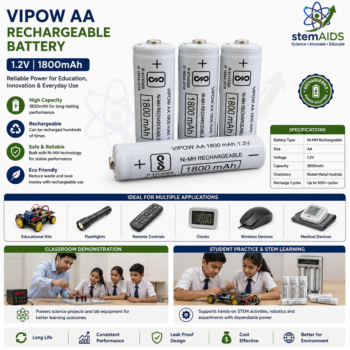
VIPOW AA Rechargeable Battery 1.2V 1800mAh
Original price was: $0.54.$0.16Current price is: $0.16.
Quick Answer: The VIPOW AA Rechargeable Battery 1.2V 1800mAh is a reusable AA-size cell with a 1.2 V nominal voltage and an 1800 mAh rated capacity. Schools use such cells in battery-powered kits, instruments and circuit experiments where disposable cells would be replaced constantly.
What 1.2 V and 1800 mAh Mean in Practice
A rechargeable AA cell at 1.2 V is typically of the nickel-metal hydride (NiMH) type. Its voltage is lower than the 1.5 V printed on alkaline AA cells, but it stays close to 1.2 V for most of its discharge, while an alkaline cell falls steadily. Most classroom devices designed for AA cells run normally on it; a few with sensitive low-battery warnings may signal empty sooner.
The 1800 mAh figure is the rated capacity: in principle, the cell could supply 180 mA for about ten hours or 1.8 A for about an hour, though real run time falls at high currents and low temperatures. For STEM kits, motors, buzzers and small instruments that are used every day, reusable cells cut down on the stream of discarded batteries a school lab otherwise produces.
The cells are also useful subjects of study. Measuring the voltage with no load and then with a known resistor connected lets students calculate internal resistance, and connecting cells in series and parallel shows how voltages and capacities combine.
Specifications
| Size | AA |
| Nominal voltage | 1.2 V |
| Rated capacity | 1800 mAh |
| Type | Rechargeable |
| Brand | VIPOW |
| Cell chemistry and pack quantity | Confirm at enquiry (1.2 V AA rechargeables are usually NiMH) |
Care & Handling
- Charge the AA rechargeable battery only in a charger designed for its chemistry; never put it in a charger meant for alkaline or lithium cells.
- Do not mix new and old cells, or rechargeable and alkaline cells, in one device.
- Store cells in a case so the terminals cannot short against coins, keys or loose wire.
- Remove cells from equipment that will stand unused for weeks, and send worn-out cells for battery recycling.
Applications
- Powering battery-operated STEM kits, robots and electronics projects
- Supplying cells for circuit experiments with bulbs, buzzers and small motors
- Measuring EMF and internal resistance of a cell
- Series and parallel cell combinations in electricity lessons
Why Choose LabEquip
Schools that run battery-powered kits every week usually switch to rechargeable cells to cut recurring purchases and waste. LabEquip lists these cells in its General Items for use across its STEM kits. Tell the team how many cells your kits take via the contact page.
Frequently Asked Questions
Why is the voltage 1.2 V instead of 1.5 V?
Rechargeable nickel-metal hydride cells, the usual type at this voltage, produce a nominal 1.2 V, while alkaline cells start at about 1.5 V. The rechargeable cell holds its voltage more steadily, so most devices work normally, though some low-battery indicators trigger earlier.
What does 1800mAh mean?
It is the rated charge the cell can deliver: roughly 1800 milliamps for one hour, or 180 milliamps for ten hours. The usable amount is lower at high currents or low temperatures.
Can I mix these with alkaline cells?
No. Different voltages and discharge behaviour mean one type can be driven into reverse charge by the others, which damages cells and can cause leakage. Use a full matched set of the same cells in each device.
How should the cells be charged?
Use a charger designed for NiMH AA cells, preferably one that stops automatically when the cells are full. Charge on a non-flammable surface, and let cells cool if they are warm after heavy use before charging.
Why are stored cells flat when we take them out?
Standard NiMH cells slowly self-discharge while stored, losing a noticeable part of their charge over weeks. Recharge cells before a practical rather than relying on charge from the previous term.
How can students measure the internal resistance of a cell?
Measure the terminal voltage with no load (close to the EMF), then connect a known resistor and measure the voltage and current again. Internal resistance equals the drop in voltage divided by the current.
Last Updated: September 2026
You must be logged in to post a review.
Bestsellers

Sale
Sale
Sale

Sale

Sale


Reviews
There are no reviews yet.