


Sale
In Stock
Resistance Heating Coil
Original price was: ₹60.00.₹20.00Current price is: ₹20.00.
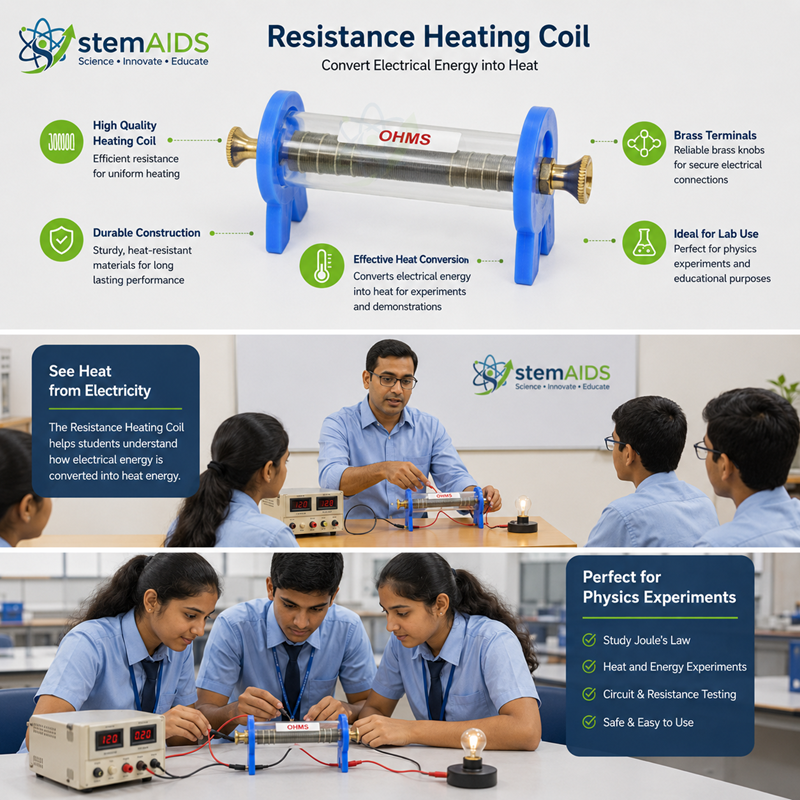
Quick answer: The Resistance Heating Coil is a wound resistance-wire coil used to demonstrate the heating effect of an electric current (Joule heating) in school and college physics experiments, such as calorimetry-based verification of Joule’s Law.
Description
The LabEquip Resistance Heating Coil is designed to be immersed in water (typically inside a calorimeter) and connected to a low-voltage electrical supply. As current flows through the coil’s resistance wire, electrical energy is converted into heat, which students can measure by recording the temperature rise of the surrounding water over time.
This makes it a standard component for experiments verifying Joule’s Law of heating (H = I²Rt) and for related calorimetry practicals that connect electrical energy input with measurable heat output.
Specifications
| Category | Physics Lab Equipment – Heat & Electricity Experiments |
| Type | Resistance-wire heating coil |
| Typical use | Joule’s Law verification, calorimetry experiments studying electrical-to-heat energy conversion |
| Resistance value | Not specified for this listing – confirm with our sales team |
| Used with | Calorimeter, low-voltage power supply, ammeter, voltmeter, thermometer |
Safety Note
The coil can become hot during use – allow it to cool before handling and avoid touching it immediately after a current has been passed through it. Use only with a low-voltage supply appropriate for classroom experiments, and switch off the current before changing connections.
Why Choose LabEquip
LabEquip supplies physics lab equipment to schools and colleges, with a straightforward buying process and a sales team that can confirm exact resistance values and specifications before you order. Explore more of our range below:
- LabEquip home page – browse our full lab equipment range
- High-Resistance Coil Unit – a related fixed-resistance circuit component
- Electric Generator Demonstration Model – another electricity-focused teaching model
Frequently Asked Questions
What experiment is the Resistance Heating Coil used for?
It is most commonly used to verify Joule’s Law of heating, where students measure the temperature rise produced in water as current passes through the coil’s resistance.
Does it need to be submerged in water to work?
For calorimetry experiments, yes – the coil is typically placed inside a calorimeter containing water so the heat generated can be measured via temperature rise.
What is the coil’s resistance value?
The exact resistance value is not specified for this listing. Please contact our sales team to confirm the specification before you order.
What other apparatus do I need for a Joule heating experiment?
You will typically also need a calorimeter, a low-voltage power supply, an ammeter, a voltmeter, a thermometer, and a stopwatch to time the heating interval.
Is the coil safe to touch after use?
Allow it to cool fully before handling, as it can become hot while current is flowing through it during the experiment.
What class level is this experiment suited for?
Joule heating and calorimetry experiments using a resistance coil are standard practicals in secondary and higher-secondary school physics.
Last Updated: September 2026
You must be logged in to post a review.
Bestsellers


Sale

Sale

Sale
Sale
Sale


Reviews
There are no reviews yet.