


Sale
In Stock
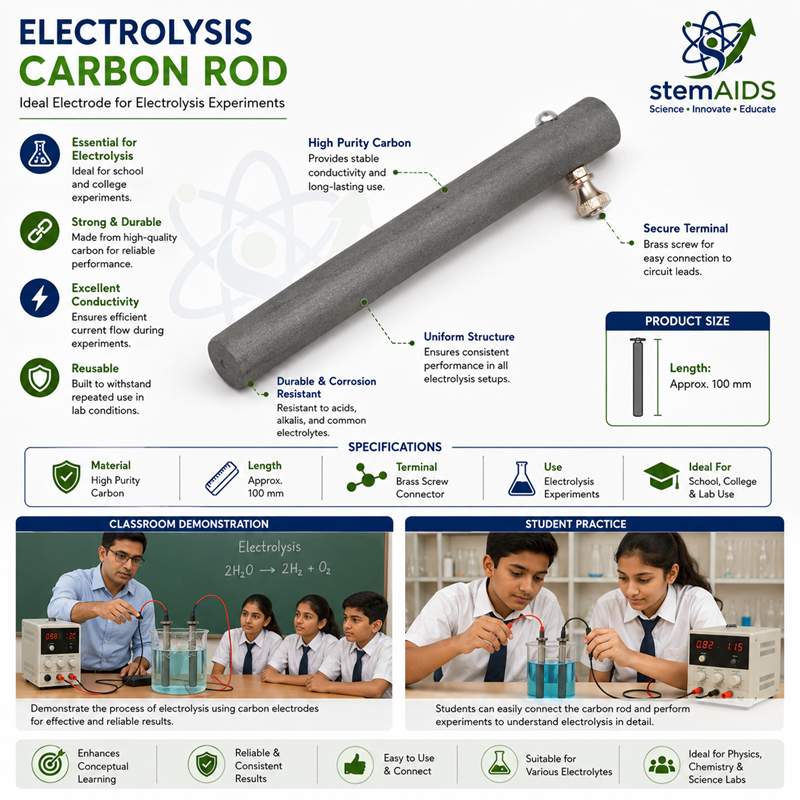
Electrolysis Carbon Rod
Original price was: ₹80.00.₹30.00Current price is: ₹30.00.
Quick answer: the Electrolysis Carbon Rod is a conductive carbon electrode used in school and college chemistry labs for electrolysis experiments — passing an electric current through an electrolyte to study conductivity and electrode reactions.
Description
Carbon electrodes are widely used in instructional electrolysis because they conduct current while avoiding the readily dissolving metal electrode seen in many other setups. The rod can serve as either the anode or cathode in a compatible electrochemical cell, depending on how the circuit is arranged. Carbon should not be assumed to be chemically inert under every condition — some wear, oxidation or reaction can occur depending on the electrolyte and current used.
This rod supports practical lessons on electrolysis, electrical conductivity, electrode reactions and the decomposition of ionic compounds in aqueous or molten systems, across school, college and training-laboratory chemistry courses.
Specifications
| Material | Carbon |
| Function | Electrode (anode or cathode) for electrolysis |
| Typical use | Electrolysis, conductivity and electrode-reaction experiments |
| Dimensions | Not specified for this listing — confirm with our sales team |
Care & Maintenance / Safety Note
- Use appropriate eye protection and follow your institution’s standard procedures whenever handling electrolytes and running a live electrolysis circuit.
- Rinse the rod thoroughly with water after use to remove residual electrolyte before storing it.
- Inspect the rod for cracking or excessive wear before each use, and replace it if it appears damaged.
- Store the rod dry, away from strong acids or bases unless a specific experiment requires their use.
Why Choose LabEquip
LabEquip supplies electrodes and general lab materials alongside a wider catalogue of chemistry and physics equipment for schools and colleges. If you are setting up electrochemistry experiments, browse our full range of lab equipment for related apparatus and accessories.
FAQ
Q: What is a carbon rod used for in electrolysis?
A: It acts as an electrode — either the anode or cathode — allowing electric current to pass into or out of an electrolyte so students can observe and study the resulting chemical reactions.
Q: Is carbon completely unreactive during electrolysis?
A: Not always — carbon can wear, oxidise or react to some extent depending on the electrolyte and current used, so it should not be assumed to be inert under every condition.
Q: What size or dimensions does this rod come in?
A: The exact dimensions are not specified for this listing. Please contact our sales team to confirm before you order.
Q: Can this rod be used as both anode and cathode?
A: Yes, the same carbon rod can function as either electrode depending on how it is connected in the circuit.
Q: How should the rod be cleaned after an experiment?
A: Rinse it thoroughly with water to remove any residual electrolyte, then dry it before storing to prevent buildup or corrosion of nearby equipment.
Q: What precautions should students follow when using it?
A: Wear appropriate eye protection, follow your institution’s standard chemical-safety procedures, and only run the electrolysis circuit under teacher supervision.
Last Updated: September 2026
You must be logged in to post a review.
Bestsellers

Sale
Sale

Sale

Sale

Sale


Reviews
There are no reviews yet.