
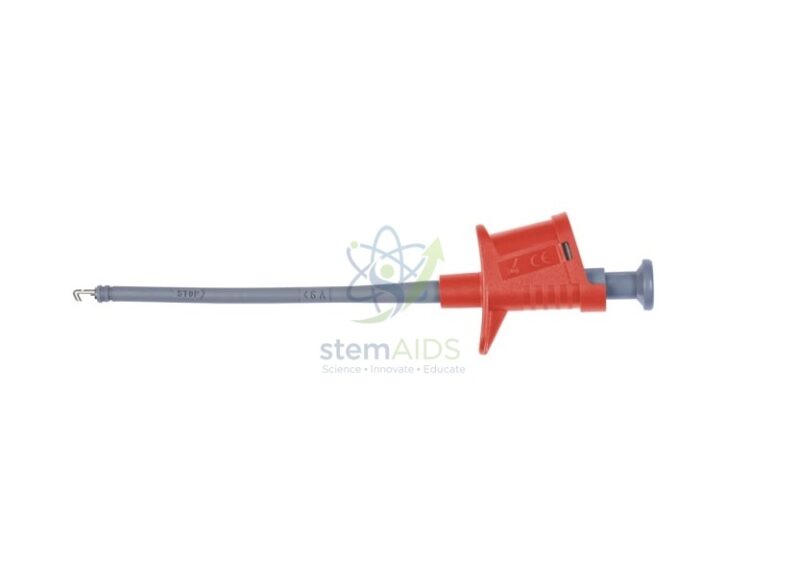
Quick Answer: Test hook clips, also called grabber clips, are spring-loaded probes whose fine hook extends from the tip when the plunger is pressed and pulls back to grip a wire or component leg; the photograph shows a red clip with a flexible lead. A test hook clip lets a meter or oscilloscope stay connected to a small point in a circuit without being held.
How a Hook Clip Grips
Pressing the back of a test hook clip pushes a fine hook out of the insulated body. The hook is placed around the lead or pin, and releasing the plunger lets a spring draw it back so the target is held against the tip. Only the very end of the hook is bare metal, so the clip can reach between closely spaced pins without touching the neighbours.
Compared with a crocodile clip, a hook clip is far narrower and much less likely to short two adjacent legs, which makes it the right choice for IC pins, transistor legs and component leads on a breadboard. Crocodile clips remain better for thick wires and terminal posts.
Specifications
| Product | Test hook clip (grabber clip) |
| Shown in photograph | Red spring-loaded clip with a flexible lead |
| Action | Plunger extends the hook; a spring retracts it to grip |
| Suitable targets | Component leads, IC pins, thin wires |
| Colours and number per order | Confirm at enquiry |
Using Hook Clips in Practicals
Attach one hook to each point to be measured, route the leads so they do not pull on the clips, and switch on only when both are secure. Students can then adjust a variable resistor, change a signal frequency or record a series of readings with both hands free, while the clips hold steady for the oscilloscope trace.
Attach clips with the circuit unpowered where possible, and never hang a heavy lead from a delicate component: support the lead so the clip carries only its own weight.
Uses
- Connecting an oscilloscope to IC pins on a breadboard
- Holding meter connections on transistor legs during bias measurements
- Monitoring a voltage while adjusting a component with both hands
- Gripping thin resistance wire in a measurement circuit
Care & Handling
- Do not force the clip onto targets thicker than the hook can close around
- Keep the plunger action clean and free of solder splashes
- Store clips so their leads are not kinked
- Use clips only on low-voltage circuits unless they are rated for more
Why Choose LabEquip
Electronics teachers buy hook clips because breadboard work quickly runs out of hands. Combine them with a 555-contact connection board and measurement leads, browse more physics lab equipment, and contact LabEquip for colours and quantities.
Frequently Asked Questions
What is the difference between a hook clip and a crocodile clip?
A hook clip is slim and grips with a small hook, so it fits between closely spaced pins. A crocodile clip has wider jaws for thicker wires and terminals and can short adjacent pins on fine work.
Can a hook clip grip an IC pin directly?
Yes, that is its main use. The hook reaches around a single pin without touching its neighbours, provided the clip is placed carefully and not twisted.
Why does my oscilloscope trace jump when I touch the lead?
A moving lead can shift the contact at the hook or pick up interference. Let the lead hang freely and support it so the clip is not pulled.
Can hook clips be used on mains circuits?
No, not in school practicals. Use them on low-voltage circuits; mains measurements need different equipment and training.
How do I keep the clip working smoothly?
Keep the plunger free of dust and solder splashes and avoid opening it wider than needed. Do not use it on thick wires or terminals that strain the spring.
Which colours are available?
The photograph shows a red clip, and red for positive with black for common is the usual convention. The colours and quantities supplied can be confirmed at enquiry.
Last Updated: October 2026






Reviews
There are no reviews yet.