
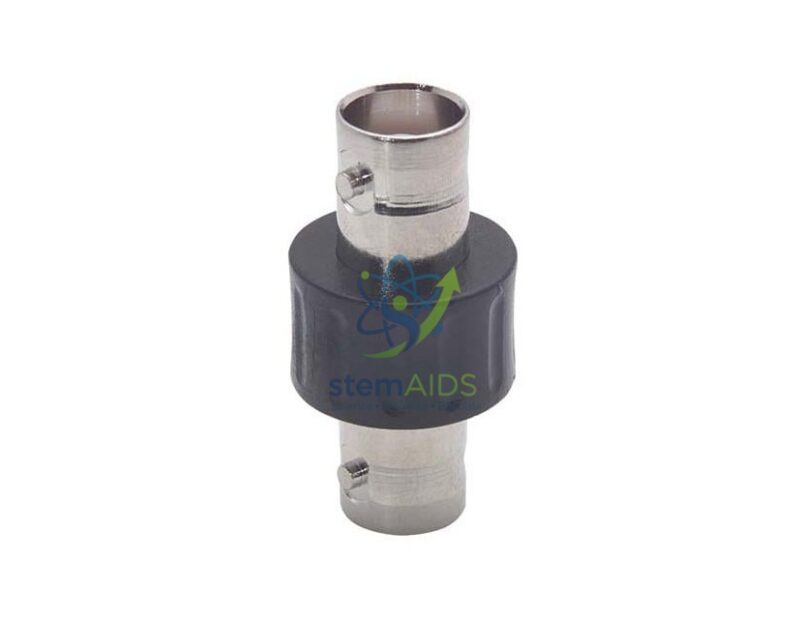
Quick Answer: The Female BNC Adapter is a straight coupler with a female BNC connector at each end, shown in the photograph with a black insulating body between the two metal ends. A female BNC adapter joins two coaxial cables that both end in male BNC plugs, extending a signal lead or linking two instruments.
Joining Coaxial Cables With a BNC Coupler
BNC connectors lock with a quarter-turn bayonet: push the plug on, turn the collar and two studs engage, so the connection cannot be pulled apart by accident. The adapter carries the centre conductor straight through from one side to the other and joins the outer screens, so the signal path and its shielding continue as if the cable were one piece.
That makes the adapter useful whenever a cable is too short, when a scope lead has to reach a distant sensor, or when two cables must be run in series. Each joint adds a small discontinuity, so use as few adapters as possible in one line.
Specifications
| Product | Female BNC adapter (coupler) |
| Connectors | BNC female at both ends |
| Shown in photograph | Straight body with a black insulating section between metal ends |
| Locking | Quarter-turn bayonet, standard for BNC |
| Use | Joining two BNC-plugged coaxial cables |
| Characteristic impedance | Confirm at enquiry |
Timing a Pulse in a Long Coaxial Cable
A classic experiment uses BNC couplers to join long coaxial cables into one line. A short pulse sent into the near end travels to the far end, reflects if that end is left open, and returns. An oscilloscope at the near end shows the outgoing and returning pulses; twice the cable length divided by the time between them gives the speed of the signal. In cables with solid polyethylene insulation the result is usually about two thirds of the speed of light.
Adding lengths and repeating shows the delay growing in proportion to length, while terminating the far end with a resistor equal to the cable’s characteristic impedance makes the reflection vanish, a direct demonstration of impedance matching.
Uses
- Extending oscilloscope or signal generator leads
- Joining cables to measure the speed of a pulse in coaxial cable
- Demonstrating reflection and matched termination
- Connecting sensor cables with BNC plugs to longer leads
Care & Handling
- Push and turn to lock, and never pull a BNC joint apart by the cable
- Keep the female centre contacts clean and free of dust
- Avoid side loads on the adapter, which can bend the centre pin of the mating plug
- Store with dust caps fitted or in a closed box
Why Choose LabEquip
Physics and electronics labs that use oscilloscopes keep BNC couplers because cables are never quite the right length. To connect a coaxial lead to ordinary 4 mm leads, the adapter for coaxial cable is the right part; contact LabEquip to confirm impedance before ordering, or see our physics lab equipment.
Frequently Asked Questions
What does a female BNC adapter join?
Two cables or devices that both end in male BNC plugs. The adapter links their centre conductors and their outer screens.
Does the adapter weaken the signal?
At the frequencies used in most school and college practicals the effect is very small. At high frequencies every joint adds a small reflection, so use the fewest joints that do the job.
How do I measure the speed of a signal in a coaxial cable?
Send a short pulse into a long cable with an open far end and measure the time to the reflected pulse on an oscilloscope. Divide twice the cable length by that time.
Why does the reflection disappear with a resistor at the far end?
A resistor equal to the cable’s characteristic impedance absorbs the pulse completely, so nothing is reflected. Any other value reflects part of the pulse.
Are 50 Ω and 75 Ω BNC connectors different?
Yes. Both exist and they usually mate mechanically, but they are designed for different cable impedances. For accurate high-frequency work, match the connector to the cable; the impedance of this adapter can be confirmed at enquiry.
How do I connect and disconnect a BNC joint?
Line up the studs, push the plug on and turn the collar a quarter-turn until it locks. To release, turn it back and pull on the connector body, not the cable.
Last Updated: October 2026




Reviews
There are no reviews yet.