
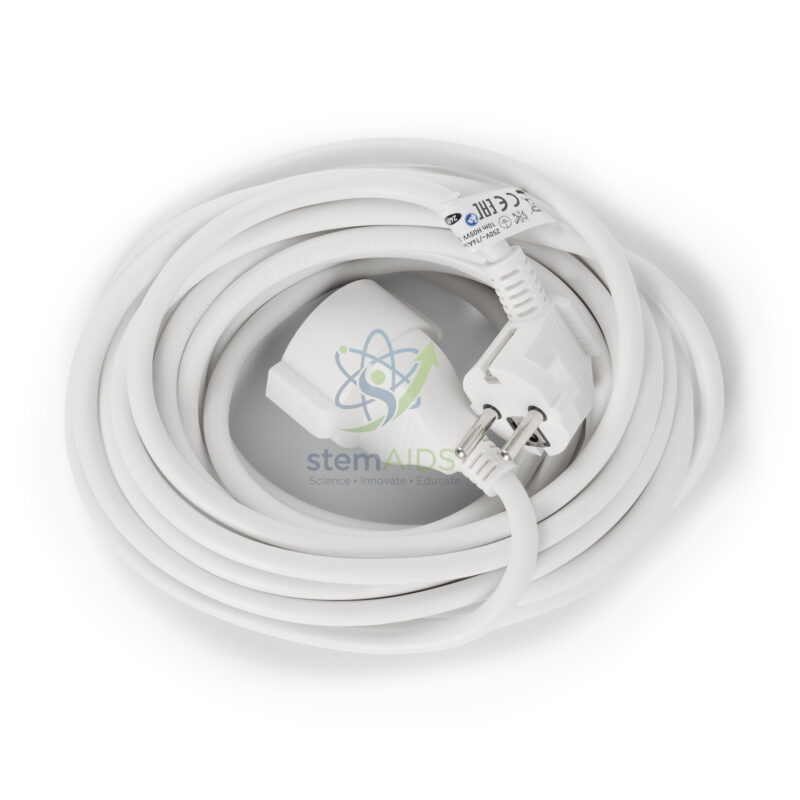
Quick Answer: This mains extension lead is a length of flexible white cable with a plug at one end and an earthed socket at the other, shown coiled in the product photograph. It carries mains power from a wall socket to apparatus placed further away, such as on a demonstration table or a trolley.
What an Extension Lead Adds to a Circuit
An extension lead adds two things to a circuit: distance and resistance. The copper conductors in the cable have a small resistance per metre, and when apparatus draws current through them a little energy is turned into heat along the length. With a modest load this is negligible. With a heavy load, such as a heater or hot plate, the cable warms, and the warming matters far more if the cable is left tightly coiled, because the turns in the middle of a coil cannot lose heat. That is why a coiled lead should be unwound fully before a large load is used.
The thickness of the conductors sets how much current the lead can carry safely, and the rating marked on the lead or plug is the figure to respect. Doubling the current quadruples the heating in the cable, since the power lost equals I squared R, which is a calculation students can do for themselves.
Using Extension Leads in the Lab
In a laboratory the lead is a temporary convenience rather than permanent wiring. It should run along walls or under covers rather than across walkways, stay clear of sinks and water baths, and never feed another extension or a power strip plugged into it. Where several instruments must be supplied at one table, the power strip goes to the wall socket and the instruments plug into the strip. Leads belong in the school’s routine inspection of portable electrical equipment and should be withdrawn at the first sign of damage.
Specifications
| Product | Mains extension lead |
| Form in the photograph | White flexible cable with plug and single socket, supplied coiled |
| Earth | Earthed plug and socket |
| Use | Temporary mains supply to apparatus away from the wall socket |
| Handling note | Uncoil fully before using with heavy loads |
| Length, current rating and plug standard | Confirm at enquiry |
Applications
- Supplying mains apparatus on demonstration tables and trolleys
- Temporary power for equipment set up away from bench sockets
- Teaching cable heating and I squared R losses with a real example
- Exhibitions and open days where apparatus is placed away from walls
Care & Handling
- Unwind the mains extension lead completely before connecting high-power apparatus
- Keep the total load within the rating marked on the lead
- Route the cable where it cannot be tripped over, trapped in doors or reached by water
- Inspect the cable and plug before use and withdraw any lead with cuts, scorching or loose parts
Why Choose LabEquip
Schools buy mains extension leads to reach demonstration tables, trolleys and temporary set-ups without moving apparatus to the wall. LabEquip can supply leads to suit your plug standard, along with power strips; request them through our contact page or browse physics lab equipment.
Frequently Asked Questions
Why should a coiled extension lead be unwound before use?
Current flowing through the cable produces heat. In a tight coil, the inner turns are insulated by the outer ones and cannot lose that heat, so the cable can overheat with a heavy load. Unwinding it lets heat escape along the full length.
How do I know if the lead can supply a heater or hot plate?
Compare the appliance’s current with the lead’s rating. Divide the appliance power in watts by the mains voltage to find the current, and keep it within the figure marked on the lead or its plug.
Can an extension lead be plugged into another extension lead?
This should be avoided. Each extra connection adds resistance and a point that can overheat, and the first lead ends up carrying the current for everything downstream.
Why does the earth wire matter?
It connects the metal case of earthed apparatus to protective earth through the lead. If the earth path is broken, a fault could leave a metal case live instead of tripping the supply.
Is it acceptable to run the lead under a mat or carpet?
No. Covering a lead traps heat and hides damage from foot traffic. Run it along a wall or use a proper cable cover designed for walkways.
How often should the lead be inspected?
Give it a quick visual check each time it is used, looking at the plug, cable and socket, and include it in the school’s scheduled testing of portable equipment. Withdraw it at once if damaged.
Last Updated: October 2026






Reviews
There are no reviews yet.