
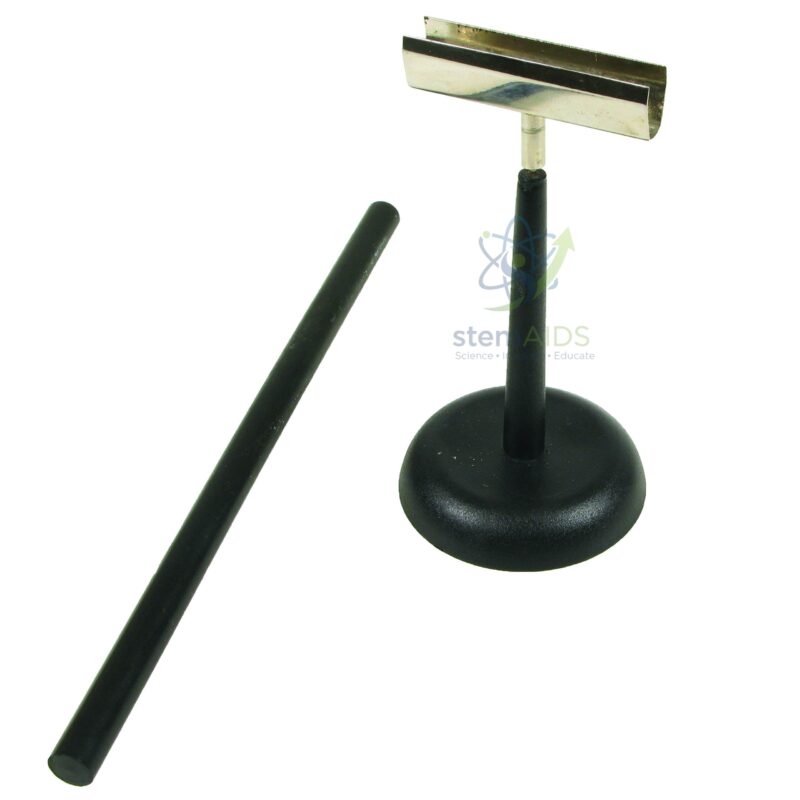
Quick Answer: The Electrostatic Pivot is a stand with a metal stirrup balanced on a vertical point, as pictured, into which a charged rod is laid so that it can turn freely in a horizontal plane. Bringing a second charged object near one end makes the rod swing toward it or away from it, which makes the forces between charges visible without any instrument.
Seeing Electric Forces Directly
Forces between rubbed rods are real but small, and a rod held in the hand hides them completely. The pivot removes almost all friction: the stirrup rests on a sharp point, so even a weak sideways force on the end of the rod produces a visible turn. This is the arrangement used in the classic experiments that established that there are two kinds of charge.
Lay a rubbed ebonite rod in the stirrup and bring a second ebonite rod, rubbed with the same cloth, toward one end: the suspended rod swings away. Bring up a glass rod rubbed with silk instead and the end swings toward it. Like charges repel and unlike charges attract, and the pivot shows both within seconds.
Attraction of Uncharged Objects
A finger, a metal rule or a sheet of paper brought near the charged rod on the pivot also attracts it, even though none of them is charged. The charged rod induces a separation of charge in the nearby object, with the opposite sign on the near side, and because that charge is closer, attraction wins. This is why attraction alone does not prove that an object is charged; only repulsion does, a point the pivot makes very clearly when an uncharged object is compared with a rod carrying like charge.
Experiments
- Demonstrating the two kinds of electric charge with rods of different materials
- Showing that like charges repel and unlike charges attract
- Comparing attraction by induction with repulsion between like charges
- Ranking materials by the charge they gain, using a reference rod in the stirrup
Care & Handling
- Place the rod in the stirrup by its middle, holding the uncharged section, so the rubbed end keeps its charge.
- Lower the stirrup gently onto its point; dropping it can blunt the tip and add friction.
- Use the pivot on a level bench away from draughts, fans and open windows.
- Store the stirrup lifted off its point so the tip does not wear between lessons.
Specifications
| Type | Electrostatic pivot (rod holder on a point bearing) |
| Construction | Metal stirrup balanced on a vertical point, on a round base, as pictured |
| Rod shown | A dark rod appears with the stand in the listing photo |
| Compatible rods | Ebonite, glass, acrylic or similar rods that fit the stirrup |
| Stirrup width and items included | Confirm at enquiry |
Why Choose LabEquip
The pivot is bought by teachers of introductory electrostatics who want a reliable, instrument-free way to show attraction and repulsion. Pair it with an ebonite rod and a glass rod, both listed in the LabEquip Physics Equipments category.
Frequently Asked Questions
Which rods work with the electrostatic pivot?
Any light insulating rod that sits in the stirrup can be used, such as ebonite, glass, acrylic or polythene. Rods of two different materials rubbed with suitable cloths gain opposite charges, which is what makes the pivot useful for comparing attraction and repulsion.
Why does the rod also turn toward my hand?
Your hand is a conductor, and the charged rod induces an opposite charge on the near side of it. The attraction between the rod and this induced charge turns the rod, even though your hand carries no net charge.
Does attraction prove that two objects are oppositely charged?
No. A charged object attracts both oppositely charged objects and neutral ones, through induction. Repulsion is the reliable test, because only an object carrying the same sign of charge pushes the rod away.
Why does the rod lose its effect after a while?
Charge leaks from the rod into damp air and through any dirt on its surface. Rub it again, keep the room dry, and handle rods by one end to avoid leaving moisture on the charged section.
How should the rod be balanced in the stirrup?
Lay the rod so it rests level, with its middle in the stirrup and roughly equal lengths on each side. A well-balanced rod turns at the slightest force, while an unbalanced one tilts and drags.
Is the pivot suitable for student practicals?
Yes. It needs no power, works with simple rubbed rods and gives a clear result quickly, so it suits small-group work as well as demonstrations. Students should handle the stirrup gently so the point bearing stays sharp.
Last Updated: October 2026






Reviews
There are no reviews yet.