







Sale
In Stock
LDR Response Analysis Apparatus
Original price was: ₹5,060.00.₹2,520.00Current price is: ₹2,520.00.
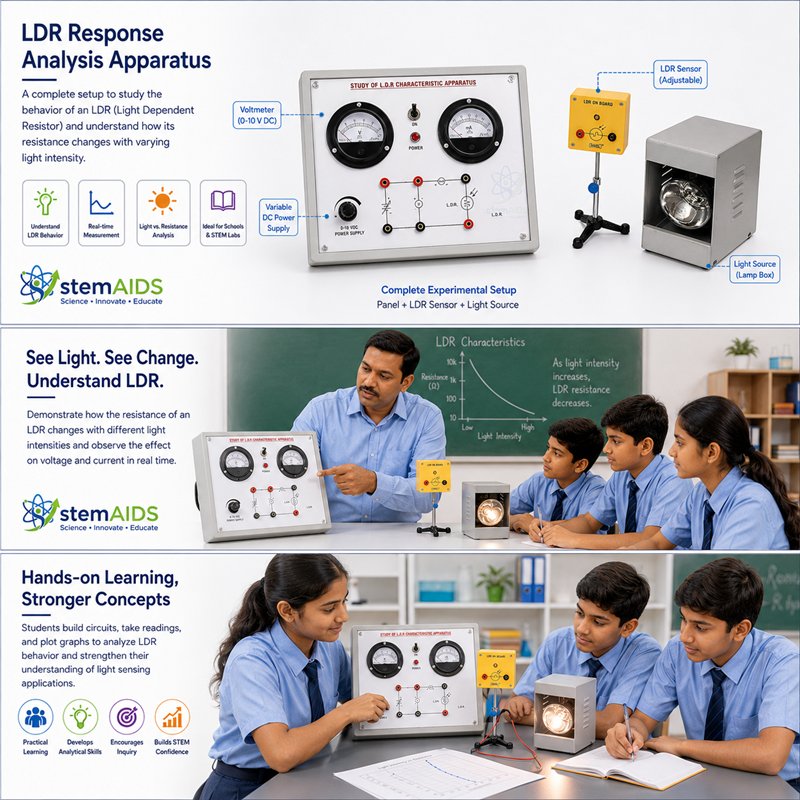
The LDR response analysis apparatus is an electronics laboratory setup used for investigating how the electrical resistance of a light-dependent resistor changes with illumination. It is intended for students, teachers and technical trainees who need a structured method for recording LDR readings, comparing light conditions and interpreting photoresistor response.
Product Description
The STEMAids LDR Response Analysis Apparatus supports practical study of a light-dependent resistor, also called a photoresistor. An LDR generally exhibits lower resistance under stronger illumination and higher resistance in darker conditions. Students can record measurements at controlled light levels and present the results as a response table or graph.
The apparatus is designed as a dedicated instructional unit for supervised physics and electronics experiments. It helps learners connect light intensity with sensor resistance and circuit output. The LDR type, illumination method, measurement range, panel material and electrical configuration are not publicly specified and should be confirmed from the current technical sheet.
Explore related electrical and electronics laboratory apparatus and complementary physics laboratory equipment.
Key Features
- Single-sensor capacity: provides one structured setup for analysing the response of an LDR.
- Light-response investigation: demonstrates how illumination affects photoresistor resistance.
- Measurement-based learning: supports tabulation of resistance, voltage or current readings, subject to the supplied circuit.
- Graphing activity: enables students to plot sensor response against relative or measured light intensity.
- Applied electronics value: connects semiconductor sensor behaviour with automatic lighting and detection circuits.
- Reusable trainer format: suitable for repeated demonstrations, practical classes and student assessments.
- Supervised operation: provides an organised experiment for controlled classroom and laboratory use.
Technical Specifications
|
Specification |
Detail |
|
Product name |
LDR Response Analysis Apparatus |
|
Brand |
STEMAids |
|
Product category |
Physics Lab Equipment / Electrical and Electronics Apparatus |
|
Experiment capacity |
One LDR response investigation |
|
Sensor studied |
Light-dependent resistor |
|
Measured parameters |
Resistance and related circuit quantities, depending on supplied configuration |
What’s Included in the Kit
- LDR Response Analysis Apparatus
- LDR sensor or integrated sensor section, subject to confirmed configuration
- Light source or illumination-control arrangement, if listed in the packing specification
- Measurement section, connecting leads and experiment instructions, where confirmed
Applications / Uses
- Studying the relationship between illumination and LDR resistance
- Plotting an LDR response curve
- Comparing sensor behaviour under bright, dim and dark conditions
- Introducing photoresistors and light-sensitive circuits
- Explaining automatic streetlight and light-activated alarm principles
- Conducting school, college and technical-training practicals
The apparatus can support broader activity-based lessons alongside electronics and STEM learning kits.
How to Use the LDR Response Analysis Apparatus
- Place the apparatus on a clean, dry and stable laboratory bench.
- Keep the power switched off while identifying the LDR, terminals and controls.
- Connect the circuit according to the supplied experiment diagram.
- Ask the instructor to inspect the electrical and sensor connections.
- Set the light source to the first approved illumination condition.
- Allow the reading to stabilise, then record the measured value.
- Repeat the measurement at several controlled light levels.
- Tabulate the results and plot the selected electrical quantity against light intensity.
Safety note: Switch off the apparatus before changing connections. Do not exceed its confirmed electrical ratings, and avoid touching a lamp or light source that becomes hot during operation.
Care & Maintenance
- Disconnect the apparatus from power before cleaning or inspection.
- Keep the LDR surface clean and free from dust that could affect illumination.
- Inspect leads, terminals and insulation before each practical session.
- Store the apparatus in a dry cabinet away from moisture and excessive heat.
Why Choose STEMAids
STEMAids is the STEM education brand of Eduscope Smart Learning Solutions Private Limited, a New Delhi-based manufacturer. Its catalogue includes physics apparatus, scientific instruments, STEM kits and educational models. The company supports school, institutional, tender and export orders. Buyers can review the wider STEMAids scientific and STEM equipment catalogue when planning a laboratory.
Frequently Asked Questions
What is an LDR response analysis apparatus used for?
It is used to investigate how the resistance of a light-dependent resistor changes under different illumination conditions.
How does light affect an LDR?
An LDR normally has higher resistance in darkness and lower resistance under stronger illumination. The exact response depends on the sensor and test conditions.
What graph can students plot with this apparatus?
Students can plot resistance or another measured circuit quantity against light intensity. The appropriate axes depend on the supplied experiment method and measurement arrangement.
Does the apparatus include a calibrated light source?
A calibrated light source has not been verified. Buyers should confirm the illumination method, adjustment system and whether light intensity is measured or only compared relatively.
Can this apparatus be used in school laboratories?
Yes. It is suitable for supervised lessons on sensors, resistance, electronics and light-controlled circuits where these topics are included in the curriculum.
What LDR range is supplied?
The sensor model and resistance range are not publicly specified. Confirm the LDR characteristics, meters and operating voltage from the current technical sheet.
Bestsellers


Sale
Sale

Sale

Sale

Sale

