
Quick Answer: The Discrete Electronics Trainer Kit is a panel-based training system on which students wire circuits from individual (discrete) components such as diodes, transistors, resistors and capacitors. It is used in electronics practicals to study how each device behaves before students move on to integrated circuits.
Discrete Components Versus Integrated Circuits
A discrete component is a single device in its own package: one transistor, one diode, one resistor. An integrated circuit puts many such devices on one chip, where students cannot measure what happens inside. A discrete trainer keeps every device separate and reachable, so voltages and currents can be measured at each terminal and the effect of changing one resistor is seen directly.
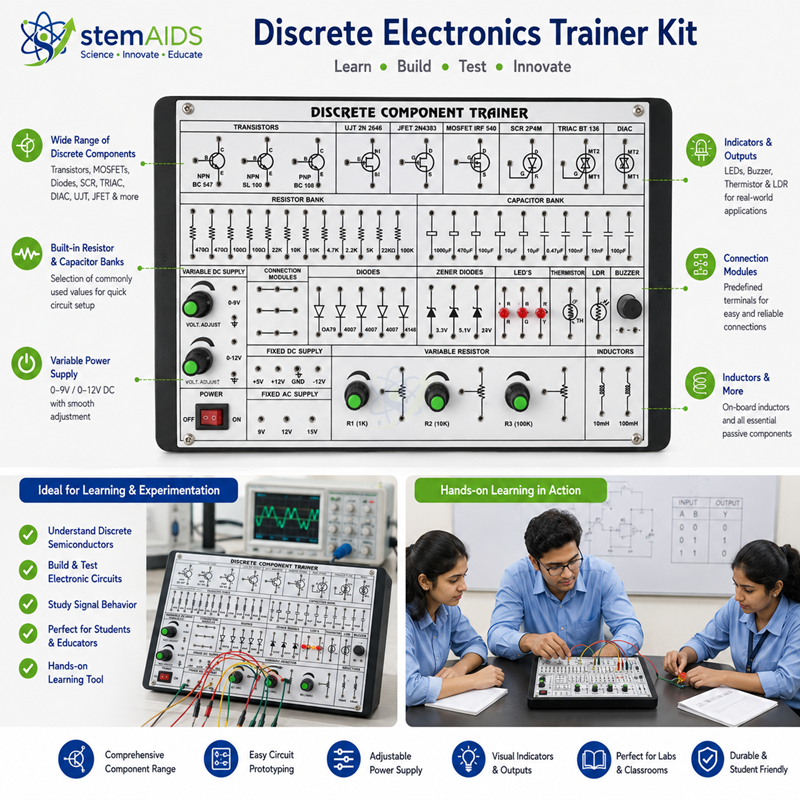
The product image shows one panel laid out in labelled blocks: bipolar transistors, a unijunction transistor, a JFET, a MOSFET, an SCR, a TRIAC and a DIAC, resistor and capacitor banks, rectifier and Zener diodes, LEDs, a thermistor, an LDR, a buzzer, inductors and potentiometers, together with fixed and variable supply outputs. The exact component types, values and supply ratings should be confirmed before ordering.
From Rectifiers to Thyristors
Work on the trainer usually starts with diodes: a half-wave and then a bridge rectifier, smoothing with a capacitor from the capacitor bank, and a Zener diode with a series resistor as a simple voltage regulator. Viewing the ripple on an oscilloscope before and after the smoothing capacitor shows why its value matters.
Transistor topics follow, such as common-emitter characteristics, voltage-divider biasing and a single-stage amplifier whose gain is measured with a signal generator. The thyristor blocks then add power-control ideas: switching an SCR on with a gate pulse, seeing it stay on after the pulse ends, and triggering it from a UJT relaxation oscillator whose timing is set by a resistor and capacitor.
Specifications
| Item | Discrete electronic component trainer built on a single panel |
| Devices shown in the product image | Bipolar transistors, UJT, JFET, MOSFET, SCR, TRIAC, DIAC, diodes, Zener diodes, LEDs |
| Passive and sensor blocks shown | Resistor and capacitor banks, potentiometers, inductors, thermistor, LDR, buzzer |
| Power | Built-in fixed and variable supply outputs, as shown in the product image |
| Connections | Terminals for linking components into circuits |
| Exact component list, values and supply ratings | Confirm at enquiry |
Course Applications
- Diploma and polytechnic practicals on semiconductor devices and basic circuits
- First-year basic electronics laboratories in engineering colleges
- Vocational electronics courses where component-level fault finding is taught
- Sensor circuits using the LDR and thermistor, such as a light- or temperature-operated switch driving an LED or the buzzer
Care & Handling
- Switch off the panel supply before changing connections
- Observe polarity on diodes and on any electrolytic capacitors before applying power
- Never link two supply outputs together or short an output with a lead
- Keep the panel dry and dust-free, and store connecting leads loosely coiled so the conductors do not break
Why Choose LabEquip
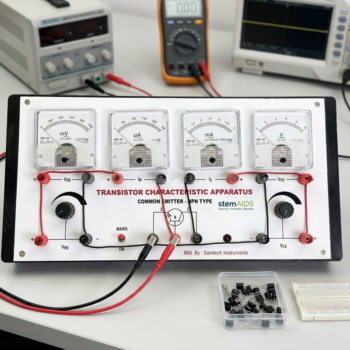
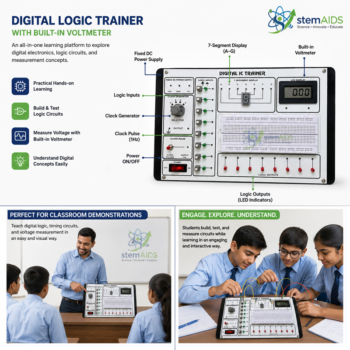
Polytechnics, engineering colleges and vocational institutes choose a discrete trainer to put a full set of device experiments on each bench, alongside single-topic boards such as the transistor V-I characteristics trainer. LabEquip lists it in its electrical and electronics range, where digital topics are covered separately by the digital logic trainer with built-in voltmeter.
Frequently Asked Questions
What is the difference between a discrete trainer and an IC trainer?
A discrete trainer uses individual devices, so students can measure the voltage and current at each terminal and see how one transistor or diode behaves. An IC trainer is built around integrated circuits such as op-amps or logic chips, where the internal devices are hidden and the circuit is studied from its inputs and outputs.
Can the trainer be used to study an SCR?
The product image shows an SCR block, which supports the classic experiments: finding the gate current needed to switch the SCR on, showing that it stays on once the gate signal is removed, and turning it off by reducing the anode current below its holding value.
What test instruments are needed alongside the trainer?
A multimeter is enough for static work such as biasing and diode characteristics. Rectifier ripple, amplifier gain and oscillator waveforms need an oscilloscope, and amplifier experiments also need a signal generator unless the trainer provides one.
Why does the panel have resistor and capacitor banks?
They give a ready choice of standard values for biasing, filtering and timing without loose components on the bench. Students can change one value, such as the capacitor in an RC timing circuit, and see its effect immediately.
Is it safe for students to wire circuits on the panel?
Circuits are powered from the panel’s own supply outputs, which on trainers of this kind are low-voltage. Students should still switch off before rewiring, avoid shorting supply terminals and have each circuit checked before switching on.
How does a UJT relaxation oscillator work?
A capacitor charges through a resistor until its voltage reaches the peak point of the unijunction transistor, which then switches on and discharges it quickly. The cycle repeats, giving a sawtooth across the capacitor and sharp pulses at the base, at a frequency set mainly by the resistor and capacitor.
Last Updated: October 2026





Reviews
There are no reviews yet.