
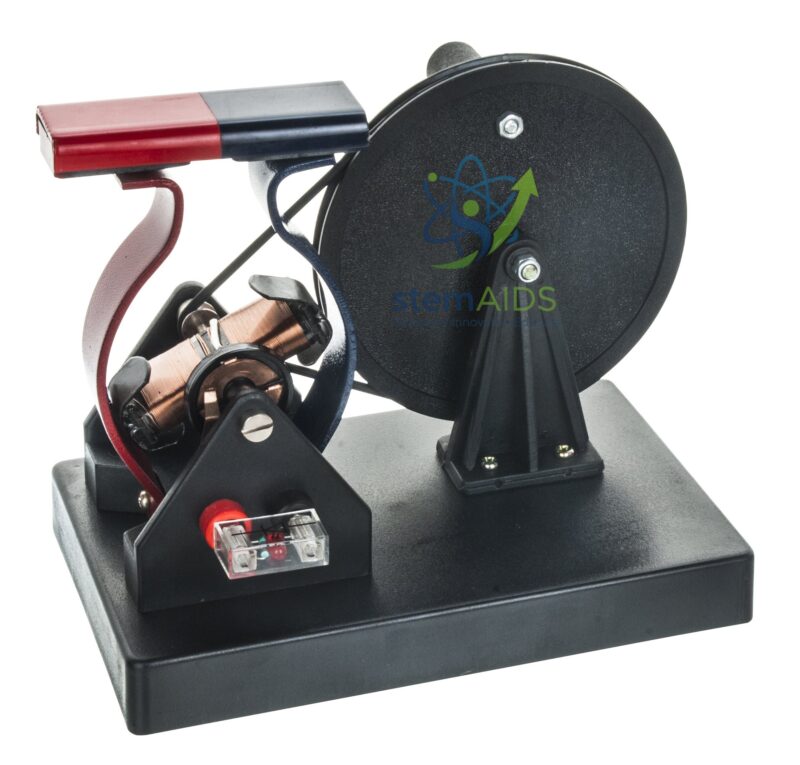
Quick Answer: The Electric Dynamo is a demonstration generator in which a large hand wheel drives an armature coil spinning between the poles of a horseshoe magnet, producing a voltage at its terminals. Every working part is in view, so a class can relate the field magnet, armature and brush contacts to Faraday’s law of induction.
Parts the Class Can See
In the product photograph the electric dynamo stands on a black base: a red and blue horseshoe magnet straddles the armature at one end, and a large hand wheel at the other end drives the armature through a belt. Because the hand wheel is much larger than the armature pulley, one slow turn of the handle spins the armature several times, raising the output to something a meter or small lamp responds to.
Nothing is hidden inside a casing. Students can point to the magnetic field between the poles, the coil that moves through it, and the contacts that carry the current out to the terminals.
Commutator or Slip Rings
An armature coil turning in a magnetic field always generates an alternating EMF, because each side of the coil moves up through the field and then down. What reaches the terminals depends on the contacts. Slip rings pass the alternating voltage straight out; a split-ring commutator reverses the connections every half turn, so the output stays in one direction and the dynamo delivers pulsating direct current. Whether this unit has a commutator, slip rings or both is noted in the specification below.
Demonstrations
- Showing that output rises with the speed of turning, using a voltmeter or small lamp
- Turning very slowly with a centre-zero galvanometer connected to watch the needle swing each half turn
- Displaying the output waveform on an oscilloscope
- Discussing how the same arrangement fed with current works as a motor
Specifications
| Device | Hand-driven demonstration dynamo |
| Field | Horseshoe permanent magnet |
| Drive | Large hand wheel with belt to the armature |
| Construction | Open, with all working parts visible on a base |
| Output contacts (commutator, slip rings or both) | Confirm at enquiry |
Care & Handling
- Keep the belt at moderate tension and free of oil or grease
- Keep steel tools and other magnets away from the horseshoe magnet to preserve its strength
- Turn the wheel smoothly; spinning it hard and stopping suddenly strains the belt
- Cover the dynamo when stored so dust does not settle on the contacts
Why Choose LabEquip
Teachers buy an open electric dynamo when they want students to see induction happen rather than take it on trust. LabEquip supplies it with sealed alternatives such as the manual electric generator as part of its physics equipment; any question about the output contacts can be raised on the contact page.
Frequently Asked Questions
What makes the dynamo produce a voltage?
As the armature coil turns between the magnet poles, the magnetic flux passing through it keeps changing. By Faraday’s law, a changing flux linkage induces an EMF in the coil, and that EMF appears at the terminals.
Why does the output increase when the wheel is turned faster?
The flux through the coil changes more quickly, and the induced EMF is proportional to the rate of change. The belt step-up from the large wheel to the armature makes the effect easy to show.
What is the difference between a dynamo and an alternator?
In common usage a dynamo delivers direct current through a commutator, while an alternator delivers alternating current, usually through slip rings or with a rotating magnet and fixed coils. Both rely on the same induction principle.
How can students see the shape of the output?
Connect an oscilloscope or a data logger voltage sensor across the terminals. Alternatively, turn the wheel very slowly with a centre-zero galvanometer connected and watch the needle direction change.
Can the dynamo light a bulb?
A small low-voltage lamp will glow when the wheel is turned briskly. Connecting it also makes the wheel harder to turn, which is a good way to show that electrical energy comes from the work done by the hand.
How should the belt be looked after?
Keep it clean, dry and free of oil, set it only tight enough not to slip, and replace it if it cracks or stretches. A slipping belt gives unsteady readings.
Last Updated: October 2026






Reviews
There are no reviews yet.