
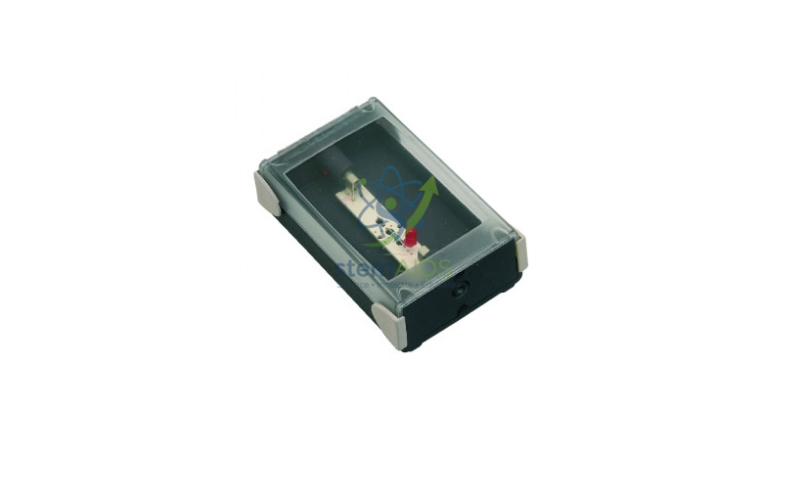
Quick Answer: This protected red LED is a red light-emitting diode mounted in a module with a clear cover and connection sockets, as pictured, with current limiting built in so that it can be connected to the low-voltage supply it is designed for without a separate series resistor. It is used to teach diode polarity and as a clear indicator in student circuits.
A Diode That Gives Light
An LED is a semiconductor diode. Current flows easily in one direction, from anode to cathode, and hardly at all the other way. When it conducts, electrons crossing the junction release energy as light, and the colour depends on the semiconductor material. A red LED needs a lower forward voltage to start conducting than blue or white ones, because red photons carry less energy.
Once an LED starts to conduct, its current rises steeply for a small rise in voltage, so a bare LED connected straight to a battery can draw a damaging current. That is the reason for the protection in this module: a series resistor, or similar current limiting inside the housing, holds the current at a safe level for the supply it is designed for.
Experiments with the Module
Connect the module to a low-voltage supply one way round and it glows; reverse the leads and it stays dark, a clear demonstration of one-way conduction. In a circuit alongside a lamp module, the LED shows students that a diode can block current in a whole branch. Because the LED draws little current for its brightness, it is also used to compare the efficiency of LEDs and filament lamps and to serve as an indicator in alarm and logic circuits.
Applications
- Demonstrating that a diode conducts in one direction only
- Acting as a visible indicator in switch, alarm and logic circuits
- Comparing the current drawn by an LED and a filament lamp of similar brightness
- Showing the effect of polarity in DC circuits
Specifications
| Component | Red light-emitting diode (LED) |
| Protection | Built-in current limiting, as indicated by the product name |
| Housing | Module with clear cover and connection sockets, as pictured |
| Use | Low-voltage DC teaching circuits |
| Designed supply voltage | Confirm at enquiry |
Care & Handling
- Connect the module only to the low-voltage supply it is designed for; the protection does not make it safe on higher voltages.
- Observe the polarity markings when wiring, so results match what students expect.
- Avoid staring into the lit LED at close range for long periods.
- Keep the clear cover clean and the module dry, and store it with other circuit modules in a padded tray.
Why Choose LabEquip
Protected LED modules are bought for class sets so students can use LEDs safely without first learning to calculate series resistors. LabEquip also lists loose round LEDs for students ready to build their own resistor circuits, and lamp modules such as the E10 socket, in its Physics Equipments category.
Frequently Asked Questions
What does protected mean for an LED module?
It means current limiting is built in, usually a series resistor inside the housing. The LED can then be connected to its designed supply without the extra resistor a bare LED would need.
Why does the LED not light when connected the other way round?
An LED is a diode, so it conducts only when its anode is more positive than its cathode. Connected in reverse, almost no current flows and no light is produced.
Why is a red LED used in this module?
Red LEDs need a lower forward voltage than blue or white ones and are very visible, which makes them well suited to low-voltage school circuits and indicator use.
Can the module be used with a higher-voltage supply?
Only within the voltage the protection is designed for. A higher voltage pushes more current through the resistor and LED and can damage them, so check the designed voltage before connecting.
How is an LED different from a filament lamp?
A filament lamp makes light by heating a thin wire and lights in either direction. An LED produces light directly at the semiconductor junction, works only one way round and draws far less current for a similar brightness.
Can students measure the LED’s characteristic with this module?
Yes, but the built-in resistor is in series with the LED, so the voltage measured across the module includes the resistor’s share. For a pure LED characteristic, a bare LED with a separate resistor is better.
Last Updated: October 2026




Reviews
There are no reviews yet.