
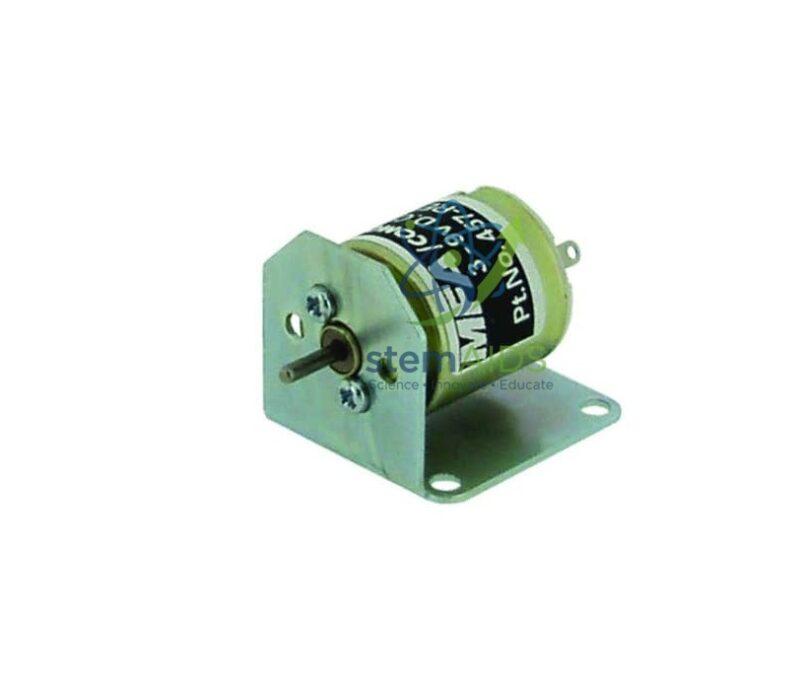
Quick Answer: The DC Electric Motor 6 to 15 V on Bracket is a small direct-current motor, pictured with a coloured label on a metal bracket, intended for the 6 to 15 V working range given in its name. Because the bracket can be clamped or screwed in place, the DC electric motor 6 to 15 V suits winding, lifting and speed measurements on the bench.
Speed and Voltage Across the 6 to 15 V Range
In a small DC motor the speed settles where the back EMF generated by the spinning coil nearly balances the supply voltage. Back EMF is proportional to speed, so with a light load the speed rises almost in proportion to the applied voltage. A span from 6 to 15 V gives room for five or six well-spaced readings, enough for a convincing straight-line graph of speed against voltage.
Speed can be measured with an optical tachometer, a light gate and a slotted disc on the shaft, or by filming a marked paper disc with a phone and counting rotations frame by frame. The gradient of the graph gives the motor’s speed constant, and the small intercept shows the voltage needed just to overcome friction.
Lifting a Load: Power and Efficiency
Fit a small drum or pulley to the shaft of the DC electric motor, clamp the bracket at the bench edge and wind up a string carrying a known mass. Timing the lift gives mechanical power, m × g × h ÷ t, while a voltmeter and ammeter give electrical power, V × I. Repeating at several voltages within the range shows how efficiency changes with operating point.
Spun by hand or by a second motor, the same machine generates a voltage: turn the shaft with a string pull or crank and a voltmeter across the terminals shows a reading that grows with speed. Motor and generator are one device used in opposite directions.
Practicals
- Plotting motor speed against supply voltage from 6 to 15 V
- Measuring efficiency by lifting a known mass
- Using the motor as a generator turned by hand
- Driving a pulley, fan or gear train in mechanics demonstrations
Specifications
| Product | DC electric motor on bracket |
| Working voltage, from title | 6 to 15 V DC |
| Mounting | Bracket for clamping or screwing to a base |
| Construction in photograph | Cylindrical motor with label, shaft and terminals on a metal bracket |
| Measurements | Speed, current, mechanical and electrical power |
| Shaft size and no-load speed | Confirm at enquiry |
Care & Handling
- Stay within the 6 to 15 V range named in the title
- Avoid stalling the motor at the higher voltages, which draws a large current
- Clamp the bracket firmly before running with a load
- Keep string, hair and loose clothing away from the turning shaft
Why Choose LabEquip
Teachers who want a motor sturdy enough for measurement, not just demonstration, choose a bracket-mounted motor with a stated voltage range. For quick circuit work on a module board the UME motor module is the alternative; contact LabEquip for quantities, or explore the wider physics lab equipment collection.
Frequently Asked Questions
Why does the motor’s speed rise with voltage?
The motor speeds up until the back EMF it generates nearly balances the supply. Since back EMF is proportional to speed, a higher supply voltage settles at a higher speed.
What happens below 6 V?
The motor may still turn, but more slowly, and it may not start under load. Readings near the bottom of the range show how much voltage is needed just to overcome friction.
How can I measure the speed without a tachometer?
Fix a paper disc with a mark to the shaft and film it with a phone, then count rotations over a known number of frames. A light gate with a slotted disc also works well.
How do I calculate efficiency with the motor?
Divide the useful work done lifting a mass, m × g × h, by the electrical energy supplied, V × I × t, during the same lift. Multiply by 100 for a percentage.
Why does the current rise when the load increases?
A heavier load slows the motor, which reduces the back EMF. More of the supply voltage then drives current through the winding, so the current increases.
Can the motor generate electricity?
Yes. Turning the shaft moves the coil in the magnetic field and an EMF appears across the terminals, rising with the speed of turning.
Last Updated: October 2026









Reviews
There are no reviews yet.