
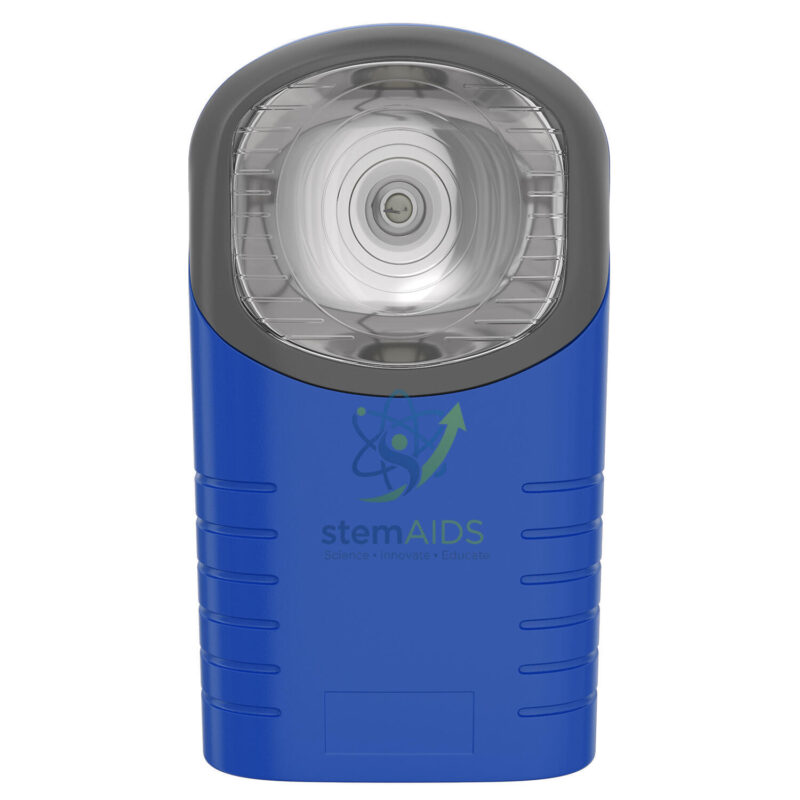
Quick Answer: The classic flashlight shown here is a box-shaped torch built around a single 3LR12 4.5 V flat battery, with a reflector and lamp at the front and a switch on the body. Besides giving light, it is a ready-made circuit for teaching cells, switches and reflection.
The 4.5 V Flat Battery Inside
A 3LR12 battery is a rectangular pack containing three cylindrical 1.5 V alkaline cells connected in series, which is why its voltage is 4.5 V. Instead of round terminals it has two flat brass strips on top; on this battery type the shorter strip is the positive terminal and the longer one the negative. In the classic flashlight, the strips press against contacts in the torch head, so the battery fits only one way.
Opening a battery is not something to do in class, but its labelling and a voltmeter tell the same story: 4.5 V from the pack, and about 1.5 V per cell if three single cells are measured and then connected in series for comparison. The flat pack’s strips also accept crocodile clips directly, which is why the battery remains popular in school electricity work.
Reflector, Lamp and Switch
At the front of the torch, the lamp sits near the focus of a curved reflector, which redirects light that would otherwise go sideways into a forward beam. The switch on the body completes the series circuit through the lamp. Students can trace that circuit with the battery removed, draw it with standard symbols and predict which single fault, a dead battery, a broken lamp or a dirty contact, would stop the torch working. A spare 3LR12 4.5 V alkaline battery keeps the torch ready, and the same battery serves on its own as a bench supply.
Specifications
| Product | Classic flashlight (box-type torch) |
| Battery | One 3LR12 4.5 V flat battery, as titled |
| Form in the photograph | Blue body with large front reflector |
| Circuit | Battery, switch and lamp in series |
| Battery contacts | Spring contacts for the two flat terminal strips |
| Lamp type and whether a battery is included | Confirm at enquiry |
Applications
- General-purpose torch for prep rooms, stores and field work
- Teaching series circuits by tracing the torch circuit and drawing it
- Showing how a curved reflector forms a beam
- Introducing the 4.5 V flat battery as three cells in series
Care & Handling
- Remove the flat battery when the classic flashlight is stored, as an exhausted alkaline battery can leak
- Check the terminal strips and contacts for corrosion and clean them if needed
- Do not bend the battery strips back and forth, as they can crack at the base
- Keep the reflector clean and free of fingerprints
Why Choose LabEquip
Schools that already use 4.5 V flat batteries in electricity practicals buy the classic flashlight so one battery type serves both the bench and the torch. LabEquip can supply torches with matching batteries; see physics lab equipment or send your request through our contact page.
Frequently Asked Questions
Which terminal of a 3LR12 battery is positive?
On the 4.5 V flat battery the shorter brass strip is the positive terminal and the longer strip is the negative. The torch contacts are arranged so the battery seats only one way.
Why is the battery 4.5 V?
It contains three 1.5 V cells connected in series inside one pack, and in series their voltages add: 1.5 V plus 1.5 V plus 1.5 V gives 4.5 V.
Can the torch use rechargeable batteries?
Rechargeable batteries in the flat 4.5 V format are uncommon. The torch is designed for the standard 3LR12 alkaline flat battery.
How does the reflector make a beam?
The reflector is curved so that light from a lamp near its focus is reflected forward in nearly parallel rays. Without it, much of the light would spread sideways and be wasted.
Can the flat battery be used for experiments too?
Yes. Its strips accept crocodile clips directly, making it a convenient 4.5 V source for lamps, motors and resistors in simple circuits.
Why does the beam become dim as the battery runs down?
As the battery discharges its voltage falls, so less current flows through the lamp. A filament lamp then runs cooler, giving dimmer, yellower light; an LED lamp gets dimmer without much change of colour.
Last Updated: October 2026




Reviews
There are no reviews yet.