
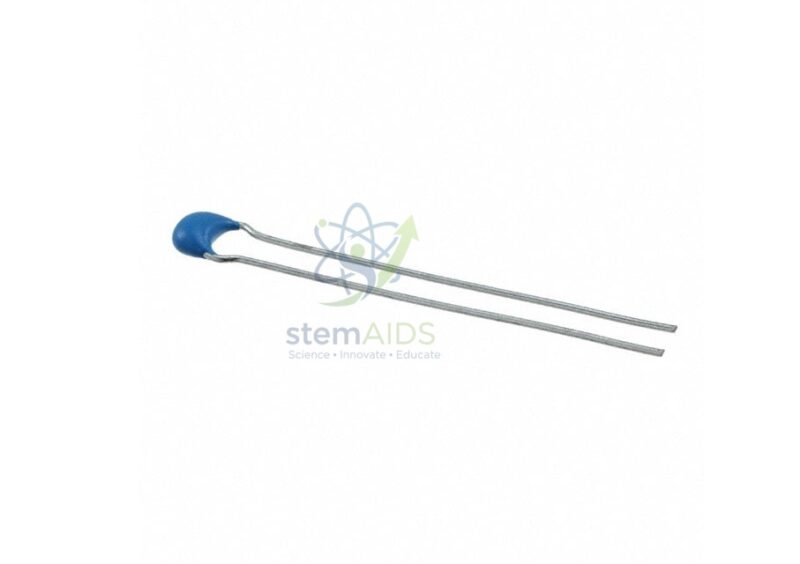
Quick Answer: The Ceramic Capacitor is a non-polarised capacitor whose dielectric is a thin ceramic layer between metal electrodes, made in small capacitance values. In electronics practicals a ceramic capacitor is used for decoupling supply lines, in RC timing and filter circuits and wherever a small, non-polarised capacitance is needed.
Construction and Strengths
A capacitor stores charge on two conducting plates separated by an insulator, the dielectric. Here the dielectric is a ceramic material, either a single disc with an electrode on each face or many thin layers stacked and interleaved with electrodes. Ceramics with a high permittivity give useful capacitance in a small body, and because there is no polarity, the capacitor can be connected either way round and used on alternating signals.
These capacitors cover the small end of the capacitance scale and handle high frequencies well; larger values are the territory of electrolytic capacitors, which are polarised. The value, voltage rating and ceramic class of this item are not given in its name and should be confirmed when ordering. Some ceramic types change capacitance noticeably with temperature and applied voltage, which matters for precise timing work.
Reading the Value Code
Small capacitors of this type are usually marked with a three-digit code rather than a printed value. The first two digits are the significant figures and the third is the number of zeros to add, with the result in picofarads. For example, a code of 104 means 10 followed by four zeros, giving 100,000 pF, or 100 nF. A letter after the code often indicates the tolerance. Decoding these marks is a small but necessary skill before building any circuit from a parts drawer.
Specifications
| Component | Ceramic capacitor |
| Dielectric | Ceramic |
| Polarity | Non-polarised |
| Typical uses | Decoupling, timing, filtering, coupling |
| Capacitance, voltage rating and tolerance | Confirm at enquiry |
Where It Goes in a Circuit
- Decoupling, placed close to the supply pins of integrated circuits such as the TL081 op amp
- RC timing circuits, charging and discharging through a resistor
- Simple low-pass and high-pass filters on audio or sensor signals
- Coupling a signal from one stage to the next while blocking the DC level
Care & Handling
- Do not exceed the voltage rating marked on, or stated for, the capacitor.
- Avoid bending the leads repeatedly where they enter the body, as the ceramic can crack.
- Solder quickly, especially with multilayer types, to avoid thermal shock.
- Sort and label capacitors by value, since many look alike and their codes are small.
Why Choose LabEquip
Electronics labs keep small non-polarised capacitors of several values in every parts drawer. LabEquip offers them in its physics lab equipment range alongside the decade capacitance box for experiments where the value must be varied; tell us the values and quantities you need through the contact page.
Frequently Asked Questions
Does a ceramic capacitor have a polarity?
No. Ceramic types are non-polarised and can be connected either way round, so they work on alternating signals as well as steady voltages. Electrolytic capacitors, by contrast, have marked positive and negative leads.
How do I read a code such as 104?
The first two digits, 10, are the significant figures and the third digit, 4, is the number of zeros, giving 100,000 picofarads. That equals 100 nanofarads or 0.1 microfarads. A following letter usually gives the tolerance.
Why are small capacitors placed next to integrated circuits?
They act as small local reservoirs of charge. When the chip draws sudden pulses of current, the capacitor supplies them, keeping the voltage at its pins steady and stopping noise from travelling along the supply lines to other parts of the circuit.
How is a capacitor used in a timing circuit?
Charged or discharged through a resistor, a capacitor’s voltage changes exponentially with a time constant equal to resistance times capacitance. A comparator or timer chip detects when the voltage crosses a threshold, giving a delay or an oscillation set by those two components.
When should I use an electrolytic capacitor instead?
When a large capacitance is needed, such as for smoothing a power supply. Electrolytics give far more capacitance in a given size but are polarised and less suited to high frequencies, so circuits often use both types side by side.
Does the capacitance of a ceramic capacitor change with temperature?
It depends on the ceramic class. Some types are very stable and suit precise timing and filters, while high-permittivity types pack more capacitance into a small body but vary more with temperature and applied voltage.
Last Updated: October 2026




Reviews
There are no reviews yet.