
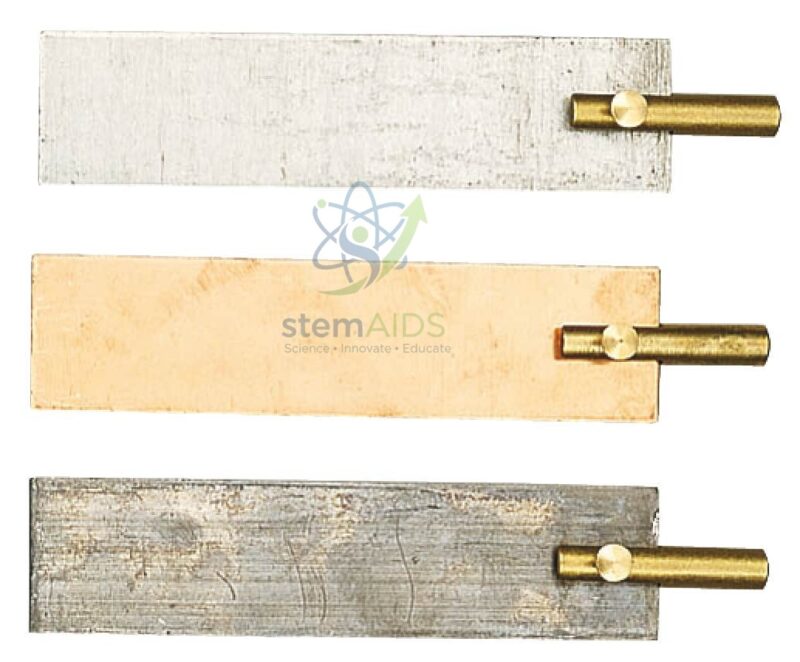
Quick Answer: This is a single metal plate electrode: a flat strip of metal with a brass terminal fixed near one end, as pictured. A plate electrode is lowered into an electrolyte to build simple cells, carry out electroplating or compare metals in the reactivity series, and the photograph shows strips in three different metals.
What a Plate Electrode Offers
A flat plate gives a large, even surface area in contact with the electrolyte. That keeps the current density, the current per unit area, lower and more uniform than on a wire or rod, so metal deposits evenly during plating and the cell voltage settles quickly in galvanic cell work. The brass terminal on each strip takes a lead, so the plate can be connected without crocodile clips biting into it.
Because the electrode is sold singly, a school can build up exactly the combination of metals it needs, for example a zinc and a copper plate for a Daniell-type cell, two copper plates for copper refining, or a series of different metals for a reactivity comparison.
Building a Simple Cell
Two different metals dipped into an electrolyte, or into two solutions joined by a salt bridge, form a cell. The more reactive metal becomes the negative terminal and the voltage measured between them grows with the difference in reactivity. Swapping one plate for another and recording each voltage builds up the reactivity series experimentally.
Specifications
| Product | Plate electrode, single |
| Shown in photograph | Three metal strips, zinc-, copper- and iron-coloured, each with a brass terminal |
| Connection | Brass terminal for a lead |
| Used with | Electrode holders, beakers, voltmeter or low-voltage supply |
| Metal supplied and plate size | Confirm at enquiry |
Practical Uses
- Building zinc and copper cells and measuring their voltage
- Electroplating copper onto another metal plate
- Purifying copper with two copper plates in copper sulfate solution
- Comparing voltages from different metal pairs to order the reactivity series
Care & Handling
- Clean the plates with fine abrasive paper before each experiment so the surface is fresh
- Keep the brass terminal above the electrolyte so it does not become part of the electrode
- Rinse and dry plates after use; store different metals apart and labelled
- Weigh plates only when fully dry if mass changes are being measured
Why Choose LabEquip
Teachers buy single plates so they can match metals to each practical rather than buy a whole set. LabEquip supplies them with electrode holders, the terminal clamps for plates and wider physics lab equipment; contact LabEquip to specify the metal.
Frequently Asked Questions
Which metal is this electrode made of?
The listing covers a single plate, and the photograph shows zinc-, copper- and iron-coloured strips. Choose the metal you need when ordering; it can be confirmed at enquiry.
Why is a plate better than a wire for electroplating?
A plate offers a larger, flatter surface, so the current spreads more evenly and the deposited metal forms a smoother, more even coat.
Which plate becomes the negative terminal in a cell?
The more reactive metal. In a zinc and copper cell, zinc gives up electrons and becomes the negative terminal.
Why should the terminal stay out of the solution?
The brass terminal is a different metal. If it touches the electrolyte, it forms part of the cell and changes both the voltage and the reactions.
How should the plates be cleaned?
Rub them lightly with fine abrasive paper to remove oxide, rinse with water and dry. A clean surface gives steadier readings.
Can the plate be weighed to measure mass change?
Yes. Dry and weigh it before and after electrolysis to find the mass of metal deposited or dissolved, as in Faraday’s law practicals.
Last Updated: October 2026




Reviews
There are no reviews yet.