
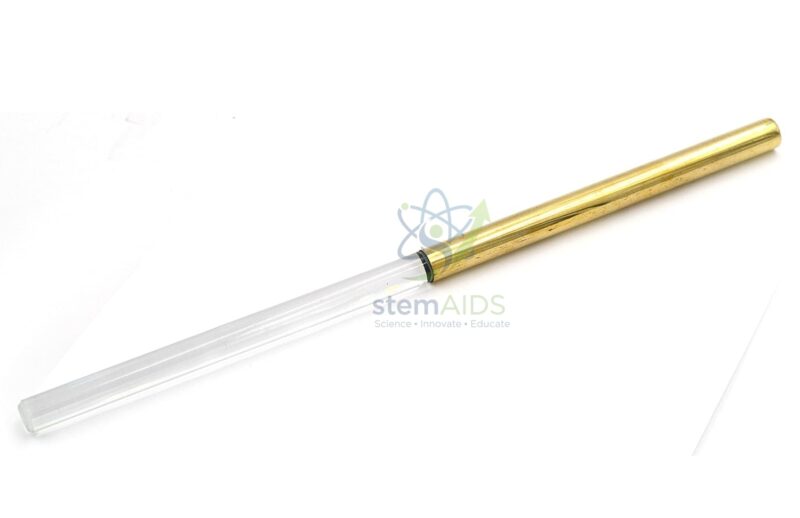
Quick Answer: The brass rod with acrylic handle is a metal rod fixed to a clear acrylic (PMMA) grip, as pictured, for electrostatics experiments. Because the acrylic insulates the brass from the hand, the metal part can be charged by rubbing or by contact and keeps its charge, which a brass rod held directly in the hand cannot do.
Can a Metal Be Charged by Rubbing?
Early experimenters concluded that metals could not be electrified by friction, because rubbing a metal rod held in the hand produced no effect. The explanation, worked out in the eighteenth century, is that a metal is a conductor: any charge produced flows straight through the rod and the experimenter’s body to earth. Mount the same metal on an insulating handle and the charge has nowhere to go, so the rod charges perfectly well.
This rod lets students repeat that discovery. Rub a plain metal rod held in the hand and test it with an electroscope: nothing happens. Then rub the brass part of this rod, holding only the acrylic, and the electroscope responds.
Conductor and Insulator on One Rod
The rod combines both classes of material, which makes it ideal for contrasting them. Charge placed on the brass spreads over the whole metal surface at once, so touching any point of the metal to an electroscope transfers charge. Charge rubbed onto the acrylic stays where it was produced, so only the rubbed patch affects an electroscope. The brass end can also act as a charge carrier, picking up charge from a generator dome or a charged sphere by contact and carrying it to an electroscope or coulombmeter, much as a proof plane does.
Experiments
- Showing that a metal can be charged by friction when it is insulated from the hand
- Contrasting how charge spreads on a conductor but stays put on an insulator
- Carrying samples of charge from a charged body to an electroscope or coulombmeter
- Charging an electroscope by contact from a metal surface
Care & Handling
- Hold the rod only by the acrylic during experiments, with dry hands.
- Wipe the acrylic with a soft, dry cloth; avoid solvents and alcohol, which can craze acrylic.
- Polish the brass occasionally with a soft cloth to remove tarnish and fingerprints.
- Store the rod so the acrylic is not scratched; scratches hold dirt and moisture that leak charge.
Specifications
| Conductor | Brass rod section |
| Handle | Clear acrylic (PMMA), as pictured |
| Purpose | Charging a metal by friction or contact while it is insulated from the hand |
| Used with | Silk, wool or leather rubbing cloths and an electroscope |
| Length and rod diameter | Confirm at enquiry |
Why Choose LabEquip
Teachers buy this rod to make the conductor and insulator distinction concrete in electrostatics lessons. It works well with the large demonstration electroscope, and more charging items are listed in the LabEquip Physics Equipments range.
Frequently Asked Questions
Why can a metal rod not be charged when held in the hand?
Metal is a conductor and so is the human body. Charge produced by rubbing flows through the rod and the body to earth straight away, so the rod never builds up a charge.
Why is acrylic used for the handle?
Acrylic, also known as PMMA, is a good electrical insulator, so it stops charge on the brass leaking into the hand. It is also clear, light and shatter-resistant, which suits handling in class.
Which cloth should be used to charge the brass?
Any clean, dry rubbing cloth such as wool, silk or fur will charge the brass while it is held by the handle. Because the sign depends on the pair of materials, check it with an electroscope that already carries a known charge.
How is this different from a proof plane?
A proof plane is a small metal disc on an insulating handle, used to sample charge from surfaces. The brass rod does the same job and can also be charged by rubbing, so it covers both kinds of experiment.
Does the whole brass part become charged?
Yes. Brass is a conductor, so charge spreads over the entire metal surface almost instantly. That is the key contrast with the acrylic, where charge stays only on the patch that was rubbed.
How do I discharge the rod?
Touch the brass with a finger or an earthed wire and the charge flows away immediately. If the acrylic has picked up charge, wipe it with a slightly damp cloth and let it dry before the next test.
Last Updated: October 2026




Reviews
There are no reviews yet.