
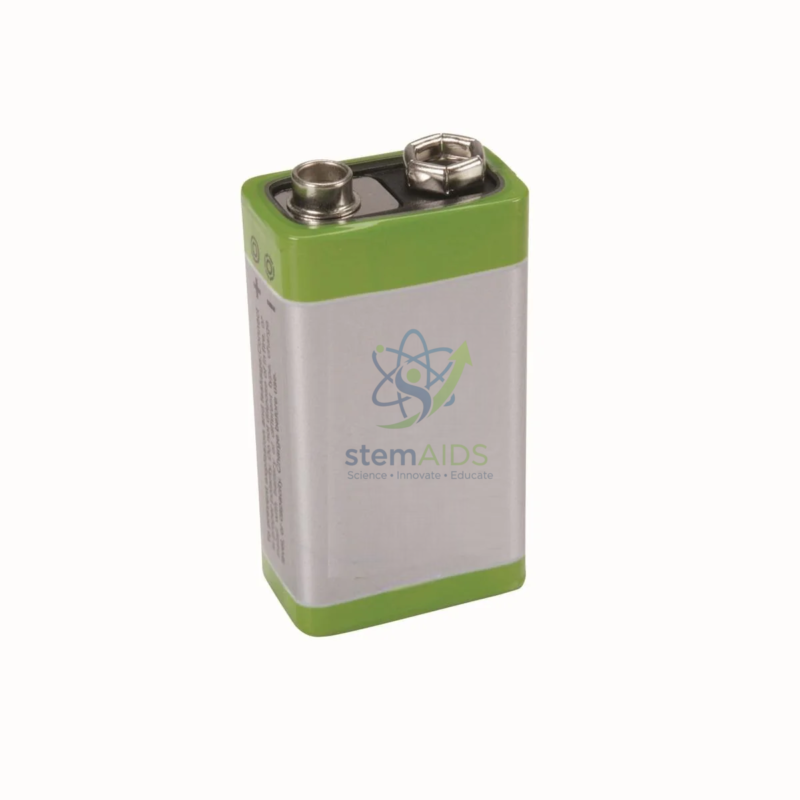
Quick Answer: This is a single 9 V alkaline battery in the rectangular format catalogued as 6F22, also known as PP3, with snap terminals at one end. The 9 V alkaline battery powers multimeters, small electronic circuits, sensors and timers in the physics laboratory.
What Is Inside a 9 V Battery
A 9 V battery is not a single cell. Inside the case are six 1.5 V cells connected in series, which is why the size code begins with a 6. The two snap terminals on top carry the full 9 V: the smaller round stud is positive and the larger hexagonal one negative, and the matching battery clip fits only one way round.
Alkaline chemistry, zinc and manganese dioxide with an alkaline electrolyte, stores considerably more energy than the older zinc-carbon type of the same size and copes better with moderate currents. Strictly, 6F22 is the international code for the zinc-carbon version, while the alkaline version is coded 6LR61; both have the same size and terminals and fit the same clip.
Specifications
| Type | Alkaline primary battery, single unit |
| Nominal voltage | 9 V, as titled |
| Format | Rectangular 6F22 (PP3) size |
| Terminals | Snap connectors |
| Rechargeable | No |
Good Uses and Poor Uses
The 9 V format suits devices that need a higher voltage at a modest current: multimeters, transistor and op-amp circuits on breadboards, timers and data-logging sensors. It is a poor choice for motors, lamps or electromagnets, which draw heavy currents and flatten it quickly; a 4.5 V flat battery or a low-voltage power supply serves those better.
Typical Lab Uses
- Powering digital multimeters and small test instruments
- Supplying transistor, op-amp and timer circuits on breadboards
- Running portable sensors and alarm models
- Demonstrating series cells and internal resistance
Care & Handling
- Store with the terminals covered or in the original pack; the close-set terminals can be shorted by keys, coins or a metal clip
- Remove the battery from instruments that will stand unused for some weeks, to prevent leakage
- Do not recharge, open or heat alkaline batteries
- Dispose of used batteries through a battery collection or recycling point, following local rules
Why Choose LabEquip
Single 9 V alkaline units are bought as consumables for multimeters and electronics benches. LabEquip supplies them alongside the 12 V switching power supply and other physics lab equipment, so one laboratory order can cover instruments and the batteries they run on.
Frequently Asked Questions
What does 6F22 mean?
In the international battery code, the 6 means six cells in series and F22 refers to a flat-cell construction of a particular size. The alkaline version of the same size is coded 6LR61.
Is a 9 V alkaline battery rechargeable?
No. It is a primary battery, and trying to charge it can cause leakage or rupture. Use a rechargeable 9 V battery and a suitable charger if recharging is needed.
Which terminal is positive?
The smaller, round snap terminal is positive and the larger, hexagonal one is negative.
Why does it go flat quickly in a motor circuit?
Motors and lamps draw large currents, and a small 9 V battery stores relatively little energy and has a high internal resistance. Its voltage drops and it runs down fast under heavy load.
How can students measure its internal resistance?
Measure the terminal voltage with no load and then with a known resistor connected. The fall in voltage divided by the current gives the internal resistance.
How should used batteries be disposed of?
Take them to a battery collection or recycling point rather than putting them in household waste, and tape over the terminals of 9 V batteries while they wait for disposal.
Last Updated: October 2026






Reviews
There are no reviews yet.