
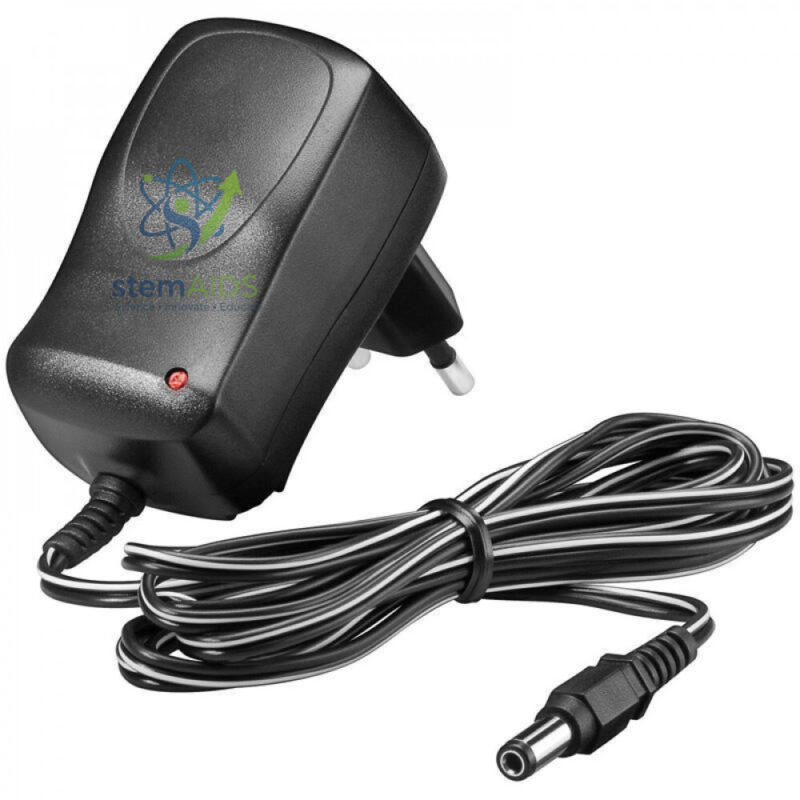
Quick Answer: This 12 V switching power supply is a plug-in mains adapter that delivers 12 V direct current at up to 600 mA, as titled, through a cable ending in a round DC plug. It powers 12 V laboratory devices such as sensor interfaces, small electronics boards, LED modules and low-power motors.
How a Switching Supply Differs
An older linear adapter uses a heavy transformer working at mains frequency, followed by a rectifier and a regulator. A switching, or switch-mode, power supply first rectifies the mains, then switches it on and off many thousands of times a second through a small high-frequency transformer, and finally rectifies and regulates the result. Working at high frequency lets the transformer be very small, so the adapter is light and wastes less energy as heat than a linear design.
A regulated switching supply holds its output close to 12 V from no load up to its rated current. The 600 mA rating means the device it powers should draw no more than 0.6 A; at full load that is 7.2 W of output power (12 V × 0.6 A).
Specifications
| Type | Plug-in switch-mode adapter, as pictured |
| Output | 12 V DC, up to 600 mA, as titled |
| Output power | 7.2 W maximum (12 V × 0.6 A) |
| Output connector | Round DC plug on a cable |
| Mains plug type and DC plug size | Confirm at enquiry |
Matching the Supply to a Device
Three checks avoid damage. The device must be designed for 12 V DC; it must draw 600 mA or less; and the DC plug must fit and have the right polarity, since some equipment expects a centre-positive plug and some a centre-negative one. The polarity symbol printed on the adapter and on the device should match. A device that needs more current will make the adapter overheat or shut down.
The product photograph shows a compact wall-plug unit with a two-pin mains plug and a lead ending in a round DC connector.
Uses
- Powering sensor interfaces and data loggers rated for 12 V DC
- Supplying microcontroller and electronics boards that have a 12 V input
- Running LED modules and small 12 V fans or motors within the current limit
- Replacing a lost adapter for 12 V laboratory equipment
Care & Handling
- Use it indoors and keep it dry; do not cover the adapter while it is working
- Unplug it from the mains when not in use and before connecting or disconnecting the device
- Do not open the case; switch-mode adapters contain parts at mains voltage
- Replace the adapter if the cable or plug is damaged
Why Choose LabEquip
A 12 V switching adapter is a practical spare for any laboratory running 12 V sensors, interfaces and electronics boards. LabEquip supplies it with the battery eliminator and other physics lab equipment; state the mains plug needed via the contact page.
Frequently Asked Questions
What is a switching power supply?
It is a power supply that converts mains to low-voltage DC by switching at high frequency through a small transformer. This makes it lighter and more efficient than an older linear adapter.
Can it power a device that needs 1 A at 12 V?
No. The adapter is rated for 600 mA. A device drawing more current would overload it, causing overheating or shutdown.
Does the voltage matter if the plug fits?
Yes. The device must be rated for 12 V DC. A plug that fits does not mean the voltage or polarity is right, so check the labels on both.
What does centre-positive mean?
It means the pin in the centre of the DC plug is positive and the outer sleeve is negative. Devices marked centre-negative need the opposite arrangement.
Can it be used to charge batteries?
Not directly. Battery charging needs a charger that controls the current and voltage to suit the battery chemistry.
Is the 12 V output safe to touch?
The 12 V DC output is a low voltage, but the adapter itself is connected to the mains. Keep it dry and do not use it if the case is damaged.
Last Updated: October 2026




Reviews
There are no reviews yet.