
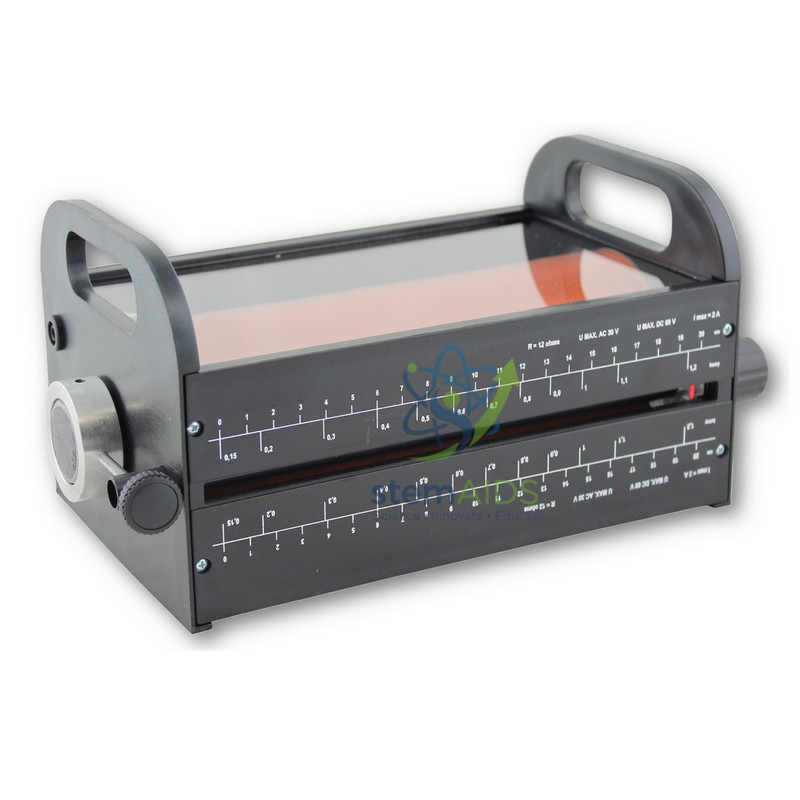
Quick Answer: The Induction coil 1.4 H is a large wound coil with an inductance of 1.4 henry, as stated in its name, used to study self-induction. As pictured, the winding sits in a frame with a carrying handle and an opening along its axis, and it is connected into circuits to show how an inductor opposes changes in current.
What 1.4 Henry Means
Any coil carrying a current sets up a magnetic field that links its own turns. When the current changes, that changing flux induces an emf in the coil which opposes the change, as Lenz’s law requires. The size of the effect is the inductance L: the induced emf equals L multiplied by the rate of change of current. An inductance of 1.4 H means that a current changing at one ampere per second induces 1.4 volts across the coil.
That is large enough for self-induction to be seen with simple lamps and meters rather than only on an oscilloscope. It also separates this item from a classic high-voltage spark induction coil, which uses two windings and an interrupter; this coil is used as an inductor in low-voltage circuits.
Seeing Self-Induction
Connect two identical lamps in parallel branches across a low-voltage DC supply, one in series with the coil and one with a resistor set so both glow equally once steady. At switch-on the lamp with the resistor lights at once while the lamp with the coil lags noticeably, because the coil’s back emf slows the rise of current. The time constant of the coil branch is L/R, so the delay grows with inductance and shrinks with resistance.
At switch-off the opposite happens. The collapsing field induces an emf that tries to keep the current flowing, and with no closed path it can be far larger than the supply voltage. A neon lamp connected across the coil flashes at the instant the switch opens, although the supply alone is too low to light it.
Measuring the Inductance
On an AC supply of known frequency f, the coil’s impedance Z is the voltage across it divided by the current through it. Its resistance R is measured with an ohmmeter, and the reactance X follows from Z² = R² + X². Since X = 2πfL, the inductance can be calculated and compared with the marked value. Inserting a soft-iron core into the axial opening, where the design allows, raises the inductance sharply, which students can see as a dimmer AC lamp in series.
Applications
- Demonstrating delayed switch-on of a lamp in series with an inductor
- Showing the high back emf at switch-off with a neon lamp
- Measuring inductance from AC impedance and DC resistance
- Recording the RL rise and decay of current with a data logger or oscilloscope
Specifications
| Type | Inductor coil for self-induction experiments |
| Inductance | 1.4 H, as stated in the product name |
| Construction | Winding in a frame with a carrying handle and an axial opening, as pictured |
| Use | Low-voltage DC and AC circuit experiments |
| Core condition for the 1.4 H value, resistance and current rating | Confirm at enquiry |
Care & Handling
- Do not touch the coil terminals while breaking a circuit; the induced voltage at switch-off can give a sharp shock even from a low-voltage supply.
- Keep within the coil’s current rating, since excess current overheats the winding.
- Lift and carry the coil by its handle; the winding is heavy and the frame protects it from knocks.
- Keep loose metal objects away from the axial opening unless the experiment calls for an iron core.
Why Choose LabEquip
A coil with an inductance this large is bought by schools and colleges that want self-induction to be visible with lamps rather than inferred from graphs. Pair it with the single pole knife switch for clean switching and a digital multimeter for resistance measurements; more items are in the LabEquip Physics Equipments category.
Frequently Asked Questions
Is this a spark induction coil?
No. A spark or Ruhmkorff induction coil has primary and secondary windings and an interrupter to produce high-voltage sparks. This coil is an inductor with a stated inductance of 1.4 H, used to study how a coil opposes changes in current.
Why does the lamp in series with the coil light late?
When the switch closes, the rising current induces a back emf in the coil that opposes the rise. The current, and so the lamp brightness, builds up over a time set by the inductance divided by the circuit resistance.
Why can the coil give a shock from a low-voltage supply?
When the current is switched off quickly, the magnetic field collapses rapidly and induces a large emf that can far exceed the supply voltage. Avoid touching the terminals when breaking the circuit, and use a diode or neon lamp across the coil to absorb the surge.
Does an iron core change the inductance?
Yes. Iron greatly increases the magnetic flux linking the turns, so inductance rises sharply with a core in place. Whether the stated value refers to the coil with or without a core should be established before precise measurements.
How can I measure the inductance in class?
Find the impedance from the AC voltage and current at a known frequency, measure the resistance with an ohmmeter, then work out the reactance and divide it by 2πf.
Can the coil be used on mains AC?
No. It is intended for low-voltage AC and DC from a laboratory power supply. Mains voltage requires equipment built and insulated for that purpose.
Last Updated: October 2026




Reviews
There are no reviews yet.