


In Stock
Primary Microscience Kit
₹1,095.00
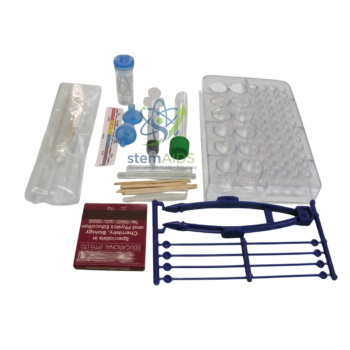
The StemAids Primary Microscience Kit is a compact educational science kit designed for primary school learners to perform hands-on activities in physics, chemistry, biology, environmental science, and STEM learning. It supports safe, small-scale practical work using simple apparatus, small quantities of materials, and reusable classroom components.
Product Description
The StemAids Primary Microscience Kit helps young learners explore science through observation, prediction, experiment, comparison, and conclusion writing. It is suitable for primary schools, STEM labs, science clubs, teacher-training programs, and activity-based classrooms.
This kit is designed to make science learning practical even in classrooms with limited laboratory space. Students can investigate everyday scientific ideas such as air, water, soil, heat, floating and sinking, magnetism, simple electricity, food testing, plant observation, matter, measurement, and basic chemical change under teacher supervision.
The kit supports individual, pair, or small-group activities and helps teachers conduct practical lessons with less setup time, reduced material usage, and easier classroom management.
Product Specifications
| Parameter | Details |
|---|---|
| Product Name | Primary Microscience Kit |
| Brand | StemAids |
| Product Type | Primary-level microscience and STEM activity kit |
| Subject Coverage | Physics, chemistry, biology, environmental science, measurement, and STEM activities |
| Recommended Learning Level | Primary school, upper primary, Grades 3 to 7, science clubs, and teacher-training programs |
| Learning Method | Small-scale practical activities, observation tasks, classroom experiments, and guided inquiry |
| Core Topics | Air, water, soil, food, heat, states of matter, simple electricity, magnetism, plant observation, measurement, floating and sinking, and basic chemical change |
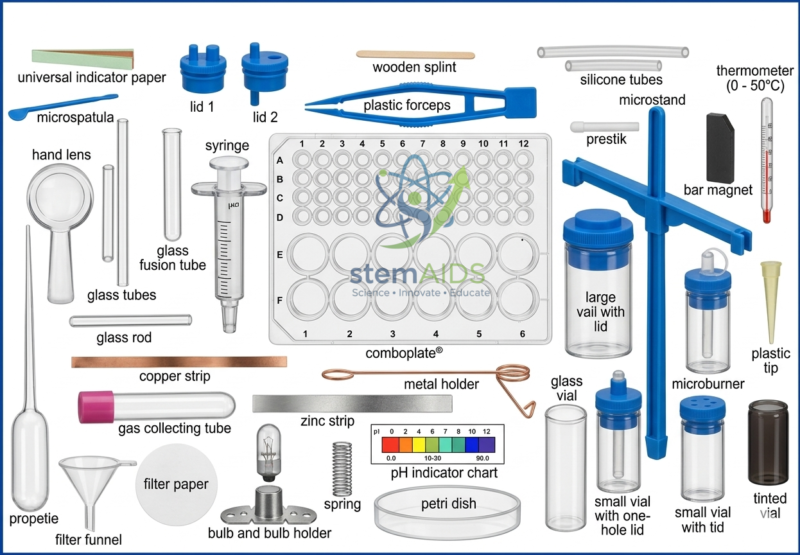
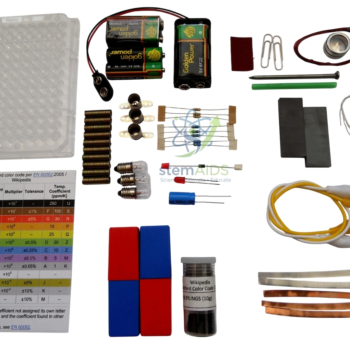
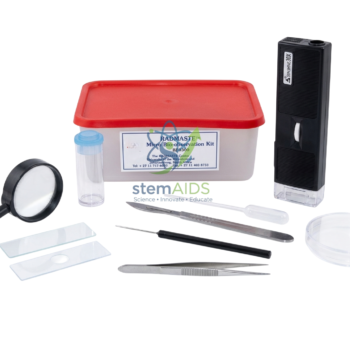
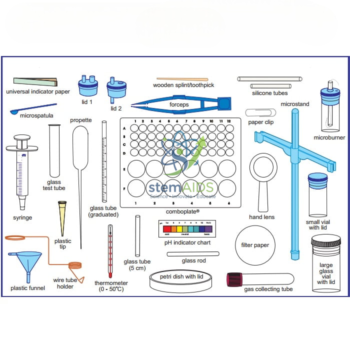
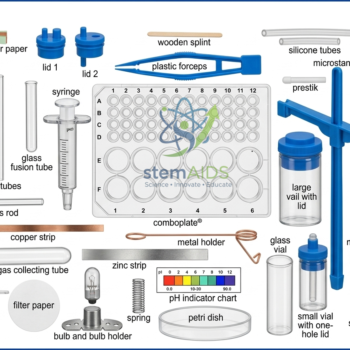
| Typical Components | Microplate or activity plate, small containers, droppers, pipettes, measuring spoons, tubes, magnets, wires, simple circuit parts, hand lens, specimen containers, labels, worksheets, and activity guide depending on kit configuration |
| Experiment Format | Low-volume and small-scale activities suitable for primary classrooms |
| Reusable Components | Yes, most apparatus items are reusable after proper cleaning and storage |
| Chemical Requirement | Uses safe household or teacher-controlled classroom materials depending on activity; any chemicals should be handled only under supervision |
| Power Requirement | Low-voltage battery use only for electricity activities, depending on kit version |
| Manual / Guide | Student activity sheets and teacher guide depending on supply configuration |
| Storage | Supplied in a compact kit box, tray, or compartment case depending on configuration |
| Safety Requirement | Teacher supervision, age-appropriate activity selection, PPE where required, and safe handling of small parts |
| Application | Primary science practicals, STEM activities, classroom demonstrations, environmental observations, and hands-on science learning |
| Suitable For | Primary schools, STEM labs, science clubs, activity centers, teacher-training institutes, and educational laboratories |
Key Features
- Designed for primary-level hands-on science learning
- Covers physics, chemistry, biology, environmental science, and STEM basics
- Uses compact microscale components for easy classroom management
- Helps reduce material use, setup time, storage space, and cleanup effort
- Supports activities on air, water, soil, heat, matter, electricity, magnetism, and food
- Reusable components support repeated classroom practical sessions
- Suitable for individual learners, pairs, and small groups
- Encourages observation, questioning, prediction, experimentation, and recording
- Useful for schools with limited laboratory infrastructure
How to Use
- Read the teacher guide or activity sheet before beginning the lesson.
- Select an age-appropriate activity such as air, water, soil, magnetism, heat, food, or simple electricity.
- Place the StemAids Primary Microscience Kit on a clean, dry, and stable classroom table.
- Distribute only the required components for the selected activity.
- Explain the aim of the experiment and ask learners to make predictions.
- Use small quantities of safe materials or teacher-approved reagents.
- Guide students to observe changes such as colour, movement, floating, sinking, heating, cooling, attraction, repulsion, or circuit response.
- Ask students to record observations through words, drawings, tables, or worksheets.
- Discuss results and connect the activity to the science concept being taught.
- Clean reusable components after the activity.
- Dry all items properly before storage.
- Return components to the kit box and store in a safe, dry place.
Applications
- Primary science classroom practicals
- STEM activity-based learning
- Air and water experiments
- Soil and environmental observation
- Heat transfer and states of matter activities
- Simple electricity and circuit demonstrations
- Magnetism activities
- Food and nutrition observation activities
- Plant and seed observation
- Measurement and classification tasks
- Science club and teacher-training activities
Safety and Handling Guidelines
- Use the kit only under teacher, instructor, or trained adult supervision.
- Select experiments suitable for the learner age group.
- Keep small parts away from very young children to avoid choking risk.
- Use only low-voltage batteries for electricity activities.
- Do not connect any kit component to mains electricity.
- Use safe, teacher-approved materials for chemistry and food activities.
- Do not taste, smell directly, or touch unknown substances.
- Wear gloves or safety goggles when the activity requires protection.
- Keep liquids away from electrical components.
- Clean spills immediately using a classroom-safe method.
- Wash hands after activities involving soil, water, food, or biological samples.
- Store the kit in a dry, clean place after use.
Quality and E-E-A-T Notes
The StemAids Primary Microscience Kit supports evidence-based science education by helping learners perform real observations, make predictions, test ideas, compare results, and explain findings in their own words. Small-scale activities make practical science more accessible, reduce material use, and support safer classroom participation when used under teacher guidance.
FAQ
1. What is the StemAids Primary Microscience Kit used for?
It is used for primary-level hands-on science activities in physics, chemistry, biology, environmental science, and STEM learning.
2. Which classes can use this kit?
It is suitable for primary and upper-primary learners, commonly from Grades 3 to 7, depending on the activity and teacher guidance.
3. What subjects does the kit cover?
The kit covers basic physics, chemistry, biology, environmental science, measurement, electricity, magnetism, heat, air, water, soil, and food-related activities.
4. What is microscience?
Microscience means performing science experiments using small-scale apparatus and small quantities of materials while maintaining hands-on learning.
5. Is this kit suitable for schools without full laboratories?
Yes, the kit is useful for schools with limited laboratory space because many activities can be performed on classroom desks under supervision.
6. Are the components reusable?
Yes, most apparatus items are reusable after proper cleaning, drying, and storage.
7. Does the kit include chemicals?
Chemical supply depends on the selected kit version. Many activities can use safe classroom materials, while teacher-controlled chemicals may be supplied separately.
8. Can this kit be used for electricity experiments?
Yes, selected configurations support simple low-voltage electricity activities using batteries, wires, switches, and small loads.
9. Can learners use the kit individually?
Yes, it can be used by individual learners, pairs, or small groups depending on classroom planning and number of kits available.
10. Does it support activity-based learning?
Yes, the kit is designed for observation-based, inquiry-based, and activity-based science learning.
11. How should the kit be cleaned?
Wash reusable plastic or glass components with clean water or a suitable mild cleaning solution, dry them completely, and store them in the kit box.
12. Why is this kit useful for STEM education?
It develops observation, questioning, measurement, comparison, problem-solving, teamwork, and scientific reasoning skills at an early learning stage.
Why Choose StemAids?
StemAids educational science kits are selected for practical learning, classroom usability, and curriculum-supportive laboratory work. The StemAids Primary Microscience Kit supports early science learning, small-scale experimentation, student participation, STEM skill development, safer classroom practicals, and economical science education for schools, science clubs, teacher-training institutes, and activity-based learning programs.
SEO Keywords
StemAids Primary Microscience Kit, Primary Microscience Kit, Primary Science Kit, School Science Kit, STEM Science Kit for Primary Students, Microscience Kit for Schools, Hands-On Science Kit, Educational Science Kit, Classroom Science Experiment Kit, Primary Physics Chemistry Biology Kit, Activity Based Science Kit, Science Practical Kit for Primary Schools
You must be logged in to post a review.
Bestsellers


Reviews
There are no reviews yet.