





In Stock
Water Purity Kit
Trousse pureté des eaux High-stability chemical indicators calibrated for colorimetric and titrimetric detection of dissolved oxygen levels with millimolar precision.
Forensic-Grade Color Comparators UV-stabilized reference scales engineered with permanent pigment-fast technology to prevent parallax errors and ensure accurate result matching in variable outdoor lighting conditions.
₹1,450.00
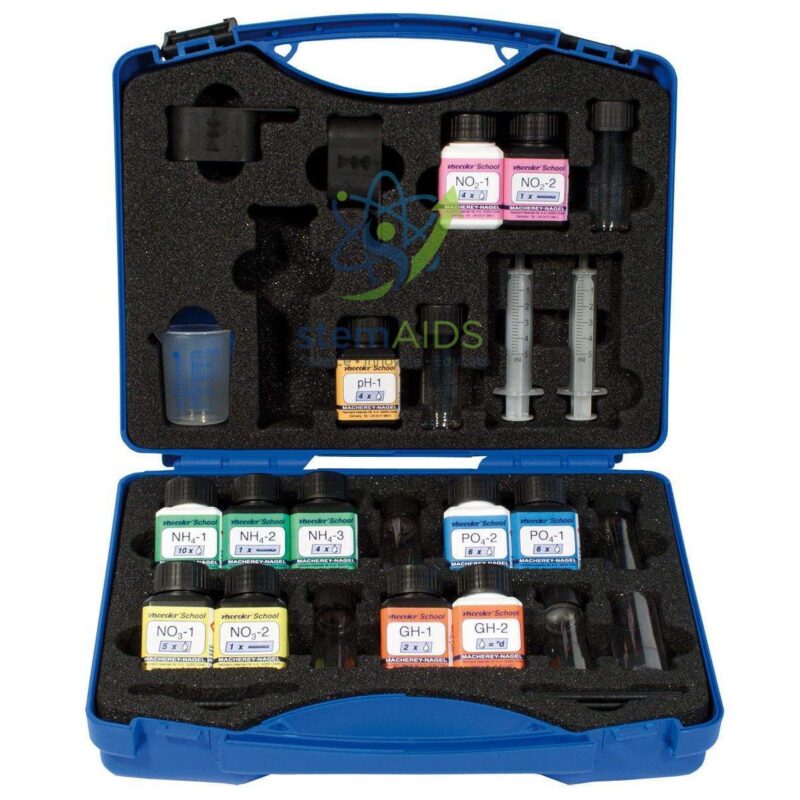
Quick Answer: The Water Purity Kit is a portable water testing kit packed in a blue carry case. The listing photograph shows reagent bottles, test vials, syringes and a small beaker, the usual contents of a colour-comparison kit in which students add reagents to a water sample and judge the result against a colour chart.
How Colour-Comparison Water Tests Work
Most parameters in a kit like this are measured colorimetrically. A measured volume of sample goes into a test vial, one or more reagents are added in a set order, and after a set waiting time the substance being tested forms a colour whose depth depends on how much of it is present. Comparing the vial with a printed colour scale gives an approximate concentration. Other tests, such as hardness, are often done by counting drops of a titrant until the colour changes.
The listing does not give the list of parameters. School water kits commonly cover several of pH, nitrate, nitrite, ammonium, phosphate, hardness and chloride, so check the list against the syllabus or project before ordering. Results are approximate and suit comparisons, such as upstream against downstream or tap against pond water, rather than regulatory testing.
The carry case keeps reagents, vials and syringes together for fieldwork, and the syringes let students measure sample volumes accurately at the waterside. When reagents run low or pass their expiry date, the Refill for Water Purity Kit replaces them without buying a new case, and a TDS/EC water testing meter adds an electronic measurement of dissolved salts.
Specifications
| Type | Portable colour-comparison water testing kit |
| Contents in photograph | Reagent bottles, test vials, syringes, beaker, carry case |
| Method | Colour comparison and drop-count tests |
| Refills | Available separately |
| Parameters tested | Confirm at enquiry |
Investigations With the Kit
- Comparing river water above and below a village, farm or outfall.
- Testing pond, well, tap and bottled water in a class investigation.
- Relating nitrate and phosphate levels to algal growth in eutrophication studies.
- Science fair and eco-club projects on local water quality.
Good Practice and Safety
- Rinse vials and syringes with the sample before measuring, and with clean water after each test, so results are not carried over.
- Read colours in daylight against a white background, holding the vial level with the chart.
- Some reagents are hazardous: read the safety data sheets, wear eye protection and gloves, and collect used test solutions for proper disposal instead of pouring them into the water body.
- Store the case closed, upright and away from heat and sunlight, and note reagent expiry dates.
Why Choose LabEquip
Geography, environmental science and biology departments buy portable water kits for fieldwork and eco-club projects. LabEquip lists the kit in General Lab Products, and the parameters covered can be confirmed through the contact page.
Frequently Asked Questions
How accurate are colour-comparison water tests?
They give approximate values, usually as a range between colour steps. They are well suited to comparing sites and spotting pollution, while legal or health decisions about water need a properly accredited testing laboratory.
Can the kit tell whether water is safe to drink?
No. Drinking water safety also depends on microorganisms and other contaminants that a school kit does not measure. Use the kit for teaching and comparison, and rely on official testing for drinking water decisions.
Why rinse the vial with the sample first?
Rinsing with a little of the sample removes traces of rinse water or earlier samples, which would dilute or contaminate the new one and change the colour.
Why must the waiting time be followed?
The colour develops over a set period, so reading too early gives a low value and waiting too long can change the shade. Time each test with a watch or stopwatch.
How should used test solutions be disposed of?
Collect them in a labelled waste bottle and dispose of them according to the reagents’ safety data sheets and your school’s rules. Never pour them back into the stream or pond being studied.
What if my results look strange?
Check the reagent expiry dates, the sample volume and the waiting time, then repeat the test. Testing distilled water or a known standard shows whether the reagents are still working.
Last Updated: September 2026
You must be logged in to post a review.
Bestsellers




Reviews
There are no reviews yet.