


In Stock
Tongs, Mercury
Hemispherical Split-Cup Tips: Precision-machined concave tips that perfectly encapsulate mercury droplets, preventing them from rolling away or fragmenting during collection.
Stout Wire Construction: Manufactured from high-tensile steel wire that provides the perfect balance of spring tension and structural rigidity.
₹235.00
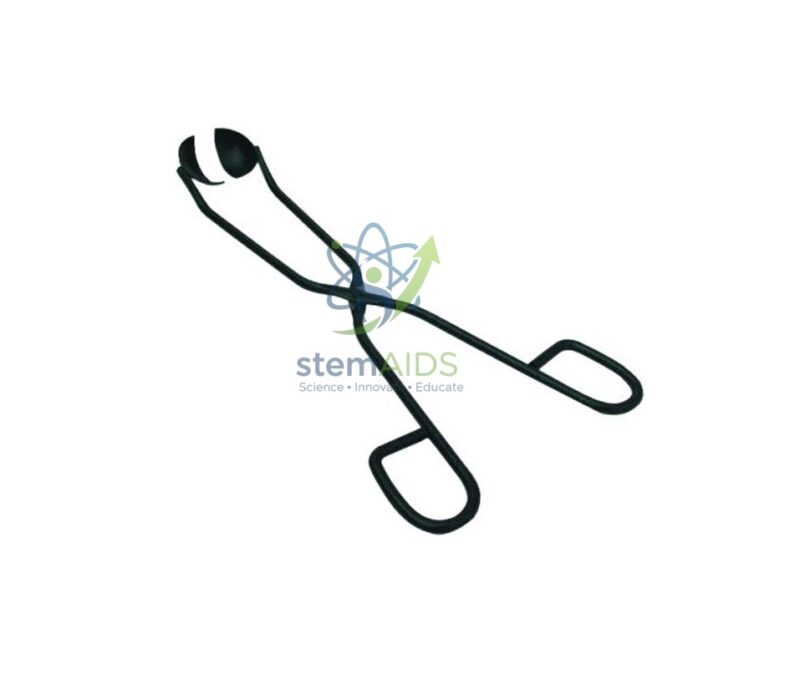
Quick Answer: Mercury tongs are scissor-action laboratory tongs whose jaws end in two small cups that close around a bead of liquid mercury or a small ball, so it can be lifted instead of pushed across the bench. The listing photograph shows dark-finished wire tongs with loop handles and cupped tips.
Why Mercury Needs Cupped Jaws
Liquid mercury has a very high surface tension, so a spill breaks into shiny beads that roll away from flat forceps and split into smaller droplets when squeezed. These tongs deal with this by closing two shallow cups around the bead from either side. The cups form a small pocket, and the bead can be lifted and dropped into a container without being pinched apart.
Material matters more than usual for a tool that touches mercury. Mercury dissolves into many metals to form amalgams, including copper, brass, zinc, tin, silver and aluminium, and a tool made of these would be attacked and would carry mercury away on its surface. Iron and plain steel do not amalgamate, which is why mercury has traditionally been stored in iron flasks. The title does not name the metal or finish of these tongs, so ask LabEquip to confirm it before using them for regular mercury work.
The same cupped tips suit other small round items that are hard to grip, such as steel ball bearings from physics apparatus, lead shot or glass beads. For hot crucibles, use purpose-made straight crucible tongs, whose jaws are shaped to grip a rim.
Care & Handling
- Put collected mercury under a layer of water in a sealed, labelled container, which cuts evaporation, and hand it over as hazardous waste according to local rules.
- Never sweep or vacuum a mercury spill; brooms scatter the beads and vacuum cleaners spread the vapour through the room.
- Wipe the cups with a damp tissue after use and dispose of the tissue with the mercury waste.
- Check that the cups still meet evenly; bent tips leave a gap through which small beads escape.
Applications
- Recovering beads of mercury from a spill tray after a broken thermometer or barometer, alongside a mercury spill kit
- Transferring small drops of mercury in older physics and chemistry apparatus that still uses it
- Picking up ball bearings, lead shot or glass beads used in physics experiments
- Handling small spherical samples that roll away from flat forceps
Specifications
| Type | Scissor-action tongs with cupped tips |
| Tips | Two small opposing cups (as pictured) |
| Handles | Wire loop finger grips (as pictured) |
| Finish | Dark finish shown in the listing photograph |
| Typical use | Lifting mercury beads and small spheres |
| Metal and length | Confirm at enquiry |
Why Choose LabEquip
Tongs of this kind are bought by schools and colleges that still hold mercury thermometers, manometers or barometers and want a spill response ready before an accident happens. LabEquip lists them in its General Lab Products range with other handling tongs; send your enquiry with the quantity needed for each lab.
Frequently Asked Questions
How do mercury tongs differ from crucible tongs?
Crucible tongs have bowed or pointed jaws for gripping the rim of a hot crucible. Mercury tongs end in two small cups that close around a bead of liquid and hold it in a pocket, which flat or pointed jaws cannot do.
Can the tongs pick up very small mercury droplets?
Only beads large enough to sit in the cups. Fine droplets are first gathered together with a stiff card or a mercury aspirator bulb, or bound with the powder in a mercury spill kit, and then transferred.
Why should tools used for mercury not be made of brass or copper?
Mercury forms amalgams with copper, brass, zinc, tin, silver and aluminium. A tool made of these metals is attacked and carries mercury on its surface. Iron and plain steel do not amalgamate.
What should I do with mercury after collecting it?
Place it in a sealed, labelled container under a little water to reduce evaporation, and dispose of it through a hazardous-waste route in line with local regulations. Never pour it down a drain.
Is it safe to handle a mercury spill in a classroom?
A small spill from a single thermometer can be managed by trained staff wearing gloves, with students moved away and the room ventilated. Large spills need specialist help. Never use a broom or vacuum cleaner.
Can the tongs be used for other small objects?
Yes. The cupped tips hold ball bearings, lead shot, glass beads and other small spheres securely, which makes them useful in physics practicals as well.
Last Updated: September 2026
You must be logged in to post a review.
Bestsellers




Reviews
There are no reviews yet.