










In Stock
Tongs, Crucible, Straight
Precision Straight Jaws: The narrow, straight-serrated tips are designed to fit perfectly into the small handle-loops or under the rims of standard crucibles, providing maximum control in confined spaces.
High-Heat Tolerance: Constructed to withstand direct contact with glowing-hot vessels without losing structural integrity or warping.
$2.37
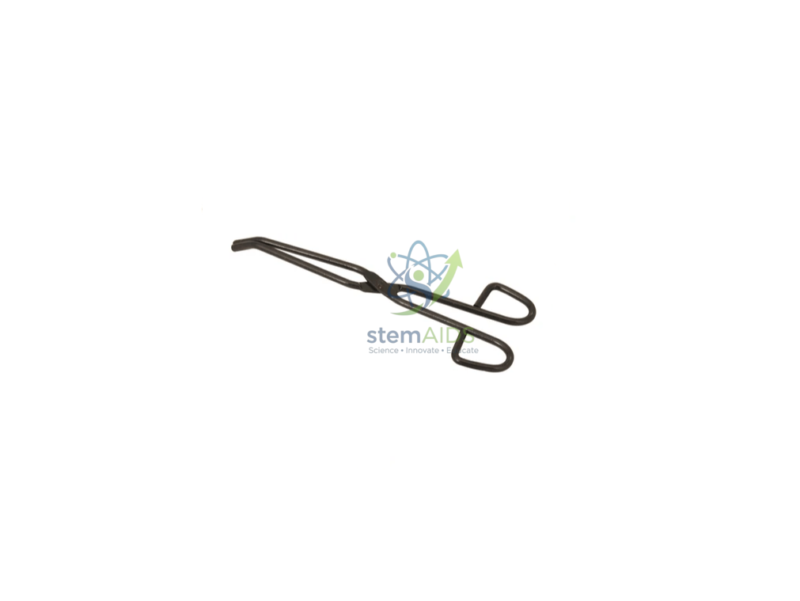
Quick Answer: The Tongs, Crucible, Straight are straight crucible tongs: scissor-action tongs with long straight arms and narrow tips for gripping crucibles, crucible lids and small evaporating dishes. The listing photograph shows a dark metal pair with finger loops.
Straight versus Bowed Crucible Tongs
Crucible tongs come in two main shapes. Bowed tongs have a curve in each jaw so they can close around the body of a crucible, while straight tongs keep the arms in line and bring narrow tips together at the end. Straight tongs are the tool for lifting a crucible by its rim, raising or tilting the lid during heating, and picking crucibles out of a furnace or a pipeclay triangle where there is little room around them.
In a classic school practical, burning magnesium in a crucible, the lid has to be lifted briefly and replaced to let air in while keeping the white oxide inside. Straight tips make that easy because they meet precisely. The same applies when a crucible is moved from the triangle to a desiccator to cool before weighing in heating-to-constant-mass work.
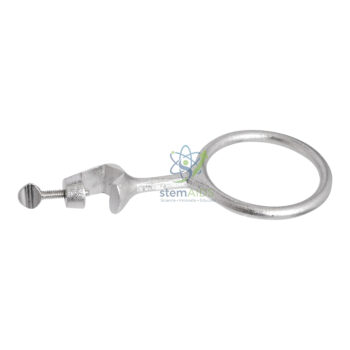
The photograph’s dark finish suggests plain steel, which tolerates flame and furnace heat but rusts if left wet; the title does not name the metal. For supporting the crucible over the burner, use a ring such as the retort ring with boss head 3 with a pipeclay triangle; for filtration crucibles, see the Gooch crucible.
Applications
- Lifting and replacing a crucible lid when burning magnesium to find the formula of its oxide
- Transferring a hot crucible from a pipeclay triangle to a desiccator when heating to constant mass
- Removing crucibles and combustion boats from a muffle furnace
- Picking up small evaporating dishes by the rim after evaporation
Specifications
| Type | Crucible tongs, straight pattern |
| Action | Scissor type with finger loops (as pictured) |
| Tips | Narrow, meeting at the end of straight arms |
| Finish | Dark metal in the listing photograph |
| Handles | Crucibles, lids, small dishes, combustion boats |
| Length and metal | Confirm at enquiry |
Care & Handling
- Warm the tips briefly before gripping a red-hot porcelain crucible, so cold metal does not crack it.
- Set hot tongs down on a heat-resistant mat with the tips off the bench.
- Dry the tongs after washing and keep the hinge lightly oiled to prevent rust.
Why Choose LabEquip
Chemistry departments running gravimetric and combustion practicals need tongs at every heating station. LabEquip supplies crucible, beaker and flask tongs from General Lab Products; add them to a stand and ring order through the contact page.
Frequently Asked Questions
When should I use straight rather than bowed crucible tongs?
Use straight tongs to grip a crucible by its rim, to handle the lid and to reach into tight spaces such as a furnace or triangle. Bowed tongs grip the body of a crucible and suit carrying larger ones.
How do I lift a crucible lid during heating?
Grip the lid at its edge with the tips, raise it slightly for a moment to admit air, and lower it back. Keep your face above and away from the crucible.
Can the tongs go into a flame or furnace?
Plain metal tongs are normally used this way. Do not leave them in the flame longer than needed, and let them cool before touching the jaws.
Why did my crucible crack when I picked it up?
Cold metal tips on a red-hot porcelain crucible can cause local thermal shock. Warm the tips briefly in the flame first and grip the crucible gently.
Where should a hot crucible go after heating?
Into a desiccator to cool before weighing, so it does not absorb moisture from the air. Move it with the tongs, not by hand.
How do I stop the tongs rusting?
Dry them after washing and store them in a dry drawer. A drop of light oil on the hinge keeps the action smooth.
Last Updated: September 2026
You must be logged in to post a review.
Bestsellers




Reviews
There are no reviews yet.