
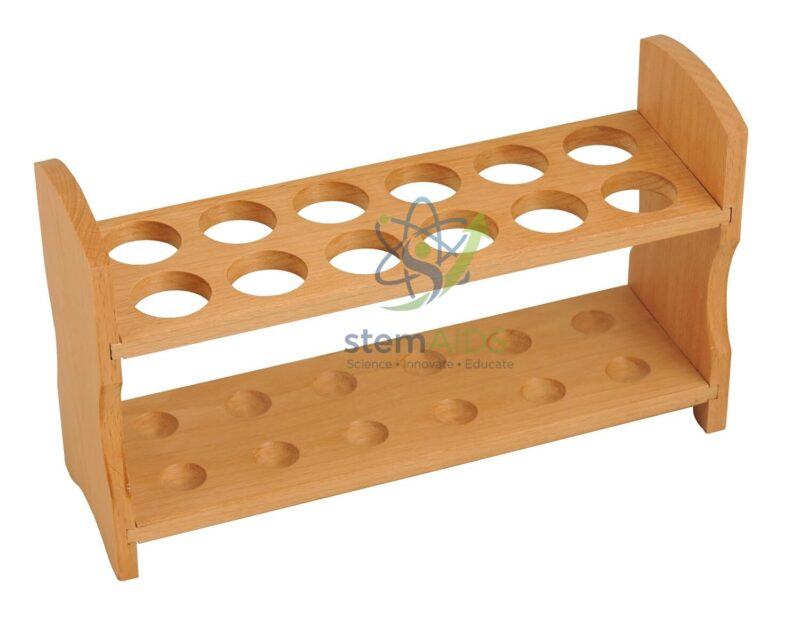
Quick Answer: The Test Tube Stand, Wooden, Without Drying Pegs is a wooden test tube stand that holds tubes upright only, with no drying pegs. The listing photograph shows a top rail drilled with two rows of six holes, carried on end pieces over a base with shallow recesses under the holes.
Holding Positions Only
Leaving off the peg row lets the stand give its whole length to holding positions. The pictured version carries two rows in the top rail, so a group can set out a whole series of tubes, such as a dilution series, a set of food tests or several precipitation reactions, and keep them in order for comparison.
The shallow recesses in the base seat the bottom of each tube, so it cannot slide sideways and stays vertical. That keeps liquid levels square to the eye when colours or volumes are compared, and a knocked stand is less likely to tip tubes against one another.
Where tubes also need drying at the bench, the stand with drying pegs adds a peg row. Wooden stands suit general school work; tubes that will be autoclaved or put in an oven need a metal rack. Standard glass test tubes are the usual partner.
Specifications
| Type | Test tube stand, holding positions only |
| Material | Wood (as titled) |
| Layout | Two rows of six holes in the top rail (as pictured) |
| Base | Shallow recesses beneath the holes (as pictured) |
| Drying pegs | None |
| Hole diameter | Confirm at enquiry |
Applications
- Setting out a series of tubes for food tests or indicator colour comparisons
- Qualitative analysis practicals where several tubes are used at once
- Holding labelled sample tubes during a practical assessment
- Storing clean tubes upright in a cupboard between lessons
Care & Handling
- Keep the wooden test tube stand away from direct heat and burners.
- Wipe drips out of the recesses in the base; standing liquid soaks into end grain.
- Store it on a dry shelf; wood swells and joints loosen in damp rooms.
Why Choose LabEquip
Schools setting up qualitative chemistry and biology practicals need many holding positions per bench. LabEquip lists this stand, and the version with drying pegs, in General Lab Products.
Frequently Asked Questions
Why choose a stand without drying pegs?
All of its length is used for holding positions, so more tubes can stand at once. Tubes are dried elsewhere, for example on a draining rack.
What are the recesses in the base for?
They seat the bottom of each tube so it cannot slide sideways, keeping the tube vertical under its hole in the top rail.
How many tubes does it hold?
The pictured stand has two rows of six holes, twelve positions in all. One stand per group covers most school practicals that use up to a dozen tubes.
Can I put hot test tubes in it?
Warm tubes are fine, but a tube taken straight from a flame can scorch the wood. Let it cool in a metal rack or in the holder first.
Is a wooden stand hygienic enough for biology?
For general school biology it is fine if wiped clean. For microbiology, where racks must be sterilised, use a metal or autoclavable plastic rack instead.
How do I keep the stand from warping?
Keep it dry, wipe spills promptly and store it away from radiators, sunny windows and damp cupboards.
Last Updated: September 2026





Reviews
There are no reviews yet.