
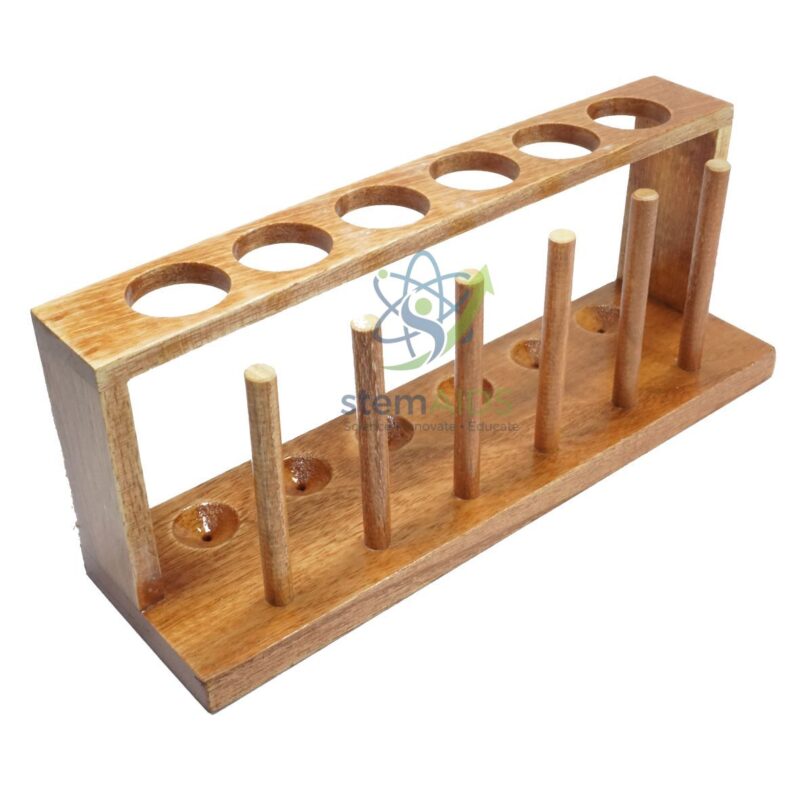
Quick Answer: The Test Tube Stand, Wooden, With Drying Pegs is a test tube stand with drying pegs: a drilled top rail holds tubes upright, and upright pegs set in the base carry washed tubes upside down to drain. The listing photograph shows six holes above and six pegs below on a varnished wooden frame.
Two Jobs on One Base
At the end of a practical, test tubes go two ways: tubes still holding a result stay upright for the teacher to check, and washed tubes need to dry. This stand does both. The holes in the upper rail take tubes in use, while the pegs along the base take clean tubes mouth-down, so water runs out and air reaches the inside.
Hanging tubes on pegs is also a simple hygiene step. A tube stored upright collects dust in its open mouth; one stored inverted does not. In a school where the same tubes are used by several classes in a day, a row of drying pegs lets each bench return clean tubes ready for the next group.
The difference from the wooden test tube stand without drying pegs is this row of pegs; the peg-less stand pictured on that listing has two rows of holes instead. For woodware made of steamed beech, see the steamed beech range.
Care & Handling
- Drain tubes over a sink before hanging them; a stream of water on the base soaks the wood.
- Wipe the stand dry at the end of the day and store it in a dry place.
- Check pegs for looseness; a loose peg can be re-seated with wood glue once the stand is dry.
Applications
- School practicals where tubes are used, washed and dried on the same bench
- Holding tubes for food tests, indicator tests and simple precipitation reactions
- Drying test tubes after washing in the prep room
- Keeping tubes dust-free between lessons by storing them inverted
Specifications
| Type | Test tube stand with drying pegs |
| Material | Wood (as titled), varnished finish in the listing photograph |
| Holding positions | Row of holes in the upper rail (six pictured) |
| Drying | Row of upright pegs in the base (six pictured) |
| Hole diameter | Confirm at enquiry |
Why Choose LabEquip
Schools with a single set of tubes per bench value a stand that also dries them. LabEquip lists both wooden stand types in General Lab Products; share your bench numbers on the contact page.
Frequently Asked Questions
What are drying pegs for?
Washed test tubes are placed mouth-down on the pegs. Water drains out and air circulates inside, so the tubes dry without collecting dust.
How is it different from the stand without drying pegs?
It combines holding and drying on one base. The stand without pegs uses its space for holding positions only.
Can tubes still be wet when hung on the pegs?
Yes, that is the purpose, but shake out most of the water first. Drips run down the peg onto the base, so wipe the base regularly.
Will boiling tubes fit?
Boiling tubes need larger holes and thicker pegs than standard test tubes. Try one tube in a hole and on a peg before a practical.
Can the stand be used for hot tubes?
Warm tubes can stand in the holes, but very hot tubes can scorch the wood. Let strongly heated tubes cool in a metal rack first.
How should the wooden stand be cleaned?
Wipe it with a damp cloth and mild detergent, then dry it. Do not soak it or put it in an oven, which cracks and warps wood.
Last Updated: September 2026





Reviews
There are no reviews yet.